
 Italiano


SKU:
ACURITEIII
Cat:
No Category
Brand:
ACU-RITE
Service
Repair
Exchange service
Refurbished sell
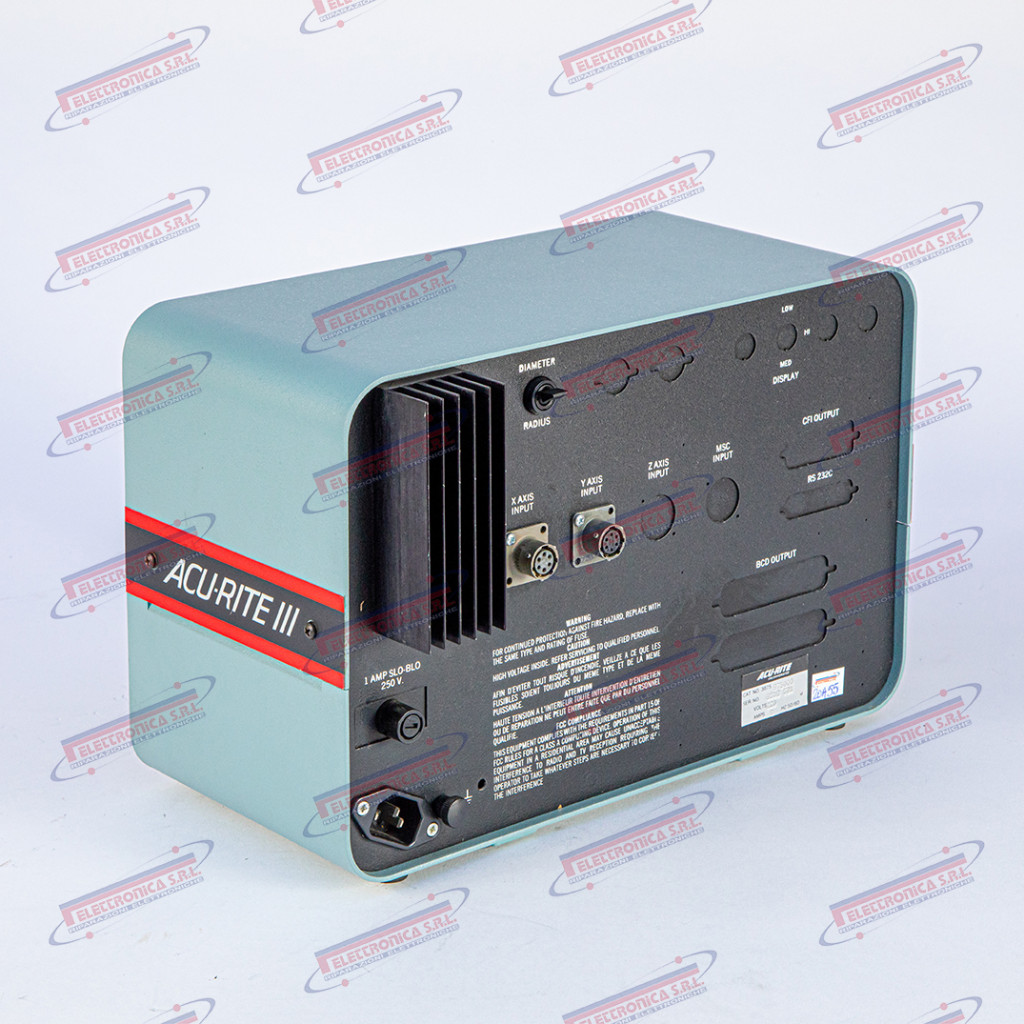
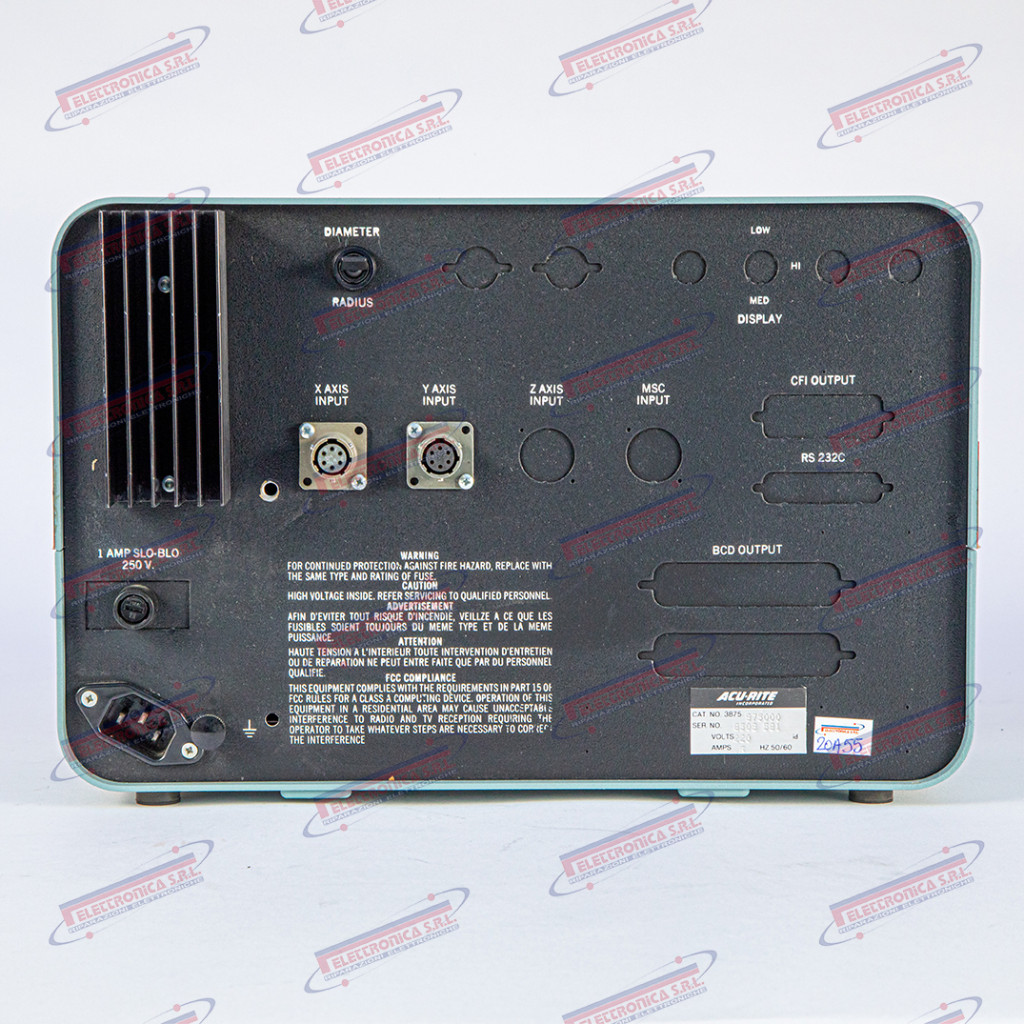
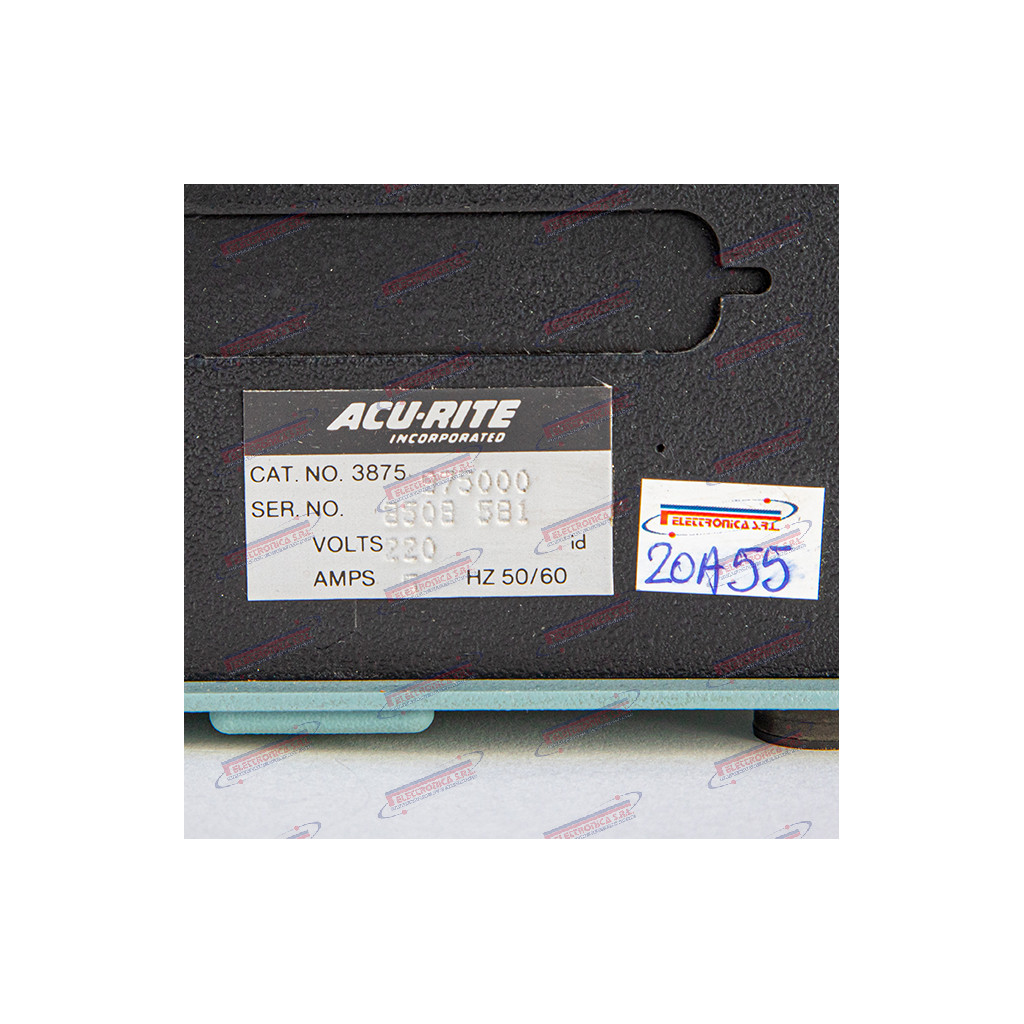
Digital Position Readout (DRO) – ACU-RITE III
The ACURITEIII is a digital position readout (“Digital Readout” – DRO) from the ACU-RITE® III series, manufactured by ACU-RITE (USA). It is a 2- or 3-axis display unit designed for manual and semi-automatic machine tools including milling machines, lathes, and grinding machines. The system receives position signals from linear encoders or glass scales, processes them, and displays machine axis coordinates in real time on an LED segment or LCD display. It incorporates basic calculation functions: axis zeroing, backlash compensation, bolt-hole circle calculation, and metric/imperial unit switching.
The digital position readout is the instrument that allows the operator to know at all times the exact position of the machine axes relative to the work zero point. Without the DRO the operator must rely on the mechanical verniers of the lead screws, with a typical inaccuracy of 0.05–0.1 mm; a faulty readout results in the loss of dimensional accuracy of machined parts and a significant increase in cycle times.
ACU-RITE is a US company founded in Jamestown (NY), historically specialised in precision scales and DRO systems for machine tools. Acquired by HEIDENHAIN (Germany) — a world leader in position measurement systems — ACU-RITE products continue to be distributed as a dedicated line for the manual and retrofit machine tool market. Models in the III series are legacy / discontinued, superseded by newer generations (200S, 300S series, etc.).
Main Technical Specifications
| Type | Digital position readout (Digital Readout – DRO), 2/3 axes |
| Part number | ACURITEIII |
| Brand | ACU-RITE (HEIDENHAIN Group) |
| Known application | Manual and semi-automatic milling machines, lathes, grinding machines; CNC retrofit installations |
| Function | Real-time display of machine axis position via linear encoder signals |
| Number of axes | 2 or 3 axes (X, Y, Z) |
| Display resolution | 0.001 mm / 0.0001″ (typical) |
| Compatible encoder signal | TTL square wave / 1 Vpp sinusoidal (ACU-RITE or compatible linear scales) |
| Power supply | ~110–240 V AC, 50/60 Hz |
| Display type | 7-segment LED (red) – typical of the III series |
| Software functions | Axis zeroing, absolute/incremental readout, backlash compensation, bolt-hole circle, metric/imperial |
| Interfaces / connectors | D-Sub connectors for linear scales; RS-232 output on some versions |
| Weight | ~1.5–3.5 kg |
| Dimensions | ~280–380 × 100–160 × 80–120 mm |
| Production status | Legacy / discontinued — superseded by ACU-RITE 200S/300S series |

SKU:
SPDM 260RGE
Cat:
Servo Drive
Brand:
ANSALDO
Service
Repair
Refurbished sell
ASROBICON Servo Drive Module – ANSALDO SPDM 260RGE
The SPDM 260RGE is a digital servo drive module (“Servo Drive Module”) from the ASROBICON series, manufactured by ANSALDO Automazione (Italy). The unit is designed for digital control of servo motors in industrial CNC systems, with integrated current and speed regulation loops. The commercial alternative part number is SPDM 260RGE (internal article code SPDM260RGE). The module may be available in multiple revisions or electrical configuration variants; always verify compatibility with the installed control system before replacement.
The ASROBICON drive is the active core of the axis or spindle control loop: it receives digital references from the CNC, regulates in real time the current delivered to the servo motor, and maintains position and speed accuracy throughout the machining cycle. A failure in this module causes the immediate and uncontrolled stop of the associated axis or spindle, rendering the machine inoperable until the unit is replaced or repaired.
ANSALDO is a historic Italian industrial group with roots dating back to the 19th century, active in automation, railway traction, energy, and defence. The ANSALDO Automazione division produced CNC systems, digital drives, and servo motors for machine tools for decades, serving both the Italian and international markets. The ASROBICON series represented ANSALDO’s flagship digital drive range. These products are now legacy / discontinued: available exclusively as used stock, NOS surplus, or through specialist repair centres.
Main Technical Specifications
| Type | Digital servo drive module (Servo Drive Module) – ASROBICON series |
| Part number | SPDM 260RGE (SPDM260RGE) |
| Brand | ANSALDO Automazione (Italy) |
| Family / Series | ASROBICON |
| Known application | CNC machine tools with ANSALDO control system; linear axis or spindle drive |
| Function | Digital current and speed regulation of servo motor; closure of control loops |
| Supply voltage | ~380–480 V AC three-phase |
| Rated current | ~260 A |
| Feedback supported | Incremental encoder / resolver (typical ASROBICON series) |
| Interfaces | Serial fieldbus to CNC; encoder/resolver connectors; power terminal blocks |
| Weight | ~5–15 kg |
| Dimensions | ~250–500 mm (; cabinet-mount module format) |
| Production status | Legacy / discontinued — used / surplus / repair only |
SKU:
LPT43
Cat:
No Category
Brand:
ASTEC
Service
Repair
Refurbished sell
Switching Power Supply – ASTEC LPT43
The LPT43 is a multi-output switching power supply unit (“Switching Power Supply Unit”) manufactured by ASTEC, belonging to the LPT series, designed to power control boards, operator interfaces and peripherals in CNC machine tools and industrial automation systems. The unit converts mains voltage into multiple regulated DC voltages (typically +5 V, ±12 V and +24 V DC) using high-frequency switching technology, delivering high efficiency, low ripple and protection against overload. It is not a conventional linear supply but a compact SMPS module with multiple independent outputs.
The power supply is the energy core of the CNC control cabinet: it provides all electronic boards with the service voltages without which no axis, no I/O and no interface can operate. A fault in the LPT43 causes the immediate shutdown of the entire machine; typical symptoms range from failure to power on to spontaneous resets, intermittent voltage errors and erratic axis behaviour under load.
ASTEC International was founded in 1975 as a pioneer in switching power supplies for the electronics and automation industries. Acquired by Emerson Electric, the products were absorbed into Emerson Network Power; the division subsequently became Artesyn Technologies (2014) and finally part of Advanced Energy Industries (2019). All products in the LPT series are legacy / discontinued: available exclusively as used, NOS or through specialist repair.
Main Technical Specifications
| Type | Multi-output switching power supply (SMPS – Switching Power Supply Unit) |
| Part number | LPT43 |
| Brand | ASTEC (Emerson Network Power / Artesyn Technologies – legacy) |
| Known application | CNC control cabinets and industrial automation systems; machine tools from the 1980s–1990s |
| Function | Regulated multi-output DC supply for CNC control boards, I/O modules and peripherals |
| Output voltages (typical) | +5 V DC, ±12 V DC, +24 V DC |
| Input voltage | 115 V / 230 V AC, 50/60 Hz |
| Total output power | ~40–100 W |
| Technology | High-frequency switching (SMPS) |
| Protections | Overload, short-circuit, overvoltage |
| Interfaces / connectors | Screw terminal block and/or multi-pin Molex connectors |
| Weight | ~0.5–1.5 kg |
| Dimensions | ~150–250 mm |
| Production status | Legacy / discontinued — used/surplus/repair only |

SKU:
LPT42
Cat:
No Category
Brand:
ASTEC
Service
Repair
Refurbished sell
Switching Power Supply – ASTEC LPT42
The LPT42 is a compact switching power supply (“Switching Power Supply”) manufactured by ASTEC International, belonging to the LPT series of high-efficiency compact switching power supply modules. The unit converts AC mains voltage into multiple regulated DC outputs, typically +5 V, ±12 V and +24 V, intended to power the electronic control boards in CNC control cabinets and industrial automation systems. The LPT series is noted for its compact form factor and universal input range, which led to its widespread adoption across a broad range of machine tools and measurement systems throughout the 1980s and 1990s.
The power supply is the energy core of the CNC control system: without it, no electronic board — CPU, axis drives, I/O modules — receives the voltage required to operate. A power supply failure results in an immediate total machine shutdown; out-of-tolerance output voltages or excessive ripple can also cause intermittent malfunctions that are difficult to diagnose and may damage downstream boards.
ASTEC International (founded in 1970 in Hong Kong) was a pioneer in industrial switching power supplies, with an extensive product range covering automation, telecommunications and computing. Acquired by Emerson Electric, the product line was absorbed into Emerson Network Power and subsequently into Artesyn Embedded Technologies. Many models in the LPT series are legacy / discontinued: available only as NOS (New Old Stock), used, or through specialist repair.
Main Technical Specifications
| Type | Compact switching power supply (Switching Power Supply) |
| Part number | LPT42 |
| Brand | ASTEC International (Emerson / Artesyn legacy) |
| Known application | CNC control cabinets and industrial automation systems, 1980s–1990s |
| Function | AC mains to multiple regulated DC outputs for CNC control electronics |
| Input voltage | 85–264 V AC, 47–63 Hz |
| DC outputs | +5 V, ±12 V, +24 V |
| Total power | ~40–50 W |
| Protections | Over-voltage (OVP), over-current (OCP), short-circuit (SCP) |
| Interfaces / connectors | Terminal strip / wire harness connectors (typical LPT series) |
| Cooling | Natural convection or forced ventilation |
| Weight | ~0.5–1.5 kg |
| Dimensions | ~150–250 mm |
| Production status | Legacy / discontinued — NOS / used / surplus / repair only |
SKU:
LPQ113
Cat:
No Category
Brand:
ASTEC
Service
Repair
Refurbished sell
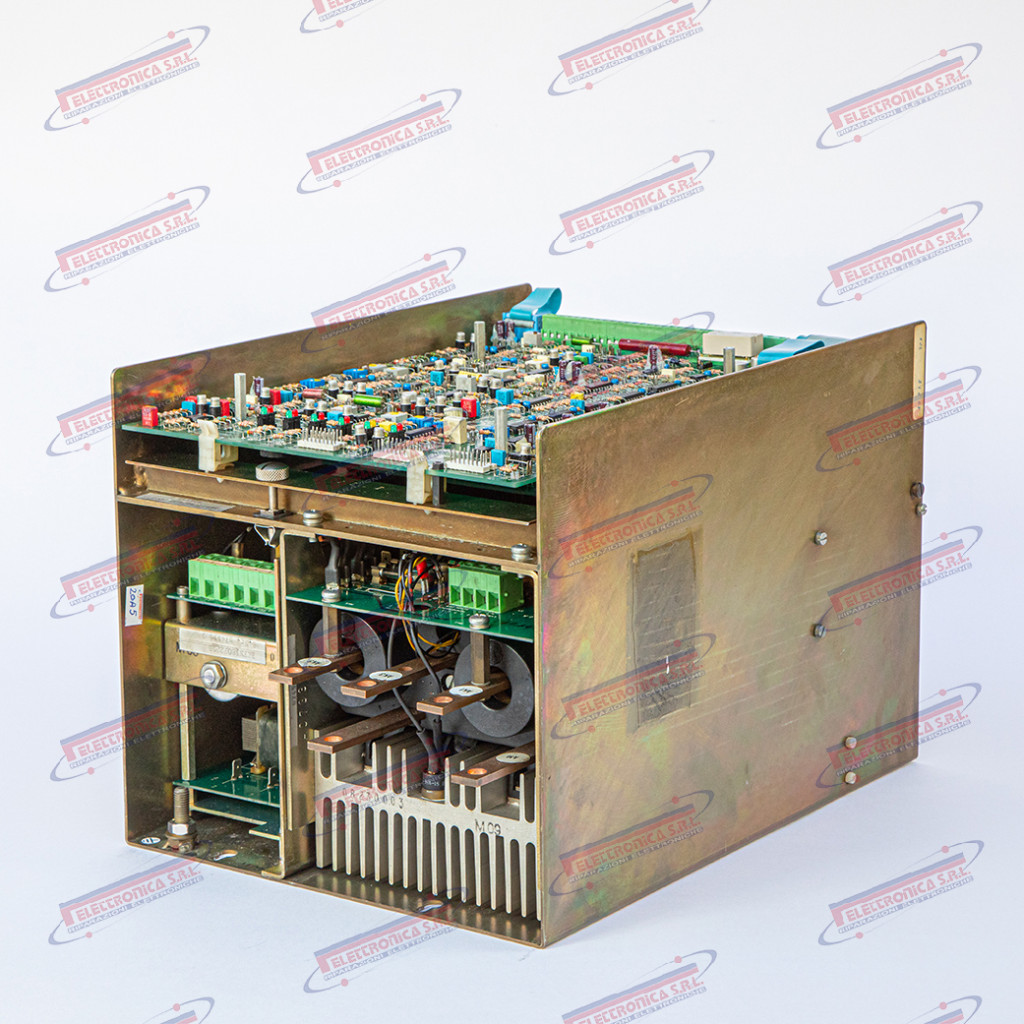
Multi-Output Switching Power Supply – ASTEC LPQ113
The LPQ113 is a multi-output switching power supply (“Multi-Output Switching Power Supply”) manufactured by ASTEC, used as the main power unit in CNC controllers and industrial automation systems from various machine builders. The module delivers the regulated DC voltages required by logic boards, control circuits and system interfaces. The ASTEC reference code is LPQ113; no documented alternative codes or known revisions are recorded for this item.
The power supply is the central element of the energy distribution system within the CNC controller: it converts the mains voltage into regulated low-voltage outputs (+5 V, ±12 V and, typically, one or more auxiliary rails) essential for the correct operation of CPUs, memories, I/O boards and communication circuits. A power supply failure immediately results in the inability to start the machine or in hard-to-diagnose operating faults, causing unplanned machine downtime.
ASTEC International (Advanced Switching Technology) is a long-established manufacturer of switching power supplies for industrial, telecommunications and embedded applications, founded in Hong Kong in the 1970s. Acquired by Emerson Network Power, the business subsequently became part of Artesyn Technologies (now part of Advanced Energy Industries). All products in the LPQ series are legacy / discontinued: available only as used stock, surplus or through specialist repair.
Main Technical Specifications
| Type | Multi-output switching power supply |
| Part number | LPQ113 |
| Brand | ASTEC (Emerson Network Power / Artesyn Technologies / Advanced Energy – legacy) |
| Known application | CNC controllers and industrial automation systems (specific application to be verified on machine documentation) |
| Function | Conversion and regulation of supply voltages for logic boards and CNC control circuits |
| Input voltage | 100–240 V AC, 47–63 Hz universal input |
| Output voltages | +5 V, +12 V, −12 V DC (typical LPQ series outputs – exact values to be verified on datasheet) |
| Total output power | ~75–150 W |
| Interfaces / connectors | Molex connectors / PCB terminal strip |
| Form factor | Open frame |
| Weight | ~0.5–1.5 kg |
| Dimensions | ~150–250 mm |
| Production status | Legacy / discontinued — used/surplus/repair only |


SKU:
BKF12/50/400-2002
Cat:
No Category
Brand:
BAUMULLER
Service
Repair
Exchange service
Refurbished sell
Digital Compact Servo Drive – BAUMÜLLER BKF12/50/400-2002
The BKF12/50/400-2002 is a digital compact servo drive (“Digital Compact Servo Drive”) from the BKF series, manufactured by Baumüller, designed to control synchronous and asynchronous AC servo motors in advanced industrial automation applications. The unit is typically installed in CNC machine tools, injection moulding machines for plastics, textile machines, and printing machinery equipped with Baumüller drive systems. It closes the current, speed, and position control loops, interfacing with the numerical controller via analogue speed reference and digital I/O. The suffix -2002 identifies a specific hardware/firmware revision of the series.
The servo drive is the heart of the axis motion system: it receives the position or speed reference from the CNC, processes the feedback signal from the encoder or resolver mounted on the motor, and generates the current required to drive the motor windings to follow the programmed trajectory with precision. A drive failure causes immediate loss of control on the affected axis, rendering the machine inoperable; in multi-axis systems the CNC may raise a general alarm on all axes to protect both the machine and the workpiece in progress.
Baumüller is a German company founded in 1930 in Nuremberg, specialising in electric drive systems, servo motors, and precision industrial automation; its products are present worldwide in the machine tool, plastics, textile, and printing sectors. The BKF series belongs to a previous generation of compact digital drives, now superseded by the b maXX next-generation families: all products in this family are therefore legacy / discontinued, available only as used, NOS surplus, or through specialist repair services.
Main Technical Specifications
| Type | Digital compact servo drive (Digital Compact Servo Drive) |
| Part number | BKF12/50/400-2002 (BKF12504002002) |
| Brand | Baumüller (Baumüller Nürnberg GmbH) |
| Known application | CNC machine tools, injection moulding machines, textile and printing machinery with Baumüller drive systems |
| Function | Current, speed and position regulation for synchronous/asynchronous AC servo motors |
| Rated output current | 12 A (rated, from part number) |
| Peak current | 50 A (peak, from part number) |
| Supply voltage | 3×400 V AC, 50/60 Hz |
| Feedback | Incremental encoder / resolver (typical for BKF series) |
| Reference input | Analogue ±10 V; digital I/O |
| Fieldbus options | SERCOS, PROFIBUS DP (typical BKF series) |
| Weight | ~3–6 kg |
| Dimensions | ~200–350 mm |
| Production status | Legacy / discontinued — used/surplus/repair only |


SKU:
ACU-RITE IIA
Cat:
No Category
Brand:
BAUSCH & LOMB
Service
Repair
Exchange service
Refurbished sell
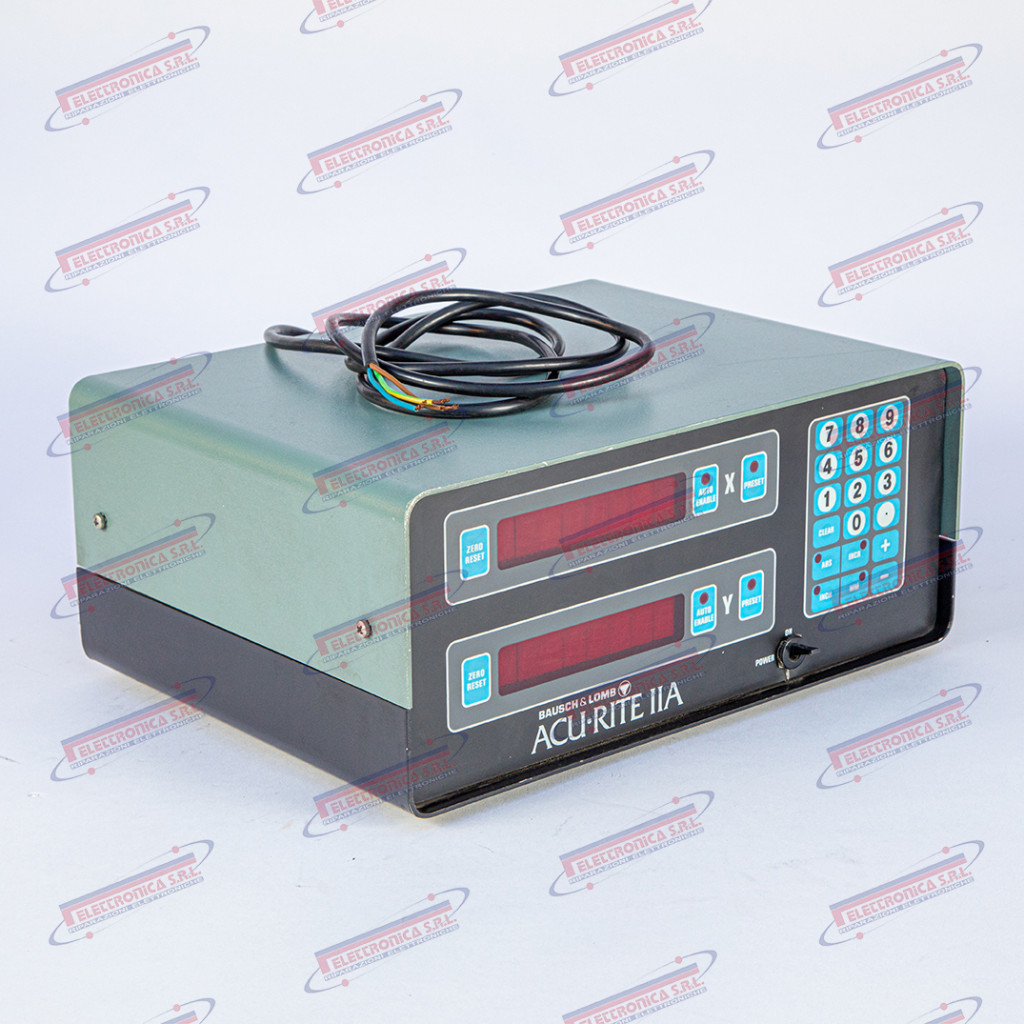
2-Axis Digital Position Readout (DRO) – BAUSCH & LOMB ACU-RITE IIA
The ACU-RITE IIA is a 2-axis digital position readout display (“Two-Axis Digital Readout Display”) manufactured by Bausch & Lomb under the ACU-RITE brand, documented as a position display unit for conventional machine tools (milling machines, lathes, surface grinders). The system acquires signals from optical or magnetic linear scales mounted on the machine axes and displays the position on 7-segment LED digit readouts. The unit supports display in both millimetres and inches and includes preset, incremental zero, and — in certain variants — bolt-hole circle calculator functions. The ACU-RITE Series II is available in several variants (including the IIA) differing in axis configuration and additional features.
The digital position readout is the device that allows the operator to know the precise position of the machine tool axes during manual machining. Without this unit the operator must rely solely on mechanical vernier dials and micrometers, dramatically reducing both accuracy and machining speed. A failure of the display or the acquisition circuitry makes it impossible to perform dimensionally accurate operations, increasing the risk of scrap parts and extending cycle time.
Bausch & Lomb is a historic American company founded in 1853, best known in the scientific and ophthalmic optics sector (lenses, microscopes, military telescopes). Its Scientific Instruments Division developed the ACU-RITE line of digital position readouts from the 1960s, becoming a benchmark for precision conventional machine tools. The division was divested and changed ownership several times before being acquired by Heidenhain in 1999. All products in the ACU-RITE IIA family are legacy / discontinued: available only as used, surplus, or through specialist repair services.
Main Technical Specifications
| Type | 2-axis digital position readout (DRO – Digital Readout) |
| Part number | ACU-RITE IIA (ACURITEIIA) |
| Brand | Bausch & Lomb – ACU-RITE (now Heidenhain, legacy) |
| Known application | Precision conventional milling machines, lathes, and surface grinders |
| Function | Digital display of X and Y axis positions; preset, incremental zero, mm / inch switching |
| Number of axes | 2 (X, Y) |
| Display | 7-segment LED digits, 6–7 digits per axis (typical) |
| Resolution | 0.001 mm / 0.0001 inch (typical for Series IIA) |
| Scale input | ACU-RITE optical or magnetic linear scales (TTL or sinusoidal 1 Vpp signal) |
| Power supply | 110 V AC or 220 V AC, 50–60 Hz (typical; selectable) |
| Interfaces / connectors | Multi-pin connectors for linear scales; power terminal strip |
| Weight | ~2.5–5 kg |
| Dimensions | ~280–380 mm × 150–220 mm × 100–160 mm |
| Production status | Legacy / discontinued — used / surplus / repair only |


SKU:
PNL-CC100M
Cat:
No Category
Brand:
BOSCH
Service
Repair
Refurbished sell
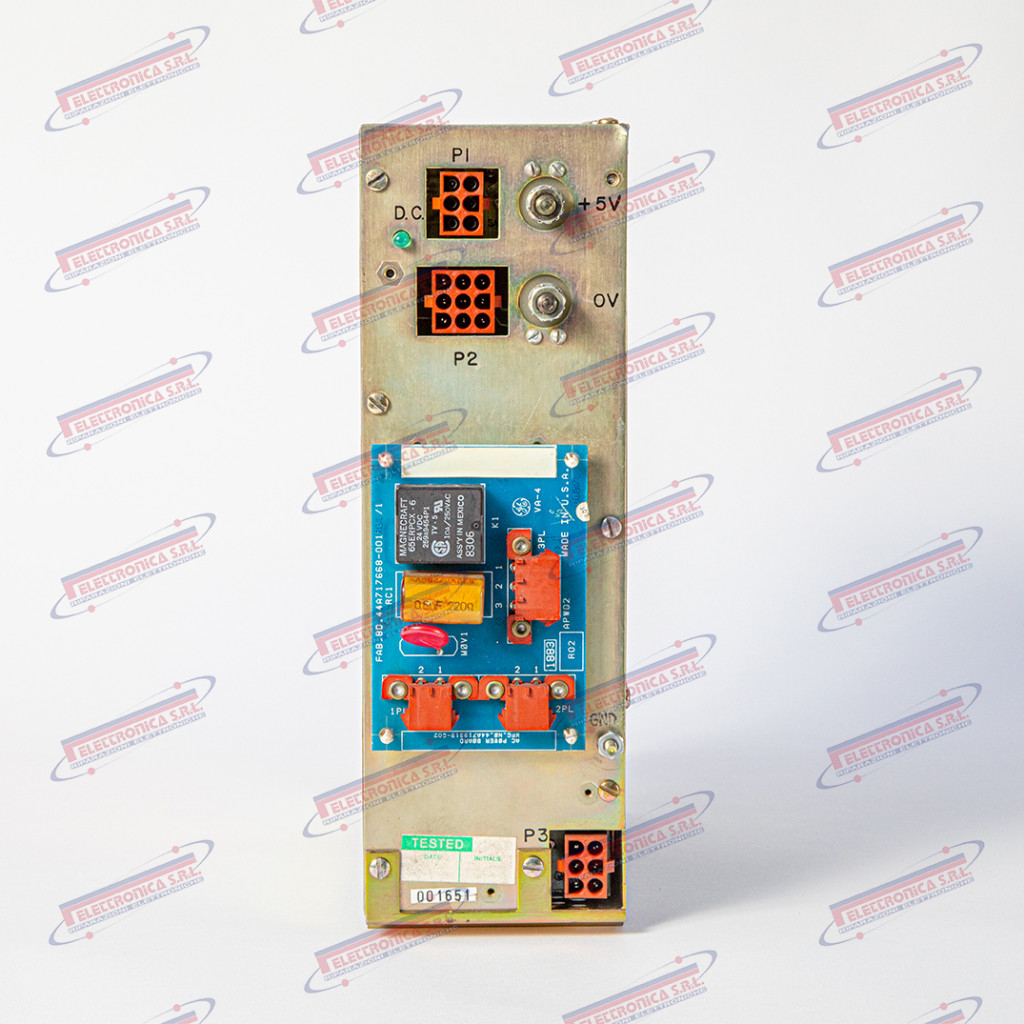
CNC Operator Panel – BOSCH PNL-CC100M
The PNL-CC100M is the operator panel (“Operator Panel” / “Bedientafel”) for the BOSCH CC100M CNC control system, designed for CNC milling machines equipped with the BOSCH CC100 series numerical control (M = milling variant). It serves as the primary human-machine interface of the CNC, integrating a monochrome display, membrane keyboard with function keys and axis keys, spindle and feed override selectors, and LED status indicators. It connects to the main CNC unit via proprietary BOSCH connectors.
The operator panel is the primary interface between the operator and the CNC numerical control: it enables ISO/G-code program entry and editing, operating mode selection (automatic, MDI, JOG, home), spindle speed and feed rate override adjustment, and real-time axis position and machine status monitoring. A failure of the operator panel makes any interaction with the CNC impossible, causing a complete machine stoppage even when all other mechanical and electrical modules are functioning normally.
BOSCH is a German multinational with a long tradition of manufacturing CNC numerical controls for machine tools (CC100, CC200, CC300, CC500, CNC 432 series). In 2001, its automation and drive activities were merged into Bosch Rexroth AG, a joint venture with Mannesmann Rexroth. All products in the CC series are legacy / discontinued: available exclusively as used/surplus or through specialist repair.
Main Technical Specifications
| Type | CNC operator panel (Operator Panel / Bedientafel) |
| Part number | PNL-CC100M (PNLCC100M) |
| Brand | BOSCH (Bosch Rexroth legacy) |
| Known application | CNC milling machines with BOSCH CC100M control (CC100 series, milling variant) |
| Function | Operator interface: program entry/editing, operating mode selection, spindle and feed override, axis position and status display |
| Display | Integrated monochrome display (CRT or dot-matrix LCD — typical for CC100 series) |
| Keyboard | Membrane keyboard: function keys F1–F8, axis keys (X/Y/Z), JOG, E-stop, override selectors |
| Interfaces | Proprietary BOSCH connectors to main CNC unit; flat/ribbon multipole cable |
| Logic supply voltage | 24 V DC (typical for CC series panel logic) |
| Weight | ~4–9 kg |
| Dimensions | ~380–520 × 270–420 × 100–200 mm |
| Production status | Legacy / discontinued — used/surplus/repair only |


SKU:
P11082B
Cat:
No Category
Brand:
CHLORIDE ELECTRO NETWORKS
Service
Repair
Refurbished sell
Industrial Power Supply – CHLORIDE ELECTRO NETWORKS P11082B
The P11082B is an industrial switching power supply (“Industrial Switching Power Supply”) manufactured by Chloride Electro Networks, designed for automation and CNC machine tool applications. The unit converts AC mains voltage into one or more regulated DC outputs required to power control boards, logic circuits, interfaces and actuators within the CNC system. The part number P11082B identifies the specific variant of this power supply within the Chloride Electro Networks product range.
The power supply is the critical component that delivers stable, regulated energy to all electronic circuits in the CNC machine: CPU boards, I/O interfaces, servo amplifiers and safety devices. A fault in the power supply causes widespread malfunctions across the entire machine, often with symptoms that are difficult to diagnose (spontaneous resets, non-repeatable CNC errors, random lockups). Timely replacement or repair is essential to restore production.
Chloride Electro Networks was a division of the British group Chloride Group plc, specialising in industrial power supplies, UPS systems and power conditioning devices for critical applications in automation, telecommunications and industry. Chloride Group was acquired by Emerson Electric in 2010; all products in this family are legacy / discontinued: available only as used, surplus or through specialist repair.
Main Technical Specifications
| Type | Industrial switching DC power supply (Industrial Switching Power Supply) |
| Part number | P11082B |
| Brand | Chloride Electro Networks (Chloride Group / Emerson Electric legacy) |
| Known application | CNC machine tools and industrial automation systems |
| Function | AC/DC voltage conversion and regulation for CNC control circuits |
| Input voltage | 115 / 230 V AC, 50–60 Hz |
| Output voltage | ±15 V, +5 V, +24 V DC (typical outputs — verify on sample unit) |
| Output current | To be verified on sample unit (typically 2–10 A per rail) |
| Interfaces / connectors | Screw terminal strip / edge connectors |
| Weight | ~1.0–3.0 kg |
| Dimensions | ~150–300 mm |
| Production status | Legacy / discontinued — used/surplus/repair only |
SKU:
UNI2403
Cat:
No Category
Brand:
CONTROL TECHNIQUES
Service
Repair
Exchange service
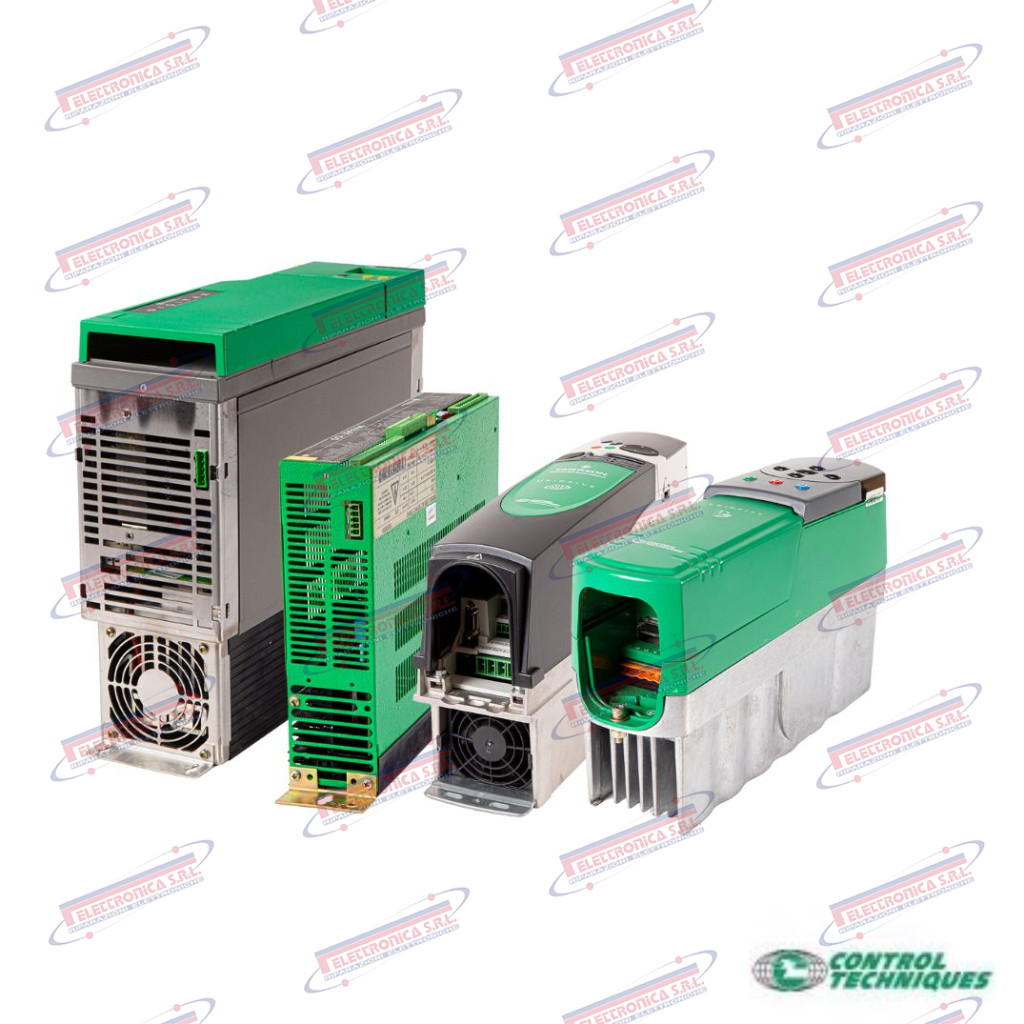
AC Variable Speed Drive – CONTROL TECHNIQUES UNI2403
The UNI2403 is an AC variable speed drive (“Variable Speed Drive”) from the Unidrive Classic family, manufactured by Control Techniques. Documented on CNC machining centres, milling machines and lathes equipped with three-phase induction motors, it regulates motor speed and torque via PWM modulation. It operates in open-loop V/Hz, open-loop vector (sensorless) and closed-loop vector modes with encoder feedback. The Unidrive Classic is the first generation of the Unidrive platform, predecessor to the Unidrive SP and Unidrive M families.
The variable frequency drive is the power and regulation element that converts three-phase mains voltage into variable voltage and frequency, enabling precise speed and torque control of the induction motor. A drive failure completely disables the associated axis or spindle, bringing the machine to a standstill; typical faults include overvoltage, overtemperature, loss of encoder feedback or short-circuit on the IGBT power stage.
Control Techniques is a British manufacturer founded in 1973, specialising in AC and DC drives, servo systems and industrial motors. Acquired by Emerson Electric in 1994 and subsequently by Nidec Corporation in 2012, it now operates as the Nidec Control Techniques division. The Unidrive Classic line is legacy / discontinued: available only as used, NOS or through specialist repair.
Main Technical Specifications
| Type | AC variable frequency drive (Variable Speed Drive) |
| Part number | UNI2403 |
| Brand | Control Techniques (Nidec Group) |
| Known application | CNC machining centres, milling machines, lathes with three-phase AC induction motors |
| Function | Three-phase induction motor speed and torque control via PWM modulation |
| Input voltage | 380–480 V AC three-phase, 50/60 Hz |
| Rated output current | ~14 A |
| Motor power | ~7.5 kW |
| Operating modes | Open-loop V/Hz; open-loop vector (sensorless); closed-loop vector (encoder) |
| Interfaces | Analogue/digital control terminal strip; encoder connector; power terminal strip |
| Weight | ~5–10 kg |
| Dimensions | ~250–350 × 150–250 mm |
| Production status | Legacy / discontinued — used/surplus/repair only |

SKU:
SP2402
Cat:
No Category
Brand:
CONTROL TECHNIQUES
Service
Repair
Exchange service
AC Vector Inverter / Variable Speed Drive – Control Techniques SP2402
The SP2402 is an AC variable speed drive (“AC Inverter / Variable Frequency Drive”) from the Unidrive SP series, manufactured by Control Techniques. It belongs to the Frame 2, 400 V class and is employed on CNC machine tools and industrial automation systems requiring precise speed and torque control of AC induction or permanent-magnet synchronous motors. It supports four operating modes: scalar V/Hz, Open Loop Vector (sensorless), Closed Loop Vector (with encoder), and Servo. An integrated RS485 / Modbus RTU interface and an option slot for fieldbus expansion modules (Profibus-DP, CANopen, DeviceNet, EtherCAT) are included.
The inverter converts the fixed-frequency mains supply into a variable-voltage, variable-frequency three-phase output, enabling precise control of motor speed and torque. In a CNC machining centre, a drive failure causes immediate shutdown of the controlled axis or spindle: the machine stops, the workpiece risks being scrapped, and — should active safety not intervene — a collision may occur.
Control Techniques is a British manufacturer founded in 1968 and specialised in variable-speed drives for AC and DC motors. Acquired by Emerson Electric in 1992 and later by Nidec Corporation in 2017, it now operates as Nidec Industrial Solutions. The Unidrive SP series is legacy / discontinued: the platform has been superseded by the Unidrive M family; SP drives are available exclusively as used, NOS (surplus), or through specialist repair centres.
Main Technical Specifications
| Type | AC inverter / variable speed drive (VFD), Unidrive SP series, Frame 2 |
| Part number | SP2402 |
| Brand | Control Techniques (Nidec Industrial Solutions) |
| Known application | CNC machine tools, machining centres and industrial automation systems with AC induction or PM synchronous motors |
| Function | AC motor speed and torque control in open-loop (sensorless) or closed-loop (encoder / resolver) mode |
| Input voltage | 380–480 V AC 3-phase, 50/60 Hz |
| Rated power | ~4.0–7.5 kW |
| Rated output current | ~9–16 A |
| Control modes | V/Hz scalar, Open Loop Vector, Closed Loop Vector, Servo |
| Feedback | Incremental encoder (AB/Z), resolver or sensorless |
| Communications | RS485 / Modbus RTU built-in; option slot for Profibus-DP, CANopen, DeviceNet, EtherCAT |
| I/O | Programmable digital and analogue inputs/outputs (parameter-configurable) |
| Protections | Overcurrent, overvoltage, undervoltage, overtemperature, earth fault, short circuit |
| Protection class | IP20 standard (IP55 with optional filter kit) |
| Weight | ~2–4 kg |
| Dimensions | ~185–250 × 100–140 × 180–230 mm |
| Production status | Legacy / discontinued — superseded by Unidrive M; available as used, NOS, or via specialist repair |


SKU:
SP1404
Cat:
No Category
Brand:
CONTROL TECHNIQUES
Service
Repair
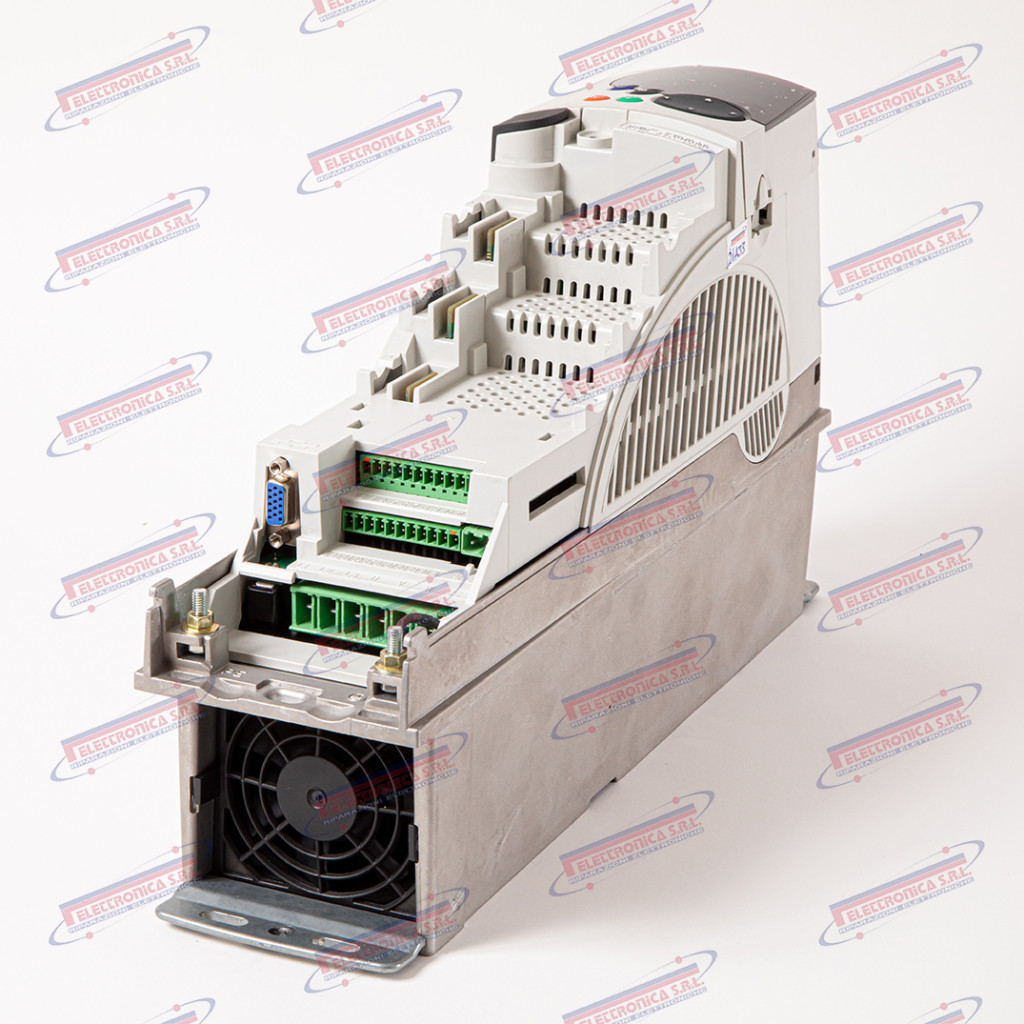
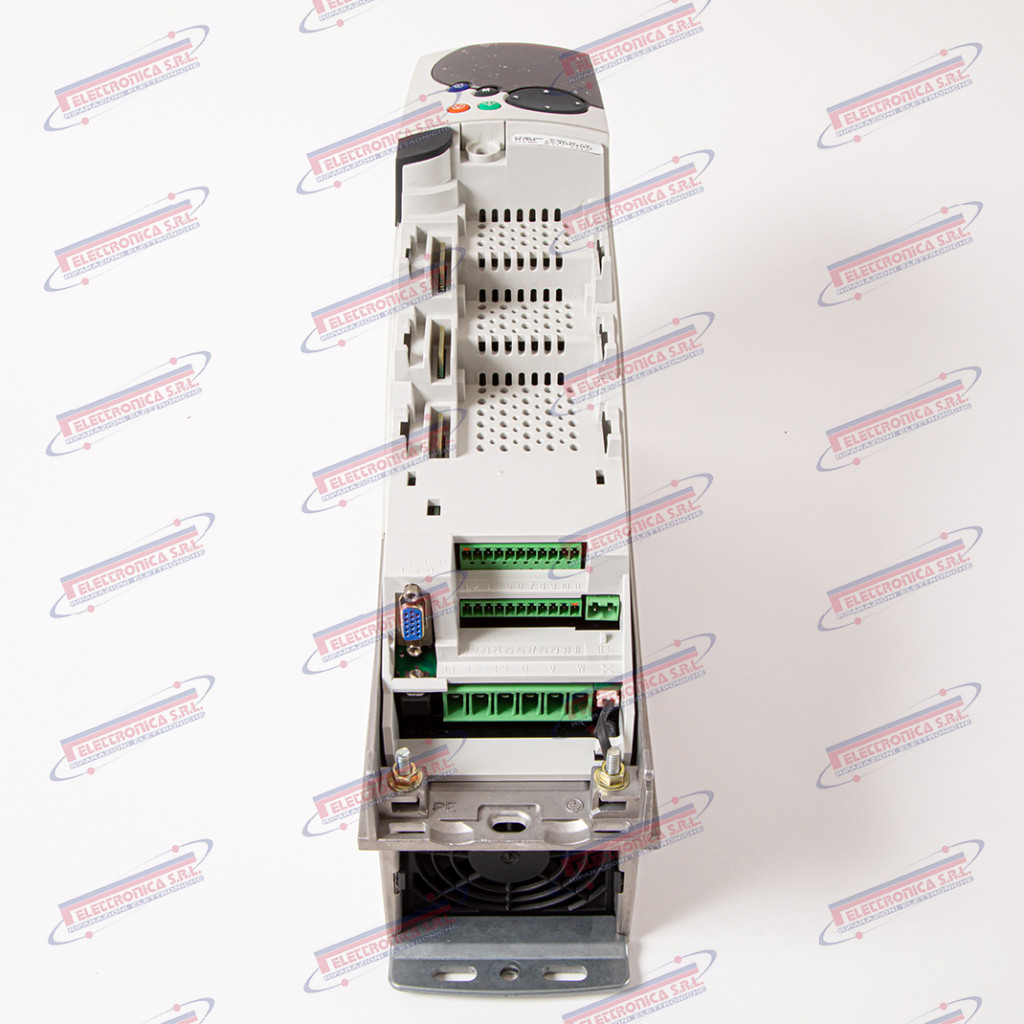
AC Variable Speed Drive – CONTROL TECHNIQUES SP1404
The SP1404 is an electronic AC variable speed drive (“AC Variable Speed Drive / Inverter”) by Control Techniques, part of the Unidrive SP series. Designed for control of three-phase induction motors and permanent magnet motors, it supports open-loop vector (RFC-A), closed-loop vector with encoder feedback, and servo control modes. Nominal input voltage 380–480 V AC three-phase 50/60 Hz; nominal output current approximately 14 A continuous; power class 5.5–7.5 kW at 400 V. Features an onboard PLC, digital and analogue I/O, RS485 serial interface, and expansion slots for optional fieldbus modules.
The AC variable speed drive is the power electronic converter that transforms fixed-frequency mains supply into variable voltage and frequency to regulate motor speed and torque. In CNC machine tools it controls the spindle, feed axes, or auxiliary motors, ensuring precise and continuous regulation across the full operating range. A drive failure results in the immediate loss of control of the affected axis or spindle, halting the machine and preventing resumption of machining.
Control Techniques is a British manufacturer of variable speed drives and servo systems, founded in 1973 and headquartered in Newtown, Wales. Acquired by Emerson Electric in 1992 and subsequently by Nidec Corporation in 2017, it now operates as Nidec Control Techniques. The Unidrive SP series is legacy / discontinued in its original variants, progressively replaced by the Unidrive M series: spare units are available primarily as used stock, NOS surplus, or through specialist repair services.
Main Technical Specifications
| Type | AC variable speed drive (Variable Speed Drive / Inverter) |
| Part number | SP1404 |
| Brand | Control Techniques (Nidec Control Techniques) |
| Known application | CNC machine tools; three-phase induction motors and permanent magnet motors |
| Function | AC motor speed and torque control via variable frequency output |
| Input voltage | 380–480 V AC, three-phase, 50/60 Hz |
| Nominal output current | ~14 A continuous (400 V class) |
| Nominal power | ~5.5–7.5 kW at 400 V |
| Control modes | Open-loop vector (RFC-A), closed-loop vector with encoder, servo |
| Communication interfaces | Onboard RS485; optional modules for Profibus, DeviceNet, CANopen, EtherNet/IP |
| I/O | Onboard digital and analogue I/O; expandable with optional modules |
| Weight | ~2–4 kg |
| Dimensions | ~230–260 mm H × 90–110 mm W × 170–190 mm D |
| Production status | Legacy / discontinued — used/surplus/repair only |


SKU:
DBE 420
Cat:
Servo Drive
Brand:
CONTROL TECHNIQUES
Service
Repair
Exchange service
Refurbished sell
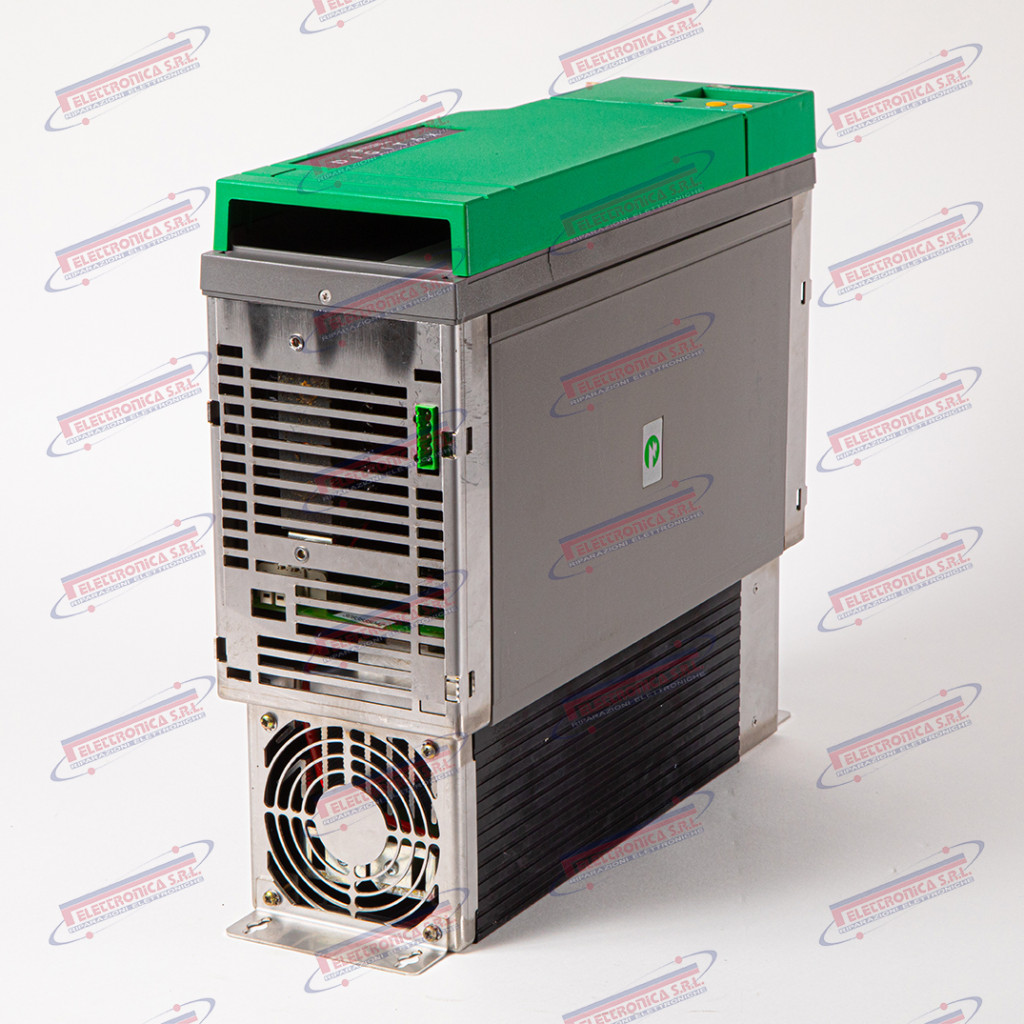
Digitax Servo Drive – Control Techniques DBE 420
The DBE 420 is an AC digital servo drive (“Digitax AC Digital Servo Drive”) manufactured by Control Techniques, part of the DIGITAX family for controlling AC brushless servo motors in motion control and CNC machine tool applications. The unit operates as a closed-loop digital servo amplifier, regulating speed, torque and position while interfacing with the CNC controller via fieldbus and encoder feedback. The designation DBE 420 identifies the size and variant within the DIGITAX catalogue; the product may exist in multiple hardware and firmware revisions.
The DIGITAX DBE 420 servo drive is the electronic controller that closes the current, speed and position loops on the servo axis: it interprets the CNC references in real time and compensates for load disturbances, maintaining axis precision and dynamics throughout machining. A drive failure renders the controlled axis completely inoperative, halting production; loss of closed-loop control can result in mechanical collisions or dimensional rejects in the workpiece.
Control Techniques is a British manufacturer and world leader in variable-speed drives and servo systems, founded in 1973 in Newtown (Wales, UK). Acquired by Emerson Electric in 1990 and subsequently by Nidec Corporation in 2017, it produces the Unidrive, Commander and DIGITAX servo drive families. Products in the DIGITAX DBE series are legacy / discontinued: available exclusively as used stock, NOS surplus, or through specialist repair services.
Main Technical Specifications
| Type | AC digital servo drive – DIGITAX series |
| Part number | DBE 420 (DBE420) |
| Brand | Control Techniques (Nidec – legacy) |
| Known application | CNC machine tools, industrial robotics and automation with AC brushless servo motors |
| Function | Digital closed-loop speed, torque and position control of AC brushless servo motor |
| Input voltage | 200–240 V AC three-phase |
| Rated output current | ~4 A nominal |
| Feedback | Incremental/absolute encoder from servo motor |
| Interfaces | Multi-pin connectors; RS-232/RS-485 serial interface |
| Weight | ~1.5–3.0 kg |
| Dimensions | ~200–300 × 80–120 mm |
| Production status | Legacy / discontinued — used/surplus/repair only |

SKU:
DB 420 NP
Cat:
No Category
Brand:
CONTROL TECHNIQUES
Service
Repair
Refurbished sell
DC Motor Drive – Control Techniques DB 420 NP
The DB 420 NP is a DC motor drive (“DC Motor Drive”) manufactured by Control Techniques, belonging to the DB series of the Welsh manufacturer’s industrial drive range. The part number identifies a combined control and power unit for DC motors intended for industrial motion control applications; the NP designation denotes a specific constructional variant (typically “Non-Plug-in” or a configuration without a removable optional module). The drive manages the speed and torque regulation loops, interfacing with the CNC system’s control bus and with the motor’s tachogenerator or encoder feedback. The product is documented on CNC machine tools, automated production lines and numerical control systems using DC motors for axis or spindle drives.
The DC drive is the core of the motor control system: it receives the speed or torque reference from the numerical controller, regulates voltage and current to the motor armature and closes the feedback loop to deliver the required motion profile with precision and stability. A drive failure renders the controlled motor completely unmanageable, causing immediate process stoppage and a real risk of mechanical damage to moving parts; availability of a replacement unit is therefore critical to limiting unplanned machine downtime.
Control Techniques, founded in 1961 in Newtown (Wales, UK), is one of the world’s leading manufacturers of variable-speed drives for AC and DC motors, servo drives and motion control systems (Mentor, Unidrive, Commander, Digitax, Epsilon families). Acquired by Emerson Electric in 1992 and subsequently by Nidec Corporation in 2017, it continues to operate as an independent brand within the group. Products in the DB series are legacy / discontinued: available only as used, surplus or through specialist repair.
Main Technical Specifications
| Type | DC motor drive (DC Motor Drive) |
| Part number | DB 420 NP (DB420NP) |
| Brand | Control Techniques (Nidec Group) |
| Known application | CNC machine tools, automated production lines, motion control systems with DC motors (axis / spindle) |
| Function | DC motor speed and torque control; closed-loop armature voltage and current regulation |
| Input voltage | ~380–480 V AC three-phase |
| Output current / Power | To be verified on original datasheet |
| Feedback | Analogue tachogenerator and/or incremental encoder (typical DB series) |
| Reference input | Analogue ±10 V (typical) and/or serial interface |
| Interfaces / Connectors | Signal and power terminal strips, encoder/tachogenerator connectors, communications bus (typical) |
| Constructional variant | NP — Non-Plug-in / variant without optional plug-in module (confirm on datasheet) |
| Weight | ~2–8 kg |
| Dimensions | ~200–400 mm |
| Production status | Legacy / discontinued — used/surplus/repair only |


SKU:
UNI1401
Cat:
Servo Drive
Brand:
CONTROL TECHNIQUES
Service
Exchange service
Repair
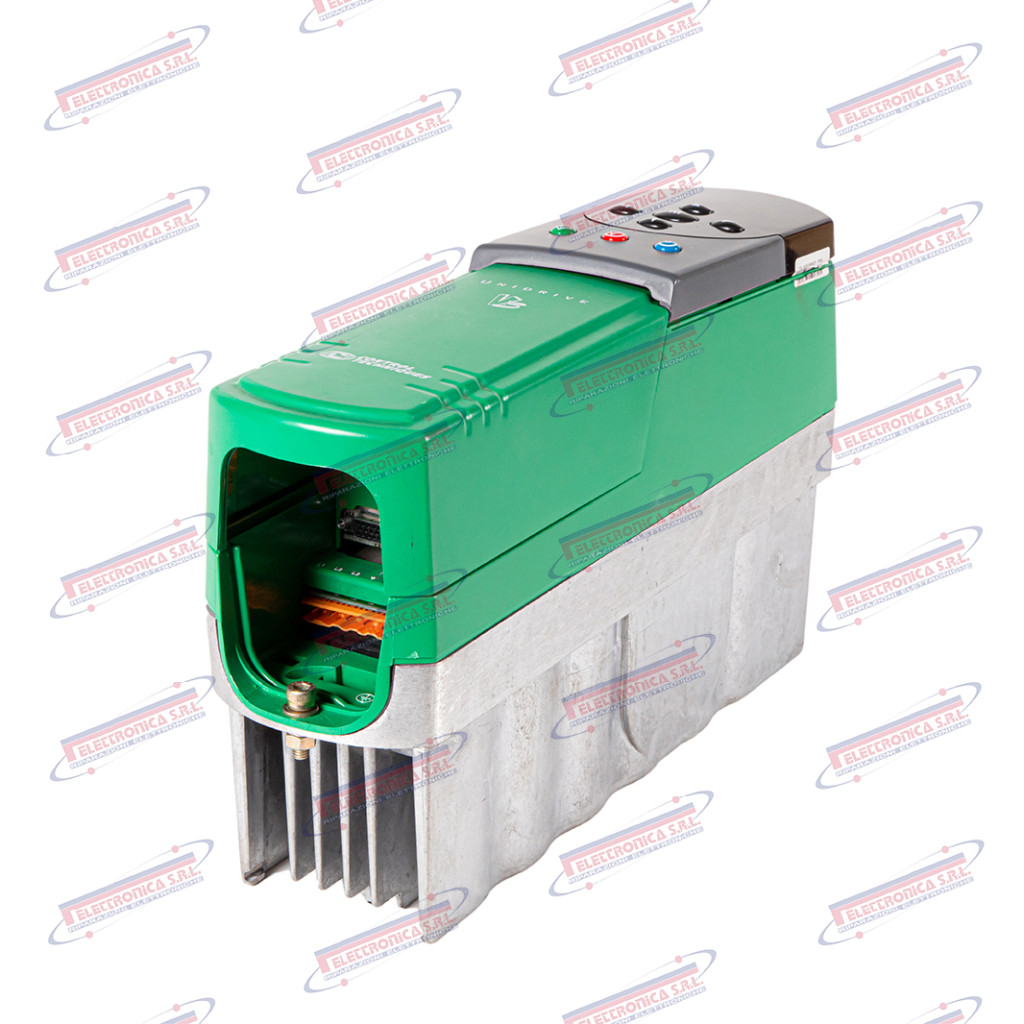
Unidrive AC Variable Speed Drive – Control Techniques UNI1401
The UNI1401 is an AC variable speed drive (“AC Variable Speed Drive”) from the Unidrive Classic series by Control Techniques. Designed to control three-phase asynchronous motors, the drive supports both open-loop (V/f) and closed-loop field-oriented control (flux vector), with a three-phase 380–480 V AC input and a rated power of approximately 1.5 kW. The unit supports encoder feedback for high-precision speed and torque applications.
The Unidrive drive controls the speed and torque of the AC motor by modulating the output voltage and frequency using PWM technique: it provides smooth starts, controlled regenerative braking, and speed stability under varying loads. In case of failure, the driven axis or spindle loses complete control, rendering the machine inoperable until the drive is replaced or repaired.
Control Techniques is a British manufacturer founded in 1968, specialised in variable speed drives and servo drives for industrial automation. Acquired by Emerson Electric in 1994 and later by Nidec Corporation in 2017, it now operates as Nidec Industrial Solutions. The Unidrive Classic series is legacy / discontinued, superseded by the Unidrive SP and Unidrive M generations.
Main Technical Specifications
| Type | AC variable speed drive (AC Variable Speed Drive) |
| Part number | UNI1401 |
| Brand | Control Techniques (Nidec Industrial Solutions) |
| Series | Unidrive Classic |
| Known application | Three-phase motor control in CNC machines, machining centres and general industrial automation |
| Function | Speed and torque regulation of three-phase AC motor – V/f and flux vector modes |
| Input voltage | 3~ 380–480 V AC, 50/60 Hz |
| Rated power | ~1.5 kW |
| Output current | ~4.1 A |
| Interfaces | Digital and analogue I/O, RS-485 serial, power and control terminal strips |
| Weight | ~2–4 kg |
| Dimensions | ~180–280 mm H × 100–160 mm W |
| Production status | Legacy / discontinued — used/surplus/repair only |


SKU:
SP1403
Cat:
Servo Drive
Brand:
CONTROL TECHNIQUES
Service
Exchange service
Repair
Refurbished sell
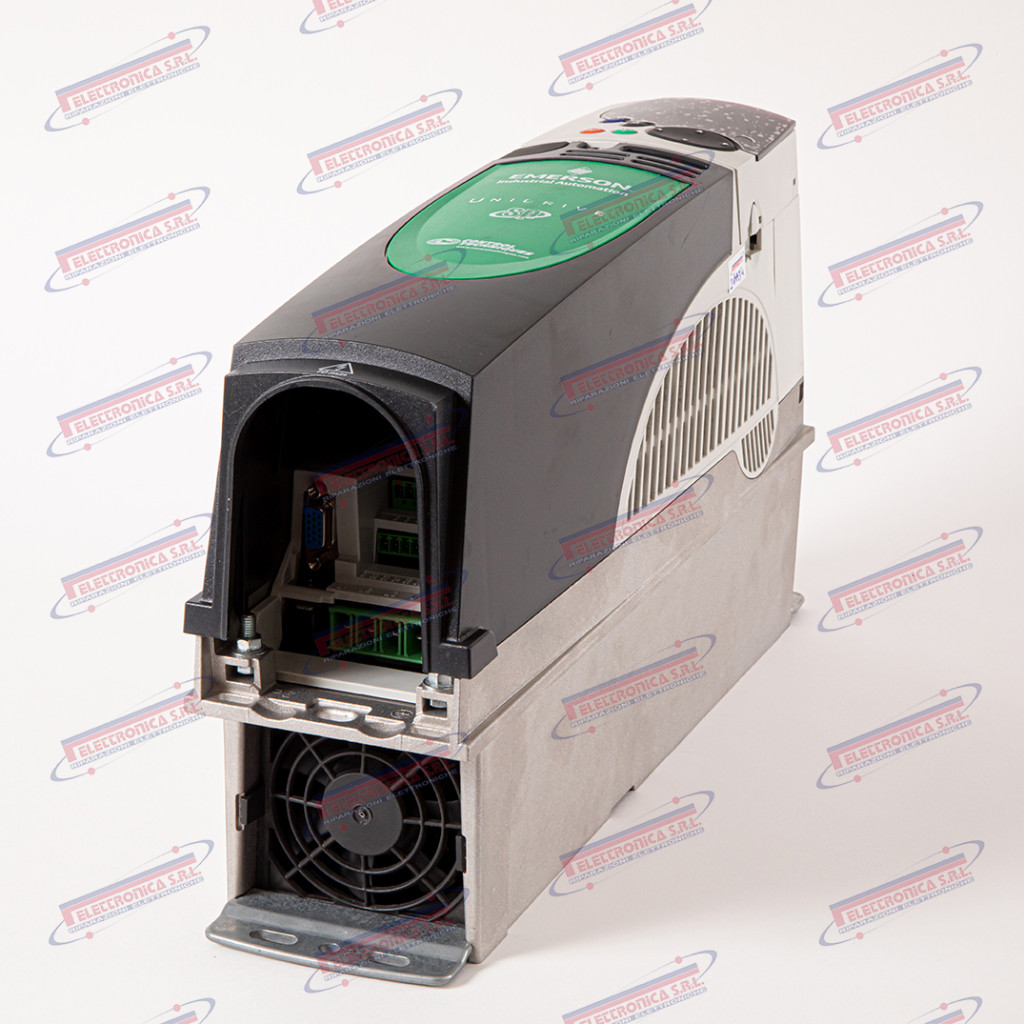
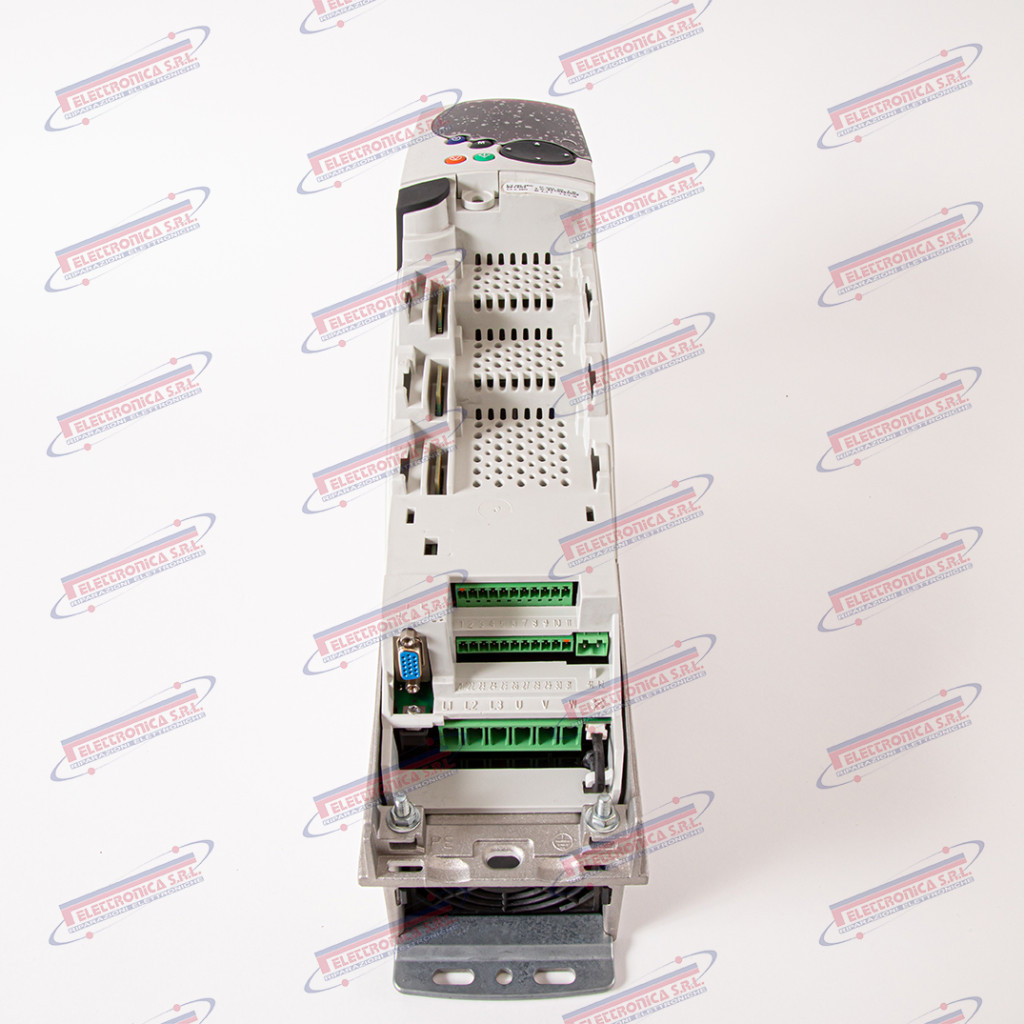
Variable Speed Drive – Control Techniques SP1403
The SP1403 is a variable speed drive (“Variable Speed Drive / Servo Drive”) from the Unidrive SP family manufactured by Control Techniques, documented in service on CNC machine tools, machining centres and industrial automation systems requiring precise control of asynchronous or synchronous motors. The Unidrive SP (“Universal Drive”) family supports open-loop, RFC (Rotor Flux Control) and servo modes with encoder feedback, managing the complete speed/torque regulation chain from the DC-bus rectifier stage through the IGBT inverter output. The unit integrates short-circuit, over-temperature and overvoltage protection, and is expandable with optional fieldbus communication and advanced encoder input cards.
The drive is the device that converts mains electrical energy into a variable voltage and frequency suitable for the motor, enabling precise speed and torque control throughout all machining phases. On a CNC machining centre its failure stops the spindle or the controlled axis, rendering the machine completely unusable; recovery requires replacing the drive and reconfiguring the regulation parameters (gains, ramps, current limits) to restore the machine’s original performance.
Control Techniques, founded in 1968 in Wales (UK), is one of the world’s leading manufacturers of variable speed drives for AC and DC motors; the Unidrive range has become a benchmark in global manufacturing industry. Acquired by Emerson Electric and subsequently by Nidec Corporation in 2017, products are now marketed under the Nidec | Control Techniques brand. The Unidrive SP series has been superseded by the Unidrive M series and is considered legacy / discontinued: available primarily as used, surplus or through specialist repair.
Main Technical Specifications
| Type | Variable speed drive / Servo drive (Unidrive SP) |
| Part number | SP1403 |
| Brand | Control Techniques (Nidec | Control Techniques) |
| Product family | Unidrive SP |
| Known application | CNC machine tools, machining centres, industrial automation systems |
| Function | AC / servo motor speed and torque control; open-loop, RFC (Rotor Flux Control) and servo modes |
| Input voltage | 380–480 V AC three-phase, 50/60 Hz |
| Rated output current | To be verified on nameplate — ~14 A |
| Nominal motor power | ~4–7.5 kW |
| Feedback | Incremental encoder / resolver / tachogenerator (via optional modules) |
| Interfaces | RS485, Modbus RTU; optional fieldbus cards (Profibus, CANopen, DeviceNet); analogue/digital control terminal strip |
| Weight | ~2–5 kg |
| Dimensions | ~170–280 × 90–130 × 180–230 mm |
| Production status | Legacy / discontinued — used/surplus/repair only |


SKU:
SP1401
Cat:
Servo Drive
Brand:
CONTROL TECHNIQUES
Service
Exchange service
Repair
Refurbished sell
AC Variable Speed Drive – CONTROL TECHNIQUES SP1401
The SP1401 is an AC variable speed drive (“AC Variable Speed Drive” / inverter) manufactured by Control Techniques, belonging to the Commander SP family. Designed for three-phase induction motor speed control, it is used in CNC machine tools, material handling systems, and industrial automation. The unit integrates V/f and sensorless vector control logic, electronic protections (over-temperature, over-current, under-voltage), and a serial communication interface. Since the alternative code matches the main part number, the component is uniquely identified as SP1401.
The SP1401 drive converts mains voltage into variable voltage and frequency via PWM modulation, enabling precise motor speed control according to the CNC reference. It is the component that makes continuous feed rate or spindle speed regulation possible: without it the motor would operate only at fixed mains frequency, making any controlled machining impossible. A drive failure causes immediate stoppage of the affected axis or spindle, resulting in machine downtime.
Control Techniques is a British manufacturer founded in 1973, a world leader in variable speed drives and servo drives (product ranges: Unidrive, Commander, Mentor, Digitax). Acquired by Emerson Electric in 2004 and subsequently by Nidec Corporation in 2017, it now operates under the Nidec brand. The Commander SP range is legacy / discontinued: available only as used, surplus, or through specialist repair services.
Main Technical Specifications
| Type | AC variable speed drive (inverter / VFD) |
| Part number | SP1401 |
| Brand | Control Techniques (Nidec – Commander SP family, legacy) |
| Known application | CNC machine tools, industrial automation, material handling |
| Function | AC induction motor speed control via PWM modulation |
| Input voltage | ~200–480 V AC, single / three-phase |
| Rated power | ~0.37–2.2 kW |
| Output frequency | 0–400 Hz (typical Commander SP) |
| Control modes | V/f, sensorless open-loop vector |
| Interfaces / communication | Analogue and digital terminal strip; RS485 (typical Commander SP) |
| Weight | ~0.5–1.5 kg |
| Dimensions | ~150–250 mm |
| Production status | Legacy / discontinued — used/surplus/repair only |


SKU:
MAXAX 200/3000
Cat:
Servo Drive
Brand:
CONTROL TECHNIQUES
Service
Exchange service
Refurbished sell
Repair
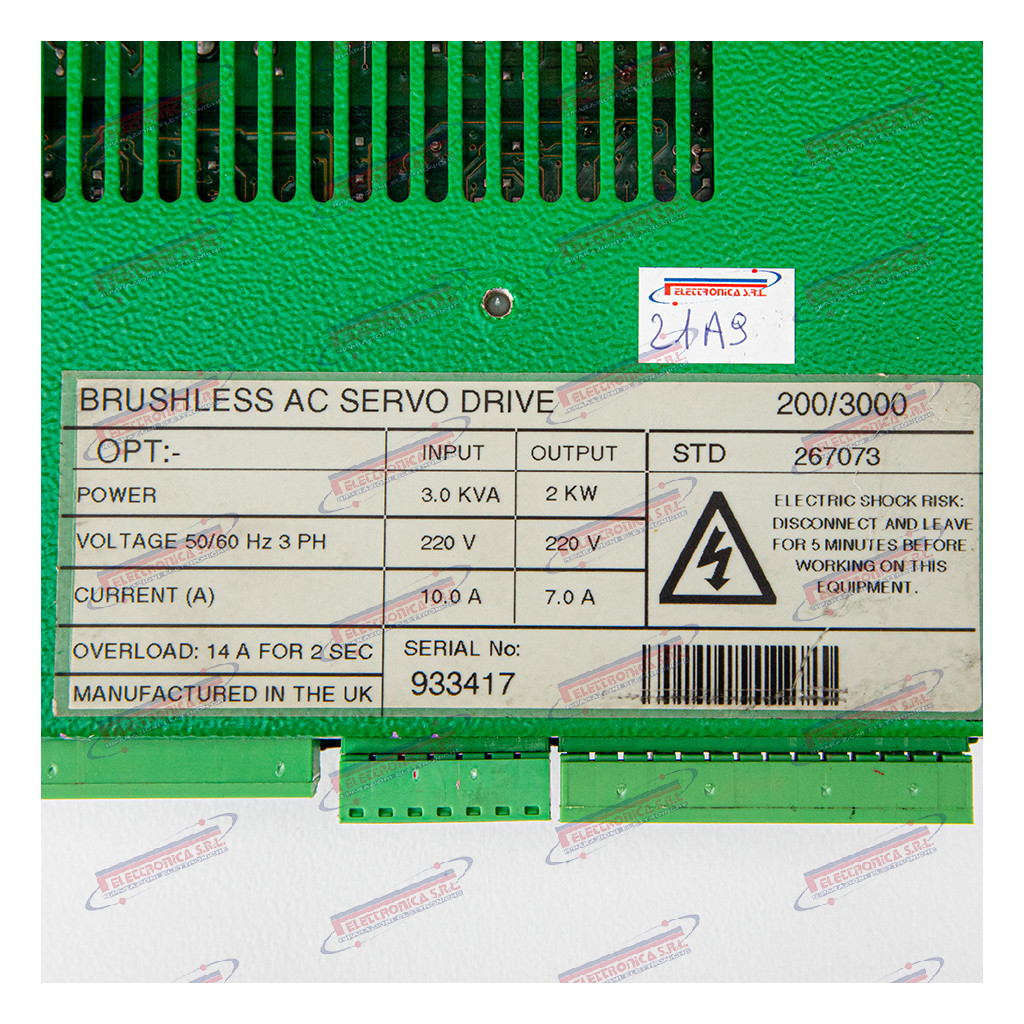
Axis Servo Drive – CONTROL TECHNIQUES MAXAX 200/3000
The MAXAX 200/3000 is an axis servo drive (“Axis Servo Drive”) manufactured by Control Techniques, belonging to the MAXAX family, a series dedicated to axis control in motion control applications for CNC machine tools. The part number identifies a compact module designed to drive servo motors (brushless AC or DC) for positioning and machining axes, with the rated voltage class and nominal speed encoded in the product designation. The module manages the current and velocity loops of the axis, interfacing with the CNC controller via an analogue speed reference and encoder feedback signals. Multiple hardware revisions and configuration variants may exist.
The axis servo drive is the power regulator that converts the position or speed references issued by the CNC into precise control currents for the axis motor: it ensures high dynamic response, positional stiffness and motor protection during machining operations. If it fails, the affected axis becomes uncontrollable or is locked in a safe state, rendering the machine completely unusable and halting production.
Control Techniques is a British manufacturer founded in 1973 in Newtown, Wales, specialising in high-performance AC, DC and servo drives for industrial automation; in 1992 it was acquired by Emerson Electric and subsequently, in 2017, by Nidec Corporation, now operating under the brand Nidec Control Techniques. All products in the MAXAX family are legacy / discontinued: available only as used, surplus or through specialist repair services.
Main Technical Specifications
| Type | Axis servo drive (Axis Servo Drive) |
| Part number | MAXAX 200/3000 (MAXAX2003000) |
| Brand | Control Techniques (Nidec / Emerson legacy) |
| Known application | CNC machine tools with servo axes (machining centres, lathes, milling machines) |
| Function | Axis servo motor current and speed regulation |
| Rated voltage | ~200 V (rated voltage class) |
| Maximum speed | ~3000 rpm (nominal reference) |
| Reference input | Analogue speed/position reference ±10 V (typical) |
| Feedback | Incremental encoder / resolver (typical for CNC axes) |
| Interfaces | Multi-pin connectors; digital I/O enable/fault; optional fieldbus |
| Weight | ~1–3 kg |
| Dimensions | ~150–300 mm |
| Production status | Legacy / discontinued — used/surplus/repair only |


SKU:
MAXAX 100/3000
Cat:
Servo Drive
Brand:
CONTROL TECHNIQUES
Service
Exchange service
Refurbished sell
Repair
Servo Axis Drive – CONTROL TECHNIQUES MAXAX 100/3000
The MAXAX 100/3000 is a servo axis drive (“Servo Axis Drive”) manufactured by Control Techniques, belonging to the MAXAX family of the MAX multi-axis control platform. The designation MAXAX identifies the module as an axis drive (AX = axis) integrated into the MAX system; the model parameters indicate a peak current class of 100 A and a nominal motor speed of 3000 rpm. The module interfaces with the central MAX controller and the axis servo motor, managing the position–velocity–current control chain. Hardware revisions and firmware variants may exist; always verify compatibility with the installed controller version.
The servo axis drive is the component that translates position and velocity commands from the CNC into precise current signals to the motor, closing the regulation loops and ensuring exact axis positioning during machining. A failure in this module makes the axis completely uncontrollable: the machine triggers an alarm and production stops immediately, with a real risk of collisions or dimensional rejects across the entire batch being machined.
Control Techniques is a British manufacturer of variable speed drives and servo systems, founded in Newtown, Wales (UK), and established as a global reference in industrial motion control. Acquired by Emerson Electric in 2004 and subsequently by Nidec Corporation (Japan) in 2017, it now operates as a strategic brand within the Nidec Motion Control division. Products in the MAXAX series are legacy / discontinued: available only as used, surplus or through specialist repair.
Main Technical Specifications
| Type | Servo axis drive (Servo Axis Drive) |
| Part number | MAXAX 100/3000 (MAXAX1003000) |
| Brand | Control Techniques (Nidec / Emerson legacy) |
| Known application | Multi-axis CNC systems with Control Techniques MAX platform |
| Function | Position, velocity and current regulation of the axis servo motor |
| Peak current | ~100 A |
| Max motor speed | ~3000 rpm |
| Supply voltage | 200–480 V AC three-phase (typical MAX series) |
| Logic supply voltages | ±15 V and +5 V DC (typical) |
| Interfaces | MAX system bus, axis encoder/resolver, digital I/O, multi-pin edge connectors |
| Weight | ~2–5 kg |
| Dimensions | ~250–400 mm |
| Production status | Legacy / discontinued — used/surplus/repair only |


SKU:
DBE 220
Cat:
Servo Drive
Brand:
CONTROL TECHNIQUES
Service
Exchange service
Refurbished sell
Repair
Digital Brushless Servo Drive – Control Techniques DBE 220
The DBE 220 is a digital brushless servo drive (“Digital Brushless Servo Drive”) manufactured by Control Techniques, belonging to the family of digital drives for brushless AC/DC servo motors used in CNC machine tools and industrial automation systems. The unit manages the current, speed and position control loops of the servo motor, receiving a digital or analogue reference from the CNC controller and driving the motor using high-frequency digital PWM modulation. Variants with different nominal current and supply voltage may exist; always verify the nameplate data before any replacement.
The digital servo drive is the core of the axis motion system: it converts the CNC’s numerical commands into precise power currents that accelerate, hold and decelerate the servo motor with the dynamic response demanded by the machining process. Without this component the controlled axis is stationary or uncontrollable; a failure causes an immediate machine stop with a drive alarm, making any machining cycle impossible.
Control Techniques is a British manufacturer founded in 1968 in Newtown (Wales), a pioneer in the development of AC inverters and digital servo drives for the global manufacturing industry. Acquired by Emerson Electric in 2004 and subsequently integrated into the Nidec Corporation group in 2017, the company continues to manufacture drives for industrial automation. Products from the older series, including the DBE family, are legacy / discontinued: available exclusively as used, NOS, or through specialist repair services.
Main Technical Specifications
| Type | Digital brushless servo drive (Digital Brushless Servo Drive) |
| Part number | DBE 220 (DBE220) |
| Brand | Control Techniques (Nidec / Emerson Electric legacy) |
| Known application | CNC machine tools, industrial automation and motion control systems |
| Function | Current, speed and position control for brushless AC/DC servo motor |
| Supply voltage | 200–240 V AC single/three-phase |
| Rated current | ~20 A continuous |
| Modulation technique | High-frequency digital PWM |
| Reference interface | Analogue ±10 V / incremental encoder / serial interface (version dependent) |
| Built-in protections | Overcurrent, overtemperature, short circuit, DC bus undervoltage, encoder fault |
| Weight | ~2–5 kg |
| Dimensions | ~200–350 mm |
| Production status | Legacy / discontinued — used/surplus/repair only |


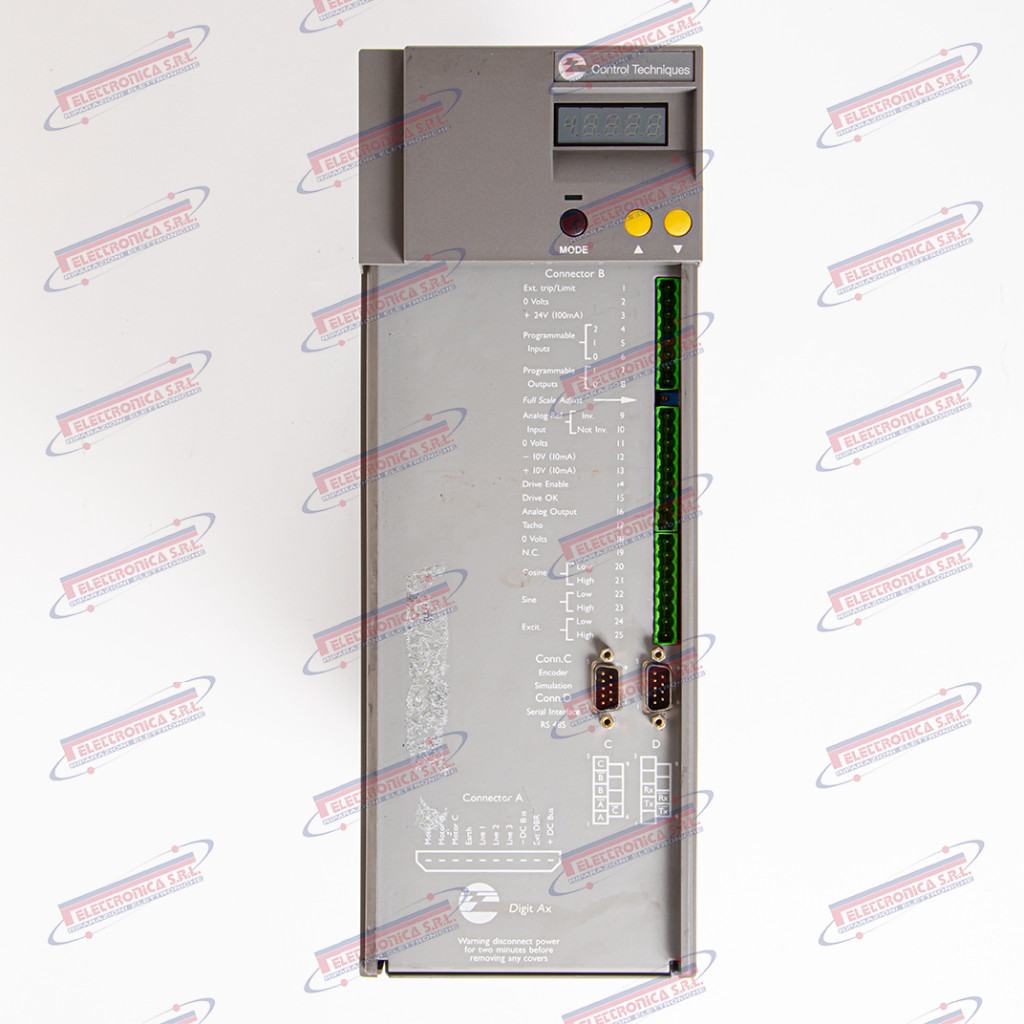

SKU:
DB420
Cat:
Servo Drive
Brand:
CONTROL TECHNIQUES
Service
Repair
Digital Servo Drive for Brushless Motor – CONTROL TECHNIQUES DB420
The DB420 is a digital servo drive (“Digital Servo Drive”) belonging to the DIGITAX series by Control Techniques, designed for speed, position and torque control of brushless AC motors (permanent-magnet AC synchronous servomotors). It is documented as a component in CNC axis-control systems for machining centres, transfer machines and high-precision industrial automation. The DB420 receives the reference from the CNC controller and drives the servo motor via a high-switching-frequency three-phase PWM output; it internally manages the current (torque) and speed loops, with feedback from an incremental encoder or resolver. The “DB” designation identifies the brushless family within the DIGITAX series; “420” refers to the current/voltage rating. No distinct alternative part number is known other than the main code.
The digital servo drive is the electronic controller that translates CNC commands into precise current delivered to the axis motor: it maintains position and speed with sub-millisecond accuracy, ensuring dimensional repeatability of the machined workpiece. If the DB420 fails, the controlled axis is completely locked or uncontrollable; the machine triggers an alarm and cannot produce, with immediate impact on productivity and a potential risk of collision.
Control Techniques is a British manufacturer founded in the 1970s, a world leader in the design of AC drives, servo drives and motion control systems. The company was acquired by Emerson Electric in 2004 and subsequently by Nidec Corporation in 2017, continuing to operate under its own brand. The original generations of the DIGITAX product line (prior to the ST series) are legacy / discontinued: available exclusively as used, surplus or through specialist repair.
Main Technical Specifications
| Type | Digital servo drive for brushless AC motor — DIGITAX series |
| Part number | DB420 |
| Brand | Control Techniques (Nidec group) |
| Series | DIGITAX (legacy generation) |
| Known application | CNC machining centres, transfer machines, industrial automation systems with brushless AC servomotors |
| Function | Speed, position and torque control of brushless AC servomotors (current loop + speed/position loop) |
| Supply voltage | ~400 V AC three-phase, 50/60 Hz |
| Output current | ~20 A nominal |
| Feedback | Incremental encoder / resolver (typical DIGITAX series) |
| Analogue inputs | Speed reference ±10 V DC (typical) |
| Communication interfaces | RS-232 / RS-485; fieldbus options CANopen, PROFIBUS-DP |
| Weight | ~1.5–4.0 kg |
| Dimensions | ~75–120 mm (W) × 200–320 mm (H) × 130–200 mm (D) |
| Production status | Legacy / discontinued — used/surplus/repair only |


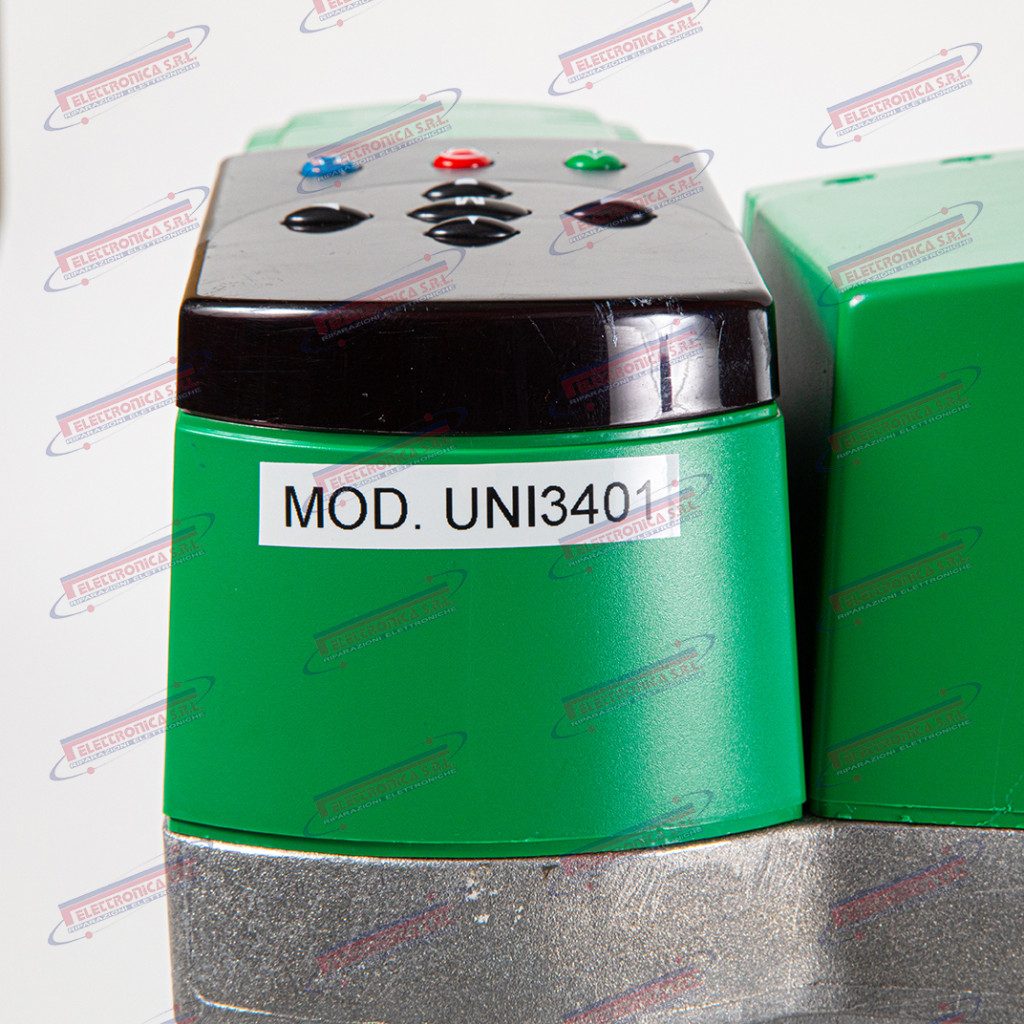
SKU:
UNI3401
Cat:
Servo Drive
Brand:
CONTROL TECHNIQUES
Service
Exchange service
Repair
Refurbished sell
AC Variable Speed Drive – Control Techniques UNI3401
The UNI3401 is an AC variable speed drive from the Unidrive Classic series by Control Techniques. It is a medium-frame (frame 3) three-phase inverter for 400 V AC supply, designed to control induction and permanent-magnet synchronous motors in CNC machine tools, industrial automation, and motion control applications. The drive supports five operating modes: open-loop V/Hz, open-loop vector, closed-loop vector (with encoder feedback), servo (brushless PM motors), and regenerative. It is not a CPU board or standalone I/O module, but a fully integrated power conversion and digital regulation drive. Option expansion slots are provided for additional I/O, fieldbus modules, and supplementary encoder interfaces.
The Unidrive drive is the core of the axis and spindle motion system in a CNC machine: it receives the speed or torque reference from the numerical control and continuously adjusts output frequency and voltage to drive the motor with high accuracy. A drive failure immediately stops the controlled axis or spindle, rendering the machine unusable; replacing or repairing the drive becomes the critical path to restoring production.
Control Techniques is a British manufacturer of drives and servo systems founded in 1968 in Newtown (Wales, UK), acquired by Emerson Electric in 1994 and absorbed into the Nidec Corporation group in 2017. The Unidrive Classic series is legacy / discontinued: superseded by the Unidrive SP series and subsequently by Unidrive M, it is now available only as used, surplus, or through specialist repair centres.
Main Technical Specifications
| Type | AC variable speed drive – Unidrive Classic series, frame 3 |
| Part number | UNI3401 |
| Brand | Control Techniques (Nidec group – formerly Emerson Electric) |
| Known application | CNC machine tools, industrial automation, motion control systems (1990s–2000s) |
| Function | Speed and torque control of AC induction and PM synchronous motors |
| Input voltage | 380–480 V AC three-phase ±10%, 50/60 Hz |
| Rated output current | ~25–40 A |
| Motor power | ~11–18 kW at 400 V |
| Operating modes | Open-loop V/Hz, open/closed-loop vector (encoder), servo (PM), regenerative |
| Interfaces / connectors | RS-485 (CT protocol), option expansion slots (I/O, fieldbus, encoder), control terminal strips |
| Protection rating | IP20 (panel mounting) |
| Weight | ~10–18 kg |
| Dimensions | ~250 × 500 × 220 mm W×H×D |
| Production status | Legacy / discontinued — used/surplus/repair only |
SKU:
LDC15F-2
Cat:
No Category
Brand:
COSEL
Service
Repair
Exchange service
Refurbished sell
DC Switching Power Supply – COSEL LDC15F-2
The LDC15F-2 is a DC switching power supply (“DC Switching Power Supply”) manufactured by COSEL, belonging to the LDC series of compact low-power industrial converters. Documented as a logic supply component in CNC control systems and industrial panels, it delivers a regulated DC output voltage — in the F2 variant typically +12 V DC — with a nominal output power of approximately 15 W. The unit accepts wide-range universal AC input and includes built-in overload and short-circuit protection.
The LDC15F-2 power supply provides stable, filtered logic supply voltages to the machine’s CNC control circuits: CPU boards, I/O modules, encoders, and communication interfaces all depend on clean, stable voltage to operate correctly. A failure or excessive ripple causes random CNC errors, parameter loss, unexpected shutdowns, or irreversible damage to control boards.
COSEL Co., Ltd. is a Japanese manufacturer founded in 1969, headquartered in Toyama, specialising in high-reliability switching power supplies for industrial, medical, and CNC applications. COSEL products are globally recognised for their long operational life and low electromagnetic interference. Some legacy series such as the LDC are legacy / discontinued: available primarily as NOS (new old stock), used, or through specialist repair.
Main Technical Specifications
| Type | DC switching power supply (DC Switching Power Supply) |
| Part number | LDC15F-2 (LDC15F2) |
| Brand | COSEL Co., Ltd. |
| Known application | CNC control systems, industrial panels, industrial automation equipment |
| Function | Regulated and filtered DC logic supply for control circuits |
| Output power | ~15 W (nominal) |
| Input voltage | 85–264 V AC, 47–440 Hz |
| Output voltage | +12 V DC |
| Output current | ~1.25 A max |
| Protection | Overcurrent, short-circuit (typical for series) |
| Interfaces / connectors | Screw terminal block; DIN rail or panel mount |
| Weight | ~0.2–0.5 kg |
| Dimensions | ~80–130 × 50–80 mm |
| Production status | Legacy / discontinued — NOS/used/repair only |
SKU:
LDA75F-18
Cat:
No Category
Brand:
COSEL
Service
Exchange service
Refurbished sell
DIN Rail Switching Power Supply 75 W / 18 V – COSEL LDA75F-18
The LDA75F-18 is an industrial DIN rail switching power supply (“DIN Rail Switching Power Supply”) manufactured by COSEL, belonging to the LDA75F series rated at 75 W. The unit accepts universal AC (85–264 V AC, 47–63 Hz) or DC (120–370 V DC) input and delivers a regulated 18 V DC output at a nominal maximum current of approximately 4.2 A. Cooling is achieved by natural convection, with no fan required. Isolation is reinforced type in compliance with major international standards (UL, CE). No official hardware revisions have been publicly documented.
The switching power supply converts mains AC voltage into a stable, regulated DC voltage, essential for powering CNC control logic boards, I/O modules, sensors, transducers and all low-voltage devices on the machine tool. A power supply failure causes an immediate loss of auxiliary power: the CNC triggers an alarm, drives may lose their enable logic voltage, and the machine stops in an uncontrolled manner, risking workpiece loss and tool damage.
COSEL Co., Ltd. is a Japanese manufacturer founded in 1969, specialised in the design and production of high-reliability AC/DC switching power supplies for industrial, medical and telecommunications applications. The LDA series is the compact DIN rail range of reference for industrial control panels, renowned for low output ripple, high efficiency and long operating life. The LDA75F-18 model is legacy / discontinued: available exclusively as NOS stock, used units, or through specialist distributors.
Main Technical Specifications
| Type | Industrial switching power supply, DIN rail 35 mm mount |
| Part number | LDA75F-18 (LDA75F18) |
| Brand | COSEL Co., Ltd. (Japan) |
| Known application | CNC control panels and industrial machine tools (general purpose) |
| Function | AC/DC mains conversion → regulated 18 V DC for control circuits, logic and I/O |
| Input voltage | 85–264 V AC (47–63 Hz) / 120–370 V DC (universal) |
| Output voltage | 18 V DC regulated |
| Max output current | ~4.2 A |
| Output power | 75 W |
| Isolation | Reinforced (EN 62368-1, UL 62368-1) – LDA series typical |
| Cooling | Natural convection (fanless) |
| Operating temperature | −10 °C to +60 °C |
| Interfaces / connectors | Screw terminal block for AC input and DC output; DIN rail 35 mm mounting clip |
| Weight | ~0.7–1.1 kg |
| Dimensions | ~45 × 125 × 113 mm W×H×D |
| Production status | Legacy / discontinued — NOS/used/surplus only |
SKU:
LDA150W-12
Cat:
No Category
Brand:
COSEL
Service
Repair
Refurbished sell
150W 12V DC Switching Power Supply – COSEL LDA150W-12
The LDA150W-12 is a single-output 12 V DC / 12.5 A industrial switching power supply (“Switching Power Supply”) manufactured by COSEL, belonging to the LDA150W series. The part number encodes the nominal output power of 150 W and the regulated output voltage of 12 V DC. The input is universal AC (85–264 V AC, 47–63 Hz), compatible with both 110 V and 230 V mains without manual range switching. The unit is designed for panel or DIN-rail mounting inside electrical cabinets and is widely used as an auxiliary power supply in CNC control systems from various manufacturers (Fanuc, Mitsubishi Electric, Mazak, Okuma, and others). The alternative commercial part number is listed exclusively in the technical table below.
The auxiliary power supply converts mains voltage into stable DC voltage, which is essential to power the CNC’s control logic, I/O modules, encoders, position sensors, operator panel, and safety circuits. A failure or output voltage drift produces erratic machine behaviour or shutdowns that are particularly difficult to diagnose, since symptoms typically appear intermittently — position errors, unexpected resets, random alarms — before the unit fails completely.
COSEL Co., Ltd. is a Japanese switching power supply manufacturer founded in 1969 and headquartered in Toyama, Japan, specialised in high-reliability power solutions for industrial, medical, and telecommunications applications. COSEL products are internationally recognised for their high build quality, long service life, and compliance with major international certifications (UL, CE, TÜV). The company remains active and independent; however, certain older revisions or series may be legacy / discontinued — it is advisable to verify availability of the specific part number with an authorised distributor before ordering.
Main Technical Specifications
| Type | Single-output industrial DC switching power supply (Switching Power Supply) |
| Part number | LDA150W-12 (LDA150W12) |
| Brand | COSEL Co., Ltd. (Japan) |
| Known application | Auxiliary power supply in industrial CNC cabinets (Fanuc, Mitsubishi, Mazak, Okuma, and other systems) |
| Function | AC/DC conversion, stable 12 V DC auxiliary voltage for control logic, I/O modules, encoders, and sensors |
| Input voltage | 85–264 V AC, 47–63 Hz (universal input, no manual range switching) |
| Output voltage | 12 V DC (on-board trimmer adjustable ±10 %) |
| Maximum output current | 12.5 A |
| Rated output power | 150 W |
| Typical efficiency | ~85–88 % |
| Operating temperature | -10 °C to +70 °C (linear derating above +50 °C) |
| Interfaces / Connectors | Screw terminals for AC input and DC output; on-board output voltage adjustment trimmer |
| Certifications | UL, CE, TÜV (typical for COSEL industrial series) |
| Weight | ~0.6–1.0 kg |
| Dimensions | ~199×98×38 mm |
| Production status | Check availability — certain revisions may be legacy / discontinued |



SKU:
DSRT15XA50
Cat:
No Category
Brand:
DAEWOO
Service
Repair
Exchange service
Refurbished sell
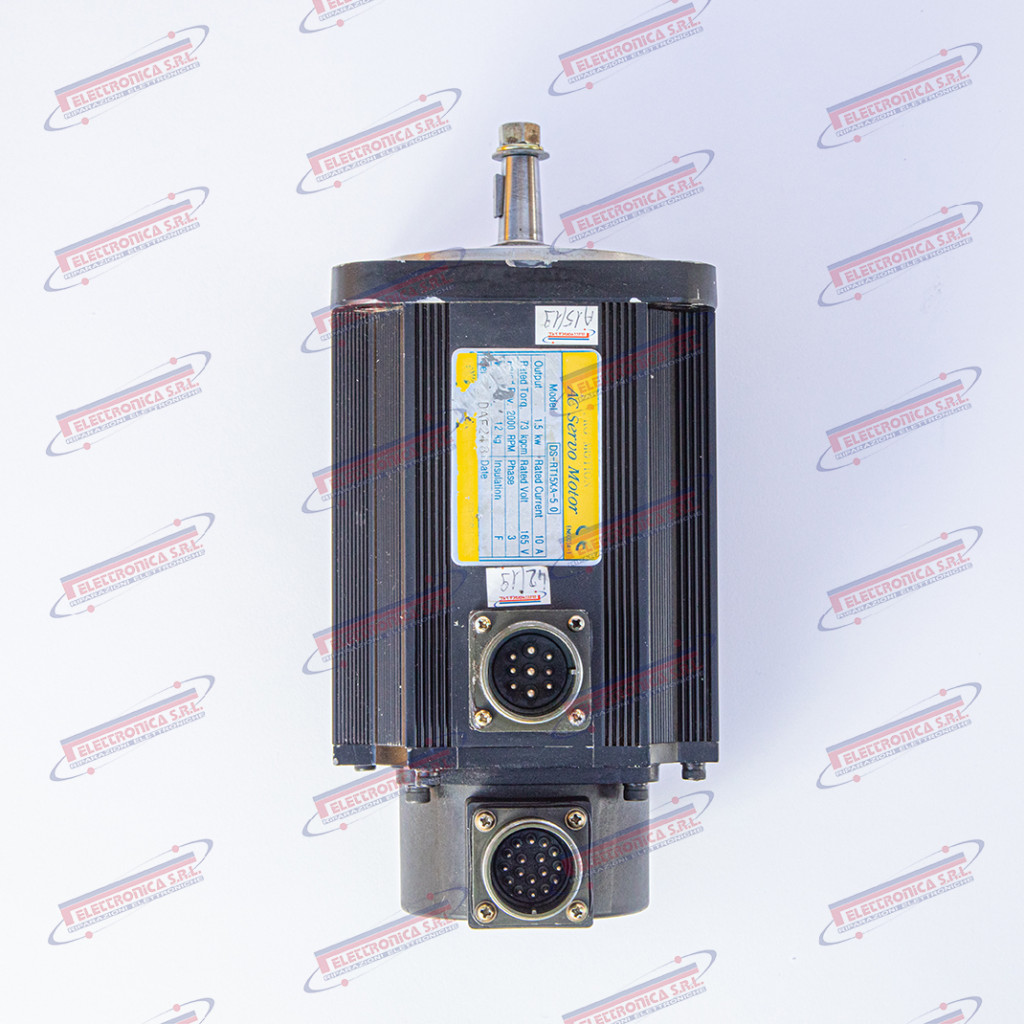
Heavy Duty Electric Motor – DAEWOO DSRT15XA50
The DSRT15XA50 is a heavy-duty electric motor for CNC machine tools (“Heavy Duty Electric Motor”) manufactured by DAEWOO Heavy Industries, used in DAEWOO HEAVY range machine tools (vertical and horizontal machining centres, CNC lathes and large-format milling machines). The part number DSRT15XA50 identifies a specific power, voltage and flange configuration within the DAEWOO heavy-duty motor family. Depending on the host machine, the component may serve as a feed axis motor or spindle motor; position and speed feedback is typically provided by an integrated encoder or resolver.
The DSRT15XA50 motor is the electromechanical component that converts electrical power into mechanical torque to drive the CNC machine’s feed axes or spindle. It plays a critical role in the motion control system: it ensures precise, repeatable axis positioning or steady spindle rotation in response to numerical control commands. Failure of this motor causes immediate machine downtime; no machining is possible until the component is replaced or repaired, with a direct impact on production output.
DAEWOO Heavy Industries was one of South Korea’s leading industrial conglomerates, with a machine tool division (DAEWOO Machine Tool Co.) producing CNC lathes, machining centres and high-end milling machines widely used in the automotive and aerospace sectors. Following the DAEWOO group’s restructuring, the division was absorbed into Doosan Infracore (now HD Hyundai Infracore), which continued production under the new brand. Original DAEWOO Heavy components are legacy / discontinued: available exclusively as used, surplus stock or through specialist repair.
Main Technical Specifications
| Type | Heavy-duty electric motor for CNC machine tools |
| Part number | DSRT15XA50 |
| Brand | DAEWOO Heavy Industries (Doosan Infracore – HD Hyundai legacy) |
| Known application | DAEWOO Heavy CNC machine tools (lathes, machining centres, large-format milling machines) |
| Function | CNC feed axis drive motor or spindle motor |
| Rated power | ~1.5–5.5 kW |
| Rated voltage | ~200–440 V AC |
| Feedback | Incremental encoder or integrated resolver |
| Interfaces / connectors | Standard DAEWOO multi-pin connectors; mounting flange |
| Weight | ~10–25 kg |
| Dimensions | ~250–450 mm L |
| Production status | Legacy / discontinued — used/surplus/repair only |
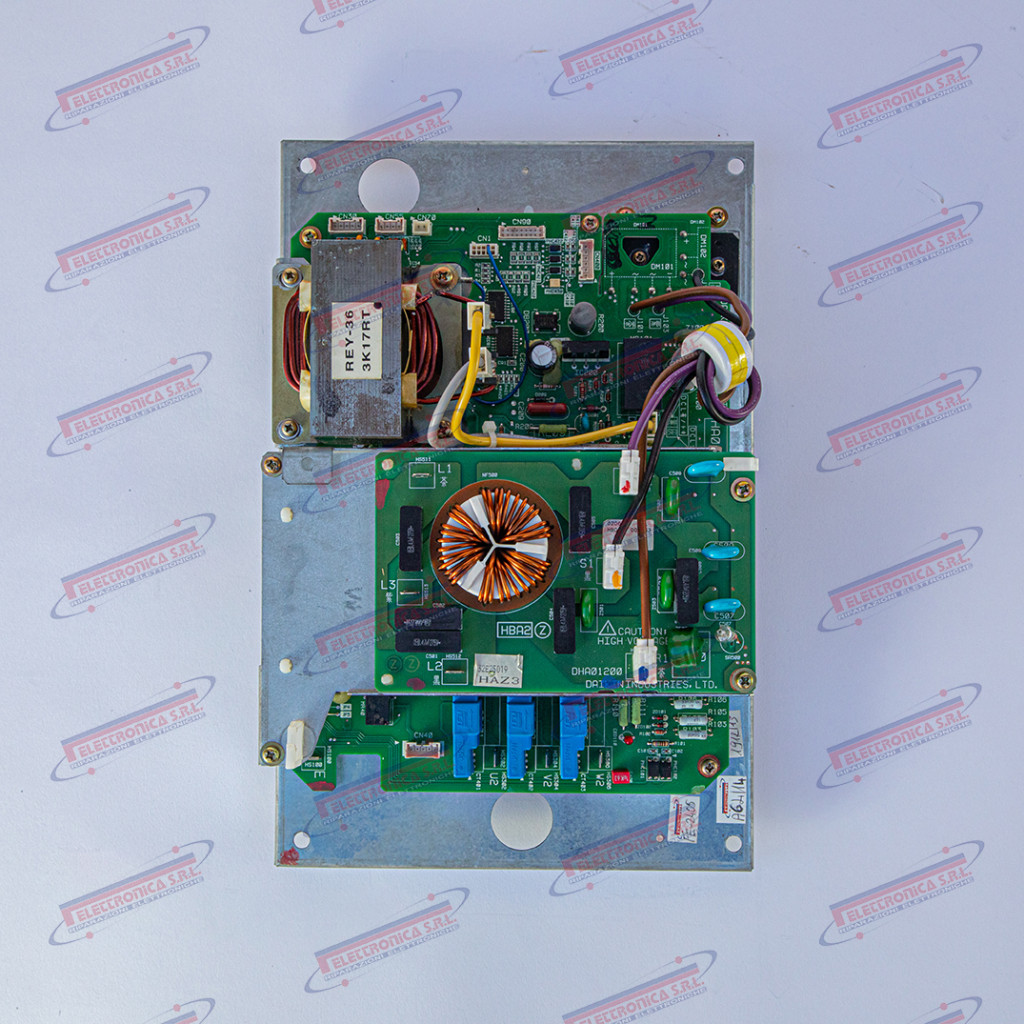
SKU:
DHA00900
Cat:
No Category
Brand:
DAIKIN
Service
Repair
Exchange service
Hydraulic Pump Control Unit – DAIKIN DHA00900
The DHA00900 is an electronic hydraulic pump control unit (“Hydraulic Pump Control Unit”) manufactured by DAIKIN Industries, industrial hydraulics division. This module forms the logical core of the hydraulic power unit fitted on CNC machine tools, machining centres and industrial systems that use DAIKIN hydraulic components for workpiece clamping, axis counterbalancing, automatic tool change and other hydraulic actuators. The unit integrates pump motor start/stop logic, operating pressure regulation, fault supervision (overtemperature, low oil, pressure anomaly) and the signal interface toward the CNC controller. No publicly documented variants or revisions are known; part number DHA00900 unambiguously identifies the component.
The control unit governs the entire hydraulic pump assembly: it starts the electric motor, brings the circuit up to operating pressure and continuously monitors oil level, temperature and pressure circuit integrity. In the event of a failure, the machine immediately loses its ability to generate the hydraulic pressure required for workpiece clamping, automatic tool change and vertical axis counterbalancing — the outcome is an immediate machine stop, with a concrete risk of losing the part being machined or causing mechanical damage to unbalanced axes.
DAIKIN Industries is a Japanese multinational founded in 1924, best known as a world leader in air conditioning and industrial ventilation. Its hydraulic division — DAIKIN Hydraulics — manufactures axial piston pumps, vane pumps, power units and electronic controls for industrial and machine tool applications, distributed worldwide with specialist technical support. Electronic modules of this generation are to be considered legacy / discontinued: availability is limited to the used market, industrial surplus stock and specialist repair services.
Main Technical Specifications
| Type | Hydraulic pump electronic control unit (Hydraulic Pump Control Unit) |
| Part number | DHA00900 |
| Brand | DAIKIN Industries – Hydraulics division |
| Known application | DAIKIN hydraulic power unit for CNC machine tools and machining centres |
| Function | Pump start/stop control, operating pressure regulation, fault supervision, CNC signal interface |
| Supply voltage | 24 V DC / 100–240 V AC |
| Inputs / outputs | Digital I/O for enable, fault, pressure-reached signals; outputs for valve control and motor contactor |
| Managed sensors | Pressure switch, oil thermostat, oil level sensor (typical for DAIKIN power units) |
| Interfaces / connectors | Screw terminal strip and multiple connectors |
| Weight | ~0.5–2.0 kg |
| Dimensions | ~150–300 mm |
| Production status | Legacy / discontinued — available as used stock, surplus or through specialist repair only |

SKU:
DVSD-TT-14A-05
Cat:
No Category
Brand:
DOOSAN
Service
Exchange service
Refurbished sell
Axis Servo Drive – DOOSAN DVSD-TT-14A-05
The DVSD-TT-14A-05 is a digital CNC axis servo drive (“Digital Axis Servo Drive”) manufactured by DOOSAN, a component of the proprietary VISION CNC system installed on machining centres and CNC lathes in the DOOSAN/Daewoo range. The part number identifies a DVSD-series drive with TT-type power stage, 14 A rated current and variant 05. It manages the current and velocity control loops of the servo motor on a linear or rotary axis, interfacing with the VISION control CPU via the internal digital bus. No standard accessories are known to be included.
The servo drive is the electronic node that closes the current and velocity loop on the axis motor: it receives the position/speed reference from the CNC CPU and drives the servo motor with microsecond precision, ensuring dimensional accuracy and repeatability throughout machining. A drive failure immediately stops the affected axis with a CNC alarm: the machine cannot operate until the component is replaced or repaired, resulting in unplanned production downtime.
DOOSAN is a South Korean industrial conglomerate whose machine tool division was consolidated through the acquisition of Daewoo Heavy Industries in 2005; it produces CNC lathes, vertical and horizontal machining centres, and proprietary control systems distributed worldwide. Products in the VISION series are legacy generation: legacy / discontinued, available primarily as used, surplus or through specialist repair.
Main Technical Specifications
| Type | Digital CNC axis servo drive (Digital Axis Servo Drive) |
| Part number | DVSD-TT-14A-05 (DVSDTT14A05) |
| Brand | DOOSAN (formerly Daewoo Heavy Industries) |
| Known application | DOOSAN VISION series CNC machining centres and lathes (PUMA, Lynx, DNM and compatible) |
| Function | Axis servo motor current and velocity regulation |
| Rated current | 14 A continuous |
| Power stage type | TT — IGBT transistor stage |
| DC bus voltage | ~300–600 V DC |
| CNC interface | Internal digital serial bus — VISION system |
| Feedback | Incremental/absolute encoder from servo motor |
| External interfaces | Multi-pin connectors (encoder bus, power bus, alarm I/O) |
| Weight | ~1.5–3.5 kg |
| Dimensions | ~150–250 × 250–350 mm |
| Production status | Legacy / discontinued — used/surplus/repair only |
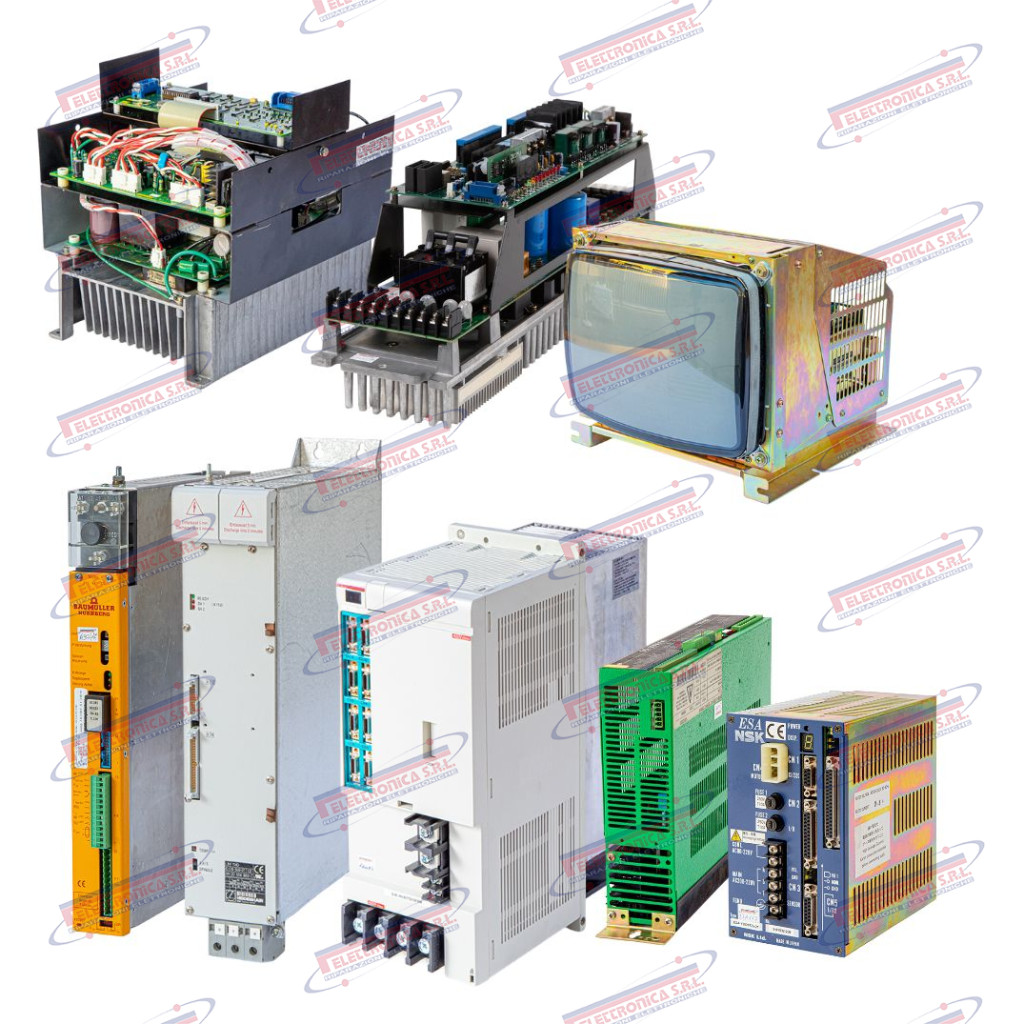
SKU:
C25-81B15-2500AG00
Cat:
No Category
Brand:
DYNAMIC RESEARC CORP
Service
Refurbished sell
Optical Incremental Encoder – DYNAMIC RESEARCH CORP C25-81B15-2500AG00
The C25-81B15-2500AG00 is an optical incremental encoder (“Optical Incremental Encoder”) manufactured by Dynamic Research Corp, designed as a position and velocity transducer for CNC systems and numerically controlled machine tools. The part number identifies a C25-series encoder with a resolution of 2500 pulses per revolution (PPR), type-A output and standard configuration (suffix G00). It provides quadrature signals A, B and zero-pulse Z, compatible with RS-422 / TTL differential interfaces for high immunity to electromagnetic interference typical of industrial environments.
The rotary encoder is the feedback transducer that informs the CNC of the actual position and speed of an axis or spindle: without it the numerical controller cannot close the position loop and the machine is inoperable. A faulty or degraded-signal encoder causes positioning errors, feedback alarms and — in the worst cases — uncontrolled axis motion with collision risk.
Dynamic Research Corp (DRC) was a US manufacturer specialising in optical incremental encoders for motion control and CNC applications, active primarily during the 1980s and 1990s. All products in this line are legacy / discontinued: available only as used spares, NOS (new old stock) or through specialist repair services.
Main Technical Specifications
| Type | Rotary optical incremental encoder |
| Part number | C25-81B15-2500AG00 (C2581B152500AG00) |
| Brand | Dynamic Research Corp (DRC) |
| Known application | CNC machine tools (linear axes, spindle); industrial motion control systems |
| Function | Position and velocity feedback for closed-loop CNC control |
| Resolution | 2500 pulses per revolution (PPR) – 10,000 counts/rev in quadrature (x4) |
| Output signals | Quadrature A, B + zero pulse Z; RS-422 / TTL differential output |
| Supply voltage | 5 V DC (typical) or 5–12 V DC |
| Current / output | ~100–200 mA; differential line driver output |
| Interfaces / Connectors | Multi-pin connector (type and pinout specific to part number; C25-series compatible) |
| Weight | ~0.2–0.5 kg |
| Dimensions | ~Ø60–80 mm, length 60–100 mm |
| Production status | Legacy / discontinued — used/surplus/repair only |
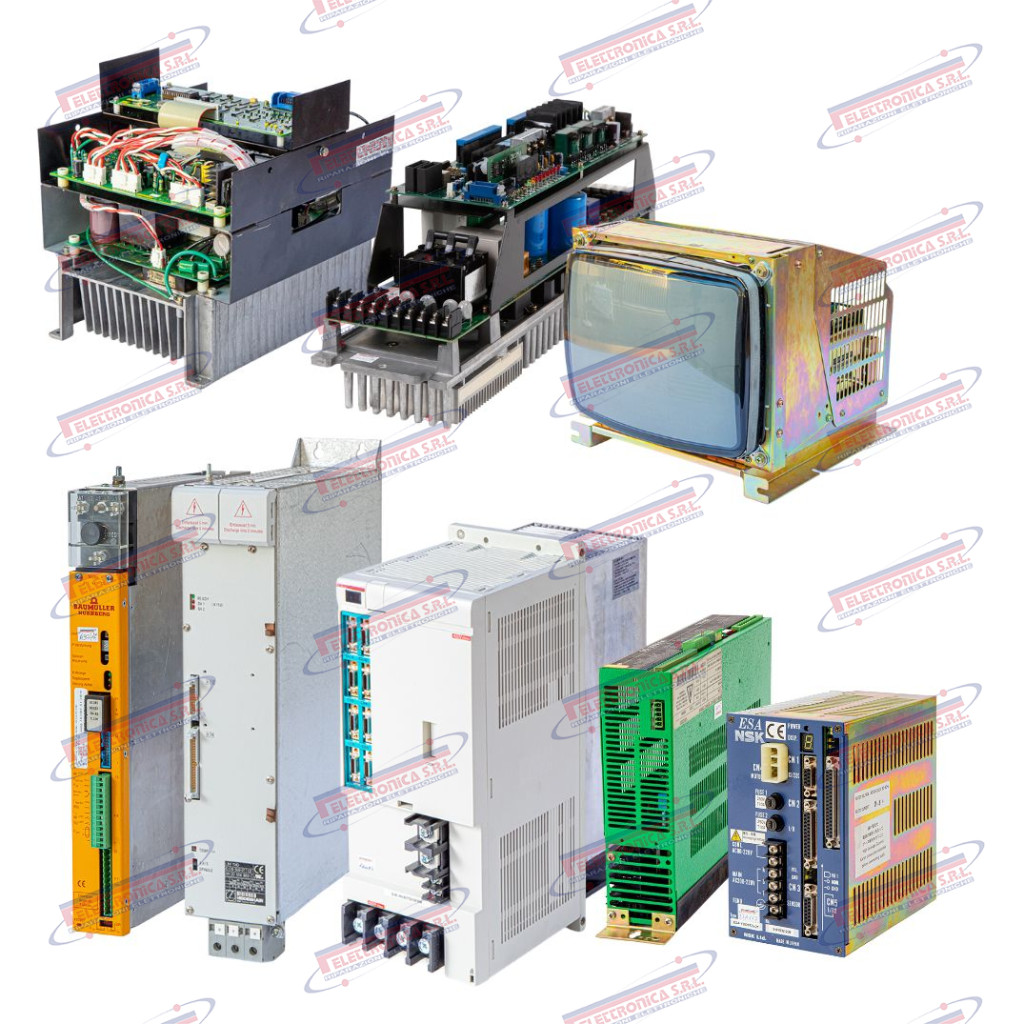
SKU:
25-S031-B15-1800G0C0
Cat:
No Category
Brand:
DYNAMIC RESEARC CORP
Service
Refurbished sell
Incremental Optical Encoder – DYNAMICS RESEARCH CORP 25-S031-B15-1800G0C0
The 25-S031-B15-1800G0C0 is an incremental optical encoder manufactured by Dynamics Research Corp (DRC), with a resolution of 1800 lines/rev (CPR). The manufacturer part number identifies an encoder from the S031 series, flange/mounting configuration B15, and differential output configuration G0C0. The component is documented on a variety of CNC machine tools that use encoder feedback for linear axes or spindle. Other resolution and output variants exist within the same product family; this listing refers specifically to the 1800 CPR version.
The encoder is the position and velocity transducer that feeds the CNC controller with the feedback signal: it converts the mechanical rotation of the motor shaft into high-precision electrical pulses, enabling the position loop to correct axis trajectory or spindle speed in real time. Without the encoder signal the CNC is blind: the axis triggers a following error alarm or the spindle loses speed control, making any machining operation impossible.
Dynamics Research Corp (DRC) was a prominent US manufacturer (Wilmington, MA) specialising in precision optical encoders for machine tools, robotics, and industrial automation. The company was acquired by Danaher Corporation, and its encoder product lines were absorbed into the Dynapar brand. All original DRC series products are legacy / discontinued: supply relies entirely on used stock, surplus, or specialist repair services.
Main Technical Specifications
| Type | Incremental optical encoder |
| Part number | 25-S031-B15-1800G0C0 (25S031B151800G0C0) |
| Brand | Dynamics Research Corp – DRC (legacy Danaher / Dynapar) |
| Known application | CNC machine tools – linear axis / spindle feedback |
| Function | Rotational position and velocity transduction for CNC feedback loop |
| Resolution | 1800 CPR (lines/rev) – 7200 counts/rev in quadrature (x4) |
| Outputs | Differential RS-422 – channels A, /A, B, /B, Z, /Z (typical) |
| Supply voltage | 5 V DC ±5 % (typical) or 5–26 V DC (verify on label) |
| Interface / connector | Multi-pin connector or cable exit (C0 configuration) |
| Mounting | Servo-mount or face-mount flange (B15 configuration) |
| Weight | ~0.2–0.6 kg |
| Dimensions | Ø 60–90 mm, L 50–90 mm |
| Production status | Legacy / discontinued — used/surplus/repair only |


SKU:
SR 92A530
Cat:
No Category
Brand:
EFORE
Service
Refurbished sell
Switching Power Supply – EFORE SR 92A530
The SR 92A530 is an industrial switching power supply (“Switching Power Supply”) manufactured by EFORE, documented as a component of ABB Robotics industrial robot control cabinets. The unit supplies regulated DC voltages to the robot controller’s electronic boards, ensuring stable power for CPU cards, I/O modules, and servo drives. The part number SR 92A530 identifies this unit within the EFORE OEM power supply family for ABB; later hardware revisions with minor circuit variants may exist.
The power supply is the energy core of the robot control cabinet: it converts mains AC voltage into stabilised and filtered DC voltages, essential for the reliable operation of all onboard electronics. A failure of this unit causes immediate robot shutdown — no axis moves, the system loses its state variables and the production line stops. The quality of the output voltages directly affects the stability of the servo drives and the service life of the downstream electronic boards.
EFORE is a Finnish manufacturer of industrial switching power supplies, specialised in OEM supply for critical sectors including robotics, industrial automation, telecommunications and medical equipment. The company has operated as a long-standing strategic power supply vendor for ABB Robotics control systems. Products in the SR series for previous-generation ABB controllers are considered legacy / discontinued: available only as used, surplus or through specialist repair.
Main Technical Specifications
| Type | Industrial switching power supply (Switching Power Supply) |
| Part number | SR 92A530 (SR92A530) |
| Brand | EFORE (OEM supplier for ABB Robotics) |
| Known application | ABB Robotics industrial robot control cabinets |
| Function | DC voltage conversion and regulation for robot control electronics |
| Input voltage | ~100–240 V AC, 50/60 Hz |
| Output voltages | Multiple regulated DC outputs – e.g. +24 V, +5 V, ±15 V |
| Total power | ~50–150 W |
| Interfaces / connectors | Dedicated ABB connectors and terminal strip for internal cabinet voltage distribution |
| Weight | ~0.5–1.5 kg |
| Dimensions | ~150–250 mm |
| Production status | Legacy / discontinued — used/surplus/repair only |



SKU:
AZMLM2B
Cat:
No Category
Brand:
EL.GE
Service
Repair
Exchange service
Servo Axis Drive – EL.GE AZMLM2B
The AZMLM2B is an electronic servo axis drive (“Servo Axis Drive”) manufactured by EL.GE (Elettronica Generale), an Italian company specialising in electronic control systems for CNC machine tools. The module belongs to the EL.GE modular drive family for brushless or DC servo motor control in precision machining applications. The part number AZMLM2B uniquely identifies the version and current rating within the manufacturer’s product range. The drive may be available in different current or voltage variants depending on the machine configuration; no distinct official alternative part number separate from the primary code is known.
The servo axis drive is the electronic module that regulates the torque, speed, and position of the servo motor connected to the controlled axis: it receives setpoints from the CNC or interpolator and closes the current, speed, and position loops in real time. In the event of a failure, the affected CNC axis becomes uncontrollable, the machine triggers an alarm, and production halts immediately; on multi-axis machines a single faulty drive can stop the entire machining cycle, resulting in potentially significant downtime costs.
EL.GE (Elettronica Generale) is an Italian company with decades of experience in designing and manufacturing electronic systems for machine tools, including servo and spindle drives, power supplies, and CNC control boards. Its products equip various Italian manufacturers of machining centres, CNC lathes, and milling machines. A significant part of the historical product range is to be considered legacy / discontinued: available mainly as used, reconditioned, or through specialist repair services.
Main Technical Specifications
| Type | Servo axis drive (Servo Axis Drive) |
| Part number | AZMLM2B |
| Brand | EL.GE (Elettronica Generale) |
| Known application | CNC machine tools equipped with EL.GE drives (lathes, machining centres, Italian CNC milling machines) |
| Function | Torque, speed, and position regulation of the axis servo motor |
| Reference input | Analogue ±10 V or digital serial (typical EL.GE range) |
| Feedback | Incremental encoder / resolver (typical) |
| Supply voltage | ~230–400 V AC three-phase |
| Output current | To be verified on EL.GE technical documentation |
| Logic supply voltages | ±15 V and +5 V DC (typical) |
| Interfaces / connectors | Edge connectors and terminal strips (typical EL.GE) |
| Weight | ~1–4 kg |
| Dimensions | ~150–300 mm |
| Production status | Legacy / discontinued — available as used, reconditioned, or through specialist repair only |
SKU:
K100A-24
Cat:
No Category
Brand:
ELCO
Service
Refurbished sell
24 V DC Switching Power Supply – ELCO K100A-24
The K100A-24 is a 24 V DC switching power supply (“DC Switching Power Supply”) manufactured by ELCO, designed to power control electronics in industrial environments and on CNC machine tools. The -24 suffix identifies the nominal regulated output voltage of 24 V DC. The unit is intended for powering I/O modules, PLCs, safety relays, encoders and electrohydraulic valves located in the machine’s electrical cabinet. Multiple hardware variants may exist; verify the revision before replacement.
The DC power supply is the heart of the logic power distribution in a CNC machine: it converts the mains voltage to stable, filtered 24 V DC, ensuring continuous supply to PLCs, I/O modules, encoders, safety relays and low-power actuators. Its failure causes immediate shutdown of all control circuits, resulting in total machine downtime; an unstable or out-of-tolerance output voltage can also generate communication errors, unexpected CNC resets and anomalous axis behaviour.
ELCO is a manufacturer specialising in industrial power supplies and power electronics components for industrial automation and machine tools. Products in the K100A series are engineered for demanding industrial environments, with particular attention to reliability under variable loads and mains disturbances. Models in this family are legacy / discontinued: available exclusively as used, surplus or through specialist repair services.
Main Technical Specifications
| Type | DC switching power supply (DC Switching Power Supply) |
| Part number | K100A-24 (K100A24) |
| Brand | ELCO |
| Known application | CNC machine tools, industrial automation control cabinets |
| Function | Regulated 24 V DC supply for control circuits, I/O modules and actuators |
| Output voltage | 24 V DC regulated |
| Output power | ~100 W |
| Output current | ~4–5 A at 24 V DC |
| Input voltage | 100–240 V AC, 50/60 Hz |
| Interfaces / connectors | Screw terminals for AC input and DC output (typical for the series) |
| Protections | Overcurrent, overvoltage, short-circuit (typical industrial switching PSU) |
| Weight | ~0.5–1.5 kg |
| Dimensions | ~150–260 mm |
| Production status | Legacy / discontinued — used/surplus/repair only |
SKU:
TK12M165HER2
Cat:
No Category
Brand:
EVERSONIC
Service
Exchange service
Refurbished sell
12” Monochromatic CRT Monitor – EVERSONIC DISPLAY 2000 TK12M165HER2
The TK12M165HER2 is a 12” monochromatic industrial CRT monitor (“12-inch Monochromatic Industrial CRT Monitor”) belonging to the DISPLAY 2000 series by EVERSONIC, a Taiwanese manufacturer specialising in displays for industrial automation and CNC machine tools. The monitor is designed to serve as the operator’s visual interface on CNC systems from various manufacturers and generations, with video inputs compatible with TTL or industry-standard composite signals. The part number TK12M165HER2 identifies the specific variant featuring a monochromatic phosphor tube (typically green or amber) with a 12” diagonal. The unit does not include its own data-processing capability: it is a passive display dedicated to showing machine parameters and status.
The CNC monitor is the display panel that allows the operator to read machine status, running programmes, alarms, and machining parameters in real time. Its absence or a CRT tube failure makes any setting, programming, or control operation impossible: the machine is effectively inoperable until the unit is replaced.
EVERSONIC Technology Co., Ltd. is a Taiwanese manufacturer active in the industrial and professional monitor sector, specialising in displays for CNC, medical, and automation applications. Monitors in the DISPLAY 2000 series, based on monochromatic CRT technology, are legacy / discontinued: CRT tube production has ceased worldwide and these components are available exclusively as used, NOS (new old stock), or through specialist repair.
Main Technical Specifications
| Type | 12” monochromatic industrial CRT monitor (Monochromatic Industrial CRT Monitor) |
| Part number | TK12M165HER2 |
| Brand | EVERSONIC Technology (DISPLAY 2000 series) |
| Known application | Multi-brand CNC machine tools – general industrial use (Fanuc, Mitsubishi, Siemens, etc.) |
| Function | Operator interface display: machine status, NC programmes, alarms, machining parameters |
| Display technology | Monochromatic CRT – green or amber phosphor (typical) |
| Screen size | 12” (approx. 305 mm diagonal) |
| Resolution | 640×480 pixels (typical for industrial CNC monitors of the era) |
| Video input | TTL composite / RGB TTL (typical for CNC systems of the ’80s–’90s) |
| Power supply | 220–240 V AC, 50/60 Hz (typical) |
| Weight | ~8–12 kg |
| Dimensions | ~320×300×380 mm |
| Production status | Legacy / discontinued — used/NOS/repair only |


SKU:
A61L-0001-0096
Cat:
Monitor
Brand:
FANUC
Service
Exchange service
Refurbished sell
Repair
14″ Colour CNC Monitor – FANUC A61L-0001-0096
The A61L-0001-0096 is a 14″ colour CRT monitor (“14-inch Colour CRT Monitor”) manufactured by FANUC, documented as a display component for FANUC CNC Series 0, 15, 16, 18 and 21 systems installed on machining centres, CNC lathes and milling machines. The monitor handles the display of the operator interface: part programs, machine parameters, alarm messages and system diagnostics. Display technology is CRT (Cathode Ray Tube) colour; the video signal is supplied directly from the CNC unit via a dedicated connection. Variants may exist with different internal revisions of the deflection circuit or connector configurations.
The operator monitor is the primary visual interface of the CNC system: it displays in real time the machining programs, machine parameters, active alarms and axis status. Without a working monitor the operator cannot program, modify parameters, read alarms or carry out any diagnostic operation, making the machine completely inoperable regardless of the condition of all other components.
FANUC (Fuji Automatic NUmerical Control) is the world’s leading manufacturer of CNC systems, servo motors, industrial robots and factory automation, founded in Japan in 1956. The A61L series monitors belong to a generation of CNC peripherals now legacy / discontinued, replaced in modern installations by LCD flat panel displays; availability is limited to the used market and specialist repair services.
Main Technical Specifications
| Type | 14″ colour CRT monitor for CNC systems |
| Part number | A61L-0001-0096 (A61L00010096) |
| Brand | FANUC |
| Known application | FANUC CNC Series 0, 15, 16, 18, 21 — machining centres, CNC lathes, milling machines |
| Function | Operator visual interface (HMI): display of part programs, machine parameters, alarms, diagnostics |
| Display technology | CRT (Cathode Ray Tube) colour |
| Screen diagonal | 14″ (approx. 355 mm) |
| Resolution | ~640 × 480 pixels |
| Power supply | ~100–240 V AC, 50/60 Hz |
| Video interface | Dedicated FANUC video connector; TTL RGB or analogue signal |
| Weight | ~12–18 kg |
| Dimensions (W × H × D) | ~370–420 × 340–380 × 400–450 mm |
| Production status | Legacy / discontinued — used/surplus/repair only |


SKU:
A61L-0001-0094
Cat:
Monitor
Brand:
FANUC
Service
Exchange service
Refurbished sell
Repair
14-Inch Colour CRT Monitor – FANUC A61L-0001-0094
The A61L-0001-0094 is a 14″ colour CRT monitor (“14-inch Colour CRT Monitor”) manufactured by FANUC, designed for use with FANUC Series 0, 15, 16, 18 and 21 CNC control systems. The cathode ray tube display provides graphic and text rendering for the operator interface (HMI) on CNC control panels. The unit supports analogue RGB video with composite sync or separate H/V sync signals and is available in variants for 100–120 V and 200–240 V AC, 50/60 Hz supply.
The monitor is the central visual component of the CNC operator panel: without it, the operator cannot view machine status, part programs, alarms or machining parameters. A monitor failure effectively stops the machine because the HMI becomes completely inaccessible, preventing any production cycle from being started or managed.
FANUC (Fuji Automatic NUmerical Control) is the world’s leading manufacturer of CNC systems, industrial robots and factory automation, founded in Japan in 1956 by Seiuemon Inaba as a division of Fujitsu and independent since 1972. CRT monitors in the A61L series are legacy / discontinued: LCD drop-in retrofit units are now the most widely adopted replacement solution in the industrial spare-parts market.
Main Technical Specifications
| Type | 14″ colour CRT monitor for CNC operator panel (Colour CRT Monitor) |
| Part number | A61L-0001-0094 (A61L00010094) |
| Brand | FANUC |
| Known application | FANUC CNC operator panels: Series 0, 15, 16, 18, 21 |
| Function | Operator HMI display: part programs, alarms, machine status, parameters |
| Display technology | Colour CRT (Cathode Ray Tube) |
| Screen diagonal | 14″ (approx. 355 mm) |
| Resolution | 640 × 480 pixels (typical VGA) |
| Video signal | Analogue RGB; composite sync or separate H/V sync |
| Power supply | 100–240 V AC, 50/60 Hz (verify specific variant) |
| Interfaces / connectors | Proprietary FANUC video connector; AC power connector |
| Weight | ~15–25 kg |
| Dimensions | ~380–450 mm W × 350–400 mm H × 380–450 mm D |
| Production status | Legacy / discontinued — used/surplus only; LCD drop-in retrofit replacement available |


SKU:
A61L-0001-0093
Cat:
Monitor
Brand:
FANUC
Service
Exchange service
Refurbished sell
Repair
9″ Monochrome CRT Monitor – FANUC A61L-0001-0093
The A61L-0001-0093 is a 9″ monochrome CRT monitor (“9-inch Monochrome CRT Display”) manufactured by FANUC, used as the standard operator display unit in FANUC CNC Series 0, Series 6, Series 10/11/12 and Series 15 control systems. The monochrome phosphor cathode ray tube display (typically green P31 or amber P39) renders the CNC operator interface: active programs, machine status, alarm messages and axis coordinates. It connects to the control unit via the dedicated video board housed in the FANUC cabinet. It carries no independent CNC logic and is a pure display peripheral.
The CRT monitor is the primary operator interface of the numerical control: without it the operator cannot view the running program, read alarm messages, check axis coordinates or interact with the CNC through the keypad. A failed monitor renders the machine operationally unusable, blocking all production, diagnostic and setup activities and causing an immediate production stoppage.
FANUC is the world leader in CNC systems, industrial robots and factory automation, founded in Japan in 1956 as a Fujitsu division and independent since 1972. This monitor belongs to the classic display line for CNC systems of the 1980s–1990s and is legacy / discontinued: available only as used, surplus stock or through specialist CRT repair services and LCD retrofit kits.
Main Technical Specifications
| Type | 9″ Monochrome CRT Monitor (9-inch Monochrome CRT Display) |
| Part number | A61L-0001-0093 (A61L00010093) |
| Brand | FANUC |
| Known application | FANUC CNC Series 0, Series 6, Series 10/11/12, Series 15; machining centres and CNC lathes 1980s–1990s |
| Function | CNC operator interface display: programs, alarms, axis coordinates, machine status |
| Screen diagonal | 9″ (inches), cathode ray tube (CRT) |
| Display type | Monochrome phosphor (green P31 or amber P39, typical) |
| Video signal | Composite video / TTL from FANUC cabinet video module |
| Power supply | ~100–240 V AC (typical for industrial CRT); powered from CNC cabinet |
| Interfaces / connectors | Dedicated FANUC video connector; power cable from cabinet; no standard VGA input |
| Weight | ~4–7 kg |
| Dimensions | ~280–330 mm W × 250–300 mm H × 310–390 mm D |
| Production status | Legacy / discontinued — used/surplus/repair or LCD retrofit only |


SKU:
A61L00010074
Cat:
Monitor
Brand:
FANUC
Service
Exchange service
Refurbished sell
Repair
14″ Colour CRT Monitor – FANUC A61L-0001-0074
The A61L-0001-0074 is a 14″ colour cathode-ray tube (CRT) monitor (“14″ Colour CRT Monitor”) manufactured by FANUC, used as the integrated display unit in MDI/CRT operator consoles of FANUC Series 0, Series 6, Series 10/11/12, Series 15 and Series 16/18/21 CNC systems, as well as selected FANUC robot cells of the same era. The unit receives the video signal from the control unit via dedicated cabling and a proprietary connector, rendering all CNC operator screens in colour CRT technology. No distinct hardware revisions with separate part numbers are documented; production batches may differ only in minor internal components.
The monitor is the primary visual interface between the operator and the CNC system: without it, it is impossible to view part programmes, machine parameters, diagnostics, or alarm messages. A monitor fault effectively halts machine operation even when the control electronics are fully intact, making it impossible to interact with menus, reset alarms, or modify critical parameters.
FANUC (Fuji Automatic NUmerical Control) is the world’s leading manufacturer of CNC systems and industrial robotics, headquartered in Oshino, Yamanashi, Japan. Founded in 1956 as a division of Fujitsu and independent since 1972, FANUC holds the highest global market share in the CNC sector. CRT monitors of the A61L family are legacy / discontinued: CRT technology is no longer manufactured industrially and these components are available exclusively as used, surplus, or via replacement with compatible LCD retrofit kits.
Main Technical Specifications
| Type | 14″ Colour CRT Monitor for CNC systems |
| Part number | A61L00010074 |
| Brand | FANUC |
| Known application | FANUC CNC Series 0, Series 6, Series 10/11/12, Series 15, Series 16/18/21; FANUC robots |
| Function | Operator interface display: part programmes, machine parameters, diagnostics, alarms |
| Display technology | Colour CRT (Cathode Ray Tube) |
| Screen size | 14″ (approx. 355 mm) diagonal |
| Resolution | ~640 × 480 pixels |
| Video signal | Analogue RGB / FANUC proprietary signal |
| Power supply | ~100–240 V AC, 50/60 Hz |
| Interfaces | FANUC proprietary connector on rear panel; dedicated cabling to CNC rack |
| Weight | ~8–14 kg |
| Dimensions | ~380–430 × 300–360 × 380–450 mm W × H × D |
| Production status | Legacy / discontinued — used/surplus/LCD retrofit only |


SKU:
S04-00-19
Cat:
No Category
Brand:
FERROCONTROL
Service
Exchange service
Refurbished sell
Servo Axis Drive – FERROCONTROL S04-00-19
The S04-00-19 is a servo axis drive module (“Servo Axis Drive”) manufactured by FERROCONTROL, designed for use in FERROCONTROL E°CNC systems fitted to CNC machining centres for wood, panel, glass and stone processing. The module controls servo-driven axes by managing the current and velocity loops of the connected servo motor. The full part reference is S04-00-19 (internal code S040019).
The servo axis drive is the heart of the machine’s positioning system: it converts the CNC controller’s position and velocity commands into motor drive currents, closing the feedback loop via encoder or resolver. A drive failure immediately halts the affected axis, making any machining operation impossible until the module is replaced or repaired.
FERROCONTROL Steuerungssysteme GmbH & Co. KG is a German manufacturer based in Herford, specialising in CNC systems for the wood and panel processing industry. Its E°CNC systems are fitted to machines from many leading sector OEMs including Holzma, Weeke and Brandt. FERROCONTROL is part of the HOMAG Group. Spares for older systems are legacy / discontinued and available only through specialist channels or repair services.
Main Technical Specifications
| Type | Servo axis drive module |
| Part number | S04-00-19 (S040019) |
| Brand | FERROCONTROL (HOMAG Group) |
| Known application | FERROCONTROL E°CNC systems on machining centres for wood, panel and glass processing |
| Function | Servo axis position and velocity control; motor current/speed loop management |
| Supply voltage | 24 V DC (logic); power stage typically 230/400 V AC or DC bus |
| Rated current | To be confirmed from specific datasheet |
| Interfaces | Internal CNC bus (typically CAN or proprietary FERROCONTROL serial); encoder/resolver feedback connectors; power terminals |
| Feedback signals | Incremental encoder or resolver (typical); diagnostic signals to CNC controller |
| Weight | ~0.5–2.0 kg |
| Dimensions | ~100–300 mm |
| Production status | Legacy / discontinued — used/surplus/repair only |

SKU:
FRN3. 7M5-2
Cat:
No Category
Brand:
FUJI
Service
Repair
Exchange service
Spindle Inverter Drive 3.7 kW – Fuji Electric FRN3. 7M5-2
The FRN3. 7M5-2 is a 3.7 kW CNC spindle inverter drive (“Spindle Inverter Drive”) from the FRENIC 5000MS5 series, manufactured by Fuji Electric. Designed specifically for variable-speed spindle control in CNC machine tools (vertical and horizontal machining centres, CNC lathes, milling machines), the drive converts three-phase mains voltage into variable-frequency, variable-voltage output to control spindle motor speed and torque. It incorporates features dedicated to machine tool requirements: spindle orientation for automatic tool change, C-axis mode, and DC braking. Available in multiple power ratings within the same MS5 family.
The FRENIC 5000MS5 spindle inverter drive is the electronic unit that converts three-phase mains power into variable frequency and voltage to govern spindle motor speed and torque throughout every phase of the machining cycle. It manages critical functions including spindle orientation for automatic tool changers, closed-loop control via encoder feedback, and rapid braking on stop. A failure of this unit renders the spindle completely uncontrollable, halting production and requiring immediate specialist intervention.
Fuji Electric Co., Ltd. is a Japanese industrial group founded in 1923 and one of the world’s leading manufacturers of industrial inverters, electric drives and automation systems. The FRENIC 5000MS5 series was dedicated specifically to the CNC machine tool industry and is today legacy / discontinued, superseded by newer lines such as FRENIC-Ace and FRENIC-MEGA; spares are available only as used units, surplus stock or through specialist repair services.
Main Technical Specifications
| Type | CNC spindle inverter drive (Spindle Inverter Drive) |
| Part number | FRN3. 7M5-2 (FRN37M52) |
| Brand | Fuji Electric |
| Series | FRENIC 5000MS5 |
| Known application | CNC machining centres, CNC lathes and milling machines with variable-speed spindle |
| Function | Spindle motor speed and torque control; spindle orientation; C-axis mode; DC braking |
| Rated output power | 3.7 kW |
| Input voltage | 3-phase 200–220 V AC, 50/60 Hz (200 V class) |
| Output frequency | 0–400 Hz (typical for spindle drives) |
| Output voltage | 0–200 V three-phase variable (PWM) |
| Feedback | Incremental encoder / tachogenerator from spindle motor |
| Interfaces / connectors | Multi-function control terminal strip; encoder connector; power terminals R/S/T – U/V/W |
| Weight | ~3–6 kg |
| Dimensions | ~200×300×150 mm |
| Production status | Legacy / discontinued — used/surplus/repair only |
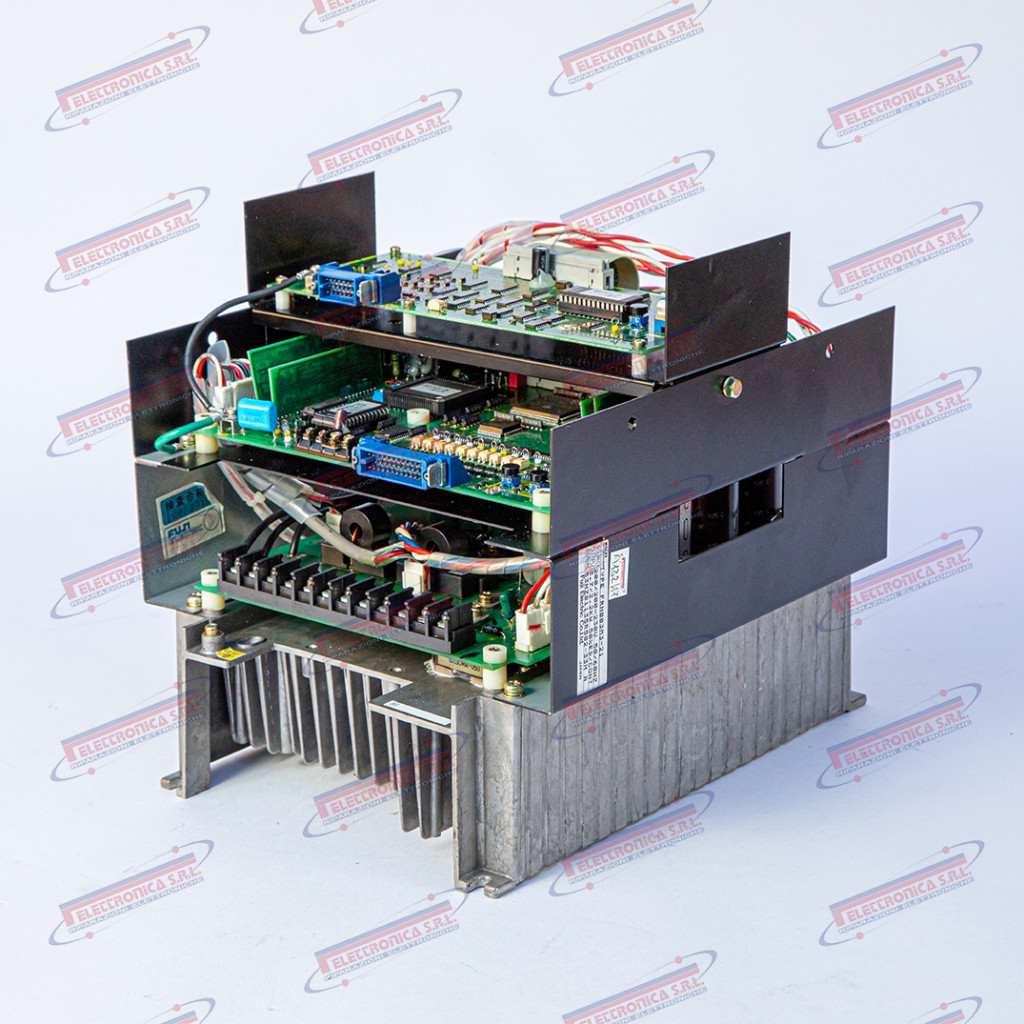
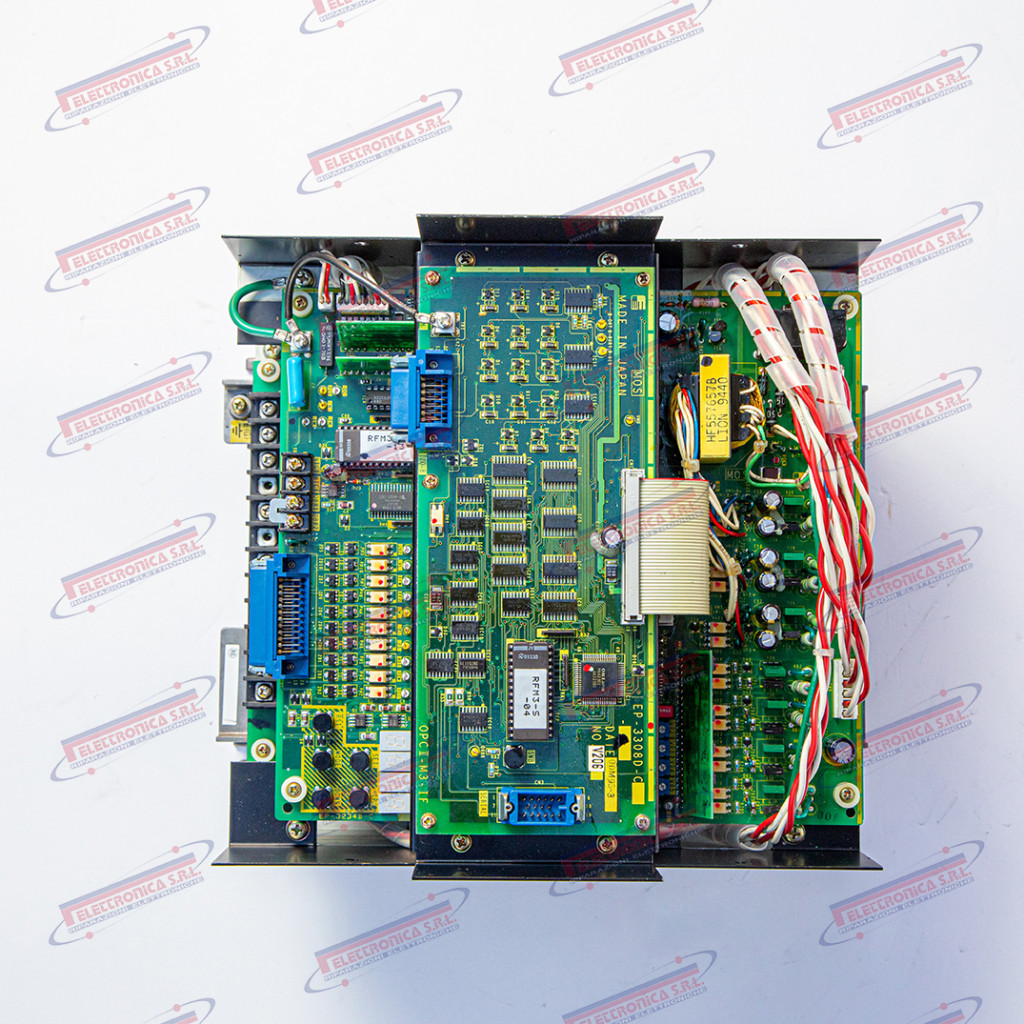
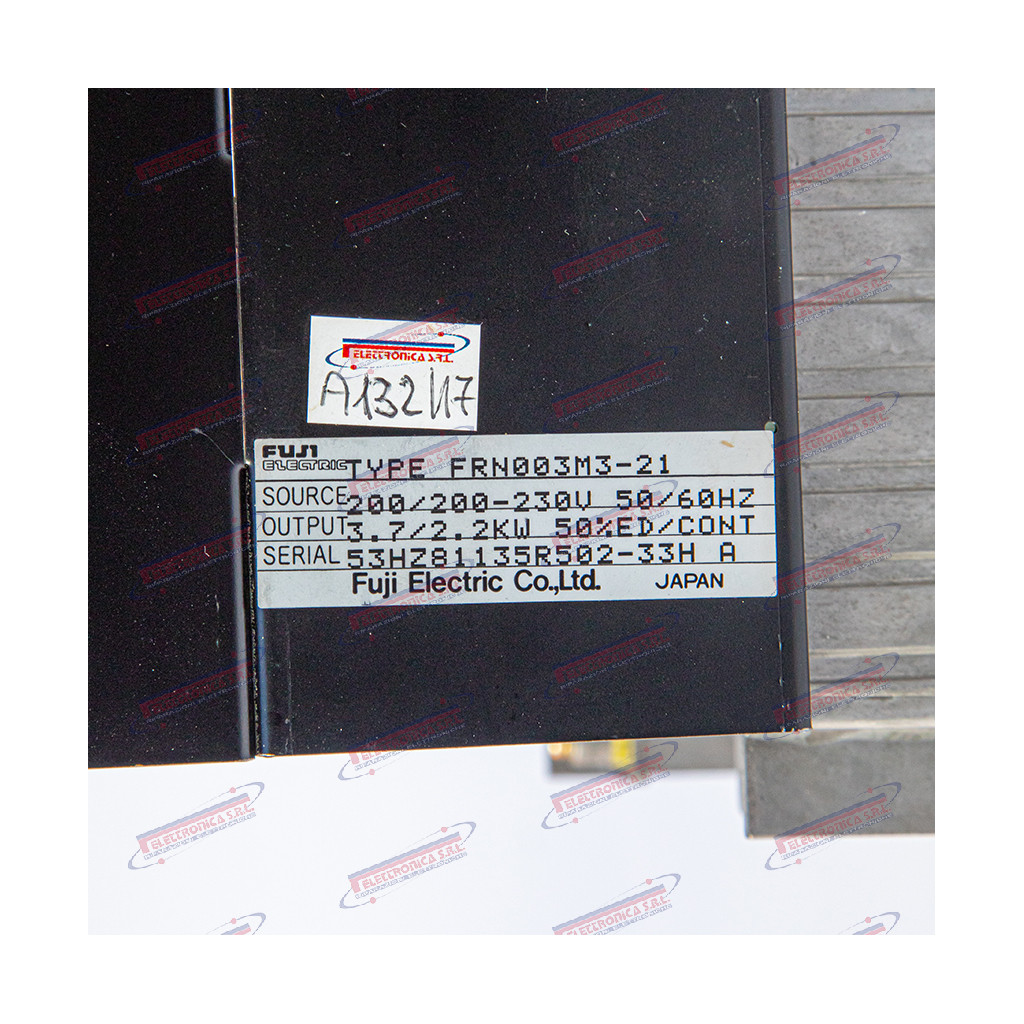
SKU:
FRN003M3-21
Cat:
No Category
Brand:
FUJI
Service
Repair
Exchange service
New Sell
Variable Frequency Drive (Inverter) – FUJI FRN003M3-21
The FRN003M3-21 is a variable frequency drive / inverter (“Variable Frequency Drive” – VFD) belonging to the FRENIC family manufactured by FUJI Electric. The part number identifies a compact frequency converter in the ~0.3–0.4 kW power class, 200 V class, designed for the speed control of three-phase induction motors in industrial applications and CNC machine tools. The unit belongs to one of the historical compact FRENIC series produced by FUJI Electric from the 1990s onward for motion control applications across a wide range of manufacturing sectors.
The frequency inverter converts fixed-frequency mains power into a variable-frequency, variable-amplitude three-phase output, enabling continuous and precise speed regulation of the driven induction motor. In a CNC machine tool it can serve the low-power spindle drive, coolant pump, chip conveyor, or auxiliary axes. A failed inverter immediately halts the controlled function in an uncontrolled manner: without it the motor cannot start or vary its speed, rendering the served machine section completely inoperative.
FUJI Electric Co., Ltd. is a leading Japanese power electronics manufacturer, founded in 1923 as a joint venture between Furukawa Electric and Siemens. The FRENIC inverter family covers power ratings from a few watts to hundreds of kilowatts and is deployed worldwide in CNC, HVAC, and industrial automation applications. Models from the M3 series and contemporaneous variants are to be regarded as legacy / discontinued: available only as used, surplus, or through specialist repair.
Main Technical Specifications
| Type | Frequency inverter / Variable Frequency Drive (VFD) |
| Part number | FRN003M3-21 (FRN003M321) |
| Brand | FUJI Electric – FRENIC series |
| Known application | CNC machine tools; auxiliary motor control, low-power spindle, coolant pump, chip conveyor |
| Function | Three-phase AC induction motor speed control via PWM modulation (V/f and/or sensorless vector) |
| Rated power | ~0.3–0.4 kW |
| Input voltage | Three-phase 200–240 V AC, 50/60 Hz |
| Output voltage | Three-phase 0–240 V AC, PWM modulated |
| Output frequency | 0–400 Hz |
| Rated output current | ~2.5 A |
| Interfaces / connectors | Power terminal block R/S/T (input) – U/V/W (output); control connector for analogue reference (±10 V) and digital I/O |
| Weight | ~0.5–1.5 kg |
| Dimensions | ~100–180 mm (H) × 80–140 mm (W) × 80–120 mm (D) |
| Production status | Legacy / discontinued — used / surplus / repair only |

SKU:
FMD-11AC-21A
Cat:
No Category
Brand:
FUJI
Service
Repair
Exchange service
Refurbished sell
AC Spindle Drive – FUJI FMD-11AC-21A
The FMD-11AC-21A is an AC spindle drive (“AC Spindle Drive”) from the FRENIC 5000M2 series by Fuji Electric. Designed specifically for vector speed and torque control of AC spindle motors on CNC machine tools, it sits between the mains supply and the spindle motor, converting fixed mains voltage into variable voltage and frequency. The prefix FMD identifies the spindle drive family within the FRENIC 5000M2 series; the numeric designation encodes the power class (~11 kW), AC indicates alternating-current technology, and 21A specifies the voltage variant (200 V class) and hardware revision. The unit may exist in multiple revisions and variants; option modules such as serial communication boards, EMI filters and encoder interface cards were available as separate accessories.
The AC spindle drive is the electronic core of the spindle speed control system in the machine tool: it receives the speed reference from the CNC, closes the speed and torque loop via encoder or tachogenerator feedback, and supplies the motor with the power required to hold the programmed speed constant under varying cutting loads. Failure of this unit causes immediate spindle shutdown and total machine downtime: no machining is possible until the drive is replaced or repaired, with consequent production losses and risk of scrapped workpieces.
Fuji Electric is a Japanese industrial group founded in 1923 and a world leader in the design and manufacture of AC/DC drives, inverters and industrial automation systems for precision applications. The FRENIC 5000M2 series belongs to the generation of CNC machine-tool spindle drives from the 1990s–2000s and is now legacy / discontinued: spare units are available only as used, NOS surplus, or through specialist repair centres.
Main Technical Specifications
| Type | AC spindle drive – vector inverter (AC Spindle Drive) |
| Part number | FMD-11AC-21A (FMD11AC21A) |
| Brand | Fuji Electric |
| Series | FRENIC 5000M2 |
| Known application | CNC machine tools with AC spindle motor (vertical/horizontal machining centres, CNC lathes) |
| Function | Vector speed and torque control of AC spindle motor |
| Power class | ~11 kW |
| Input voltage | 3~ 200 V AC ±10%, 50/60 Hz – 200 V class |
| Output voltage | 3~ variable 0–200 V, variable frequency 0–400 Hz |
| Reference input | Analogue ±10 V / 0–10 V; serial RS-232 / RS-422 (optional) |
| Feedback | Incremental encoder / tachogenerator from spindle motor |
| Built-in protections | Overcurrent, overtemperature, undervoltage, overvoltage, earth fault |
| Interfaces / connectors | Power terminal block, edge signal connectors, optional serial port |
| Weight | ~8–15 kg |
| Dimensions | ~300–500 mm × 200–350 mm |
| Production status | Legacy / discontinued — used / surplus / repair only |
SKU:
EP-3358C-C
Cat:
No Category
Brand:
FUJI
Service
Repair
Exchange service
Refurbished sell
Positioning Control Board – FUJI EP-3358C-C
The EP-3358C-C is an electronic positioning control board (“Positioning Control Board”) manufactured by FUJI Electric, designed for use in CNC systems and industrial automation equipment of the same make. The board handles axis position control and feedback processing from encoders or resolvers, interfacing with the servo drives within the same control system. It is not a CPU or generic I/O module, but a dedicated unit for precise machine axis positioning.
The positioning board is the electronic module that closes the position loop in the CNC system: it processes axis encoder feedback signals, calculates position error, and generates correction references for the servo drives. Without it, precise axis positioning is impossible: any machining operation requiring tight geometric tolerances would produce out-of-tolerance parts or risk collisions due to position reference errors.
FUJI Electric is a Japanese manufacturer with over a century of history in industrial electronics, founded in 1923 as a joint venture between Furukawa Electric and Siemens. Specialised in power electronics, drives, CNC systems and factory automation (FA), its product lines include the FRENIC inverter series and Alpha servo systems. Products in the EP-3358C-C family belong to a legacy / discontinued generation of controls and are available only as used units, NOS stock, or through specialist repair services.
Main Technical Specifications
| Type | Positioning control board (Positioning Control Board) |
| Part number | EP-3358C-C (EP3358CC) |
| Brand | FUJI Electric (legacy) |
| Known application | FUJI Electric CNC systems and industrial automation equipment |
| Function | CNC axis positioning control and regulation |
| Feedback | Incremental encoder / resolver (typical FUJI systems) |
| Logic supply voltages | ±15 V and +5 V DC (typical FUJI control boards) |
| Interfaces | Edge / flat cable connectors towards CPU and servo drives |
| Axes managed | ~1–4 axes |
| Weight | ~0.3–0.8 kg |
| Dimensions | ~150–280 mm |
| Production status | Legacy / discontinued — used/surplus/repair only |
SKU:
EP-3308D-C
Cat:
No Category
Brand:
FUJI
Service
Repair
Exchange service
Refurbished sell
Axis Positioning Control Board – FUJI EP-3308D-C
The EP-3308D-C is an electronic axis positioning control board (“Axis Positioning Control Board”) manufactured by FUJI Electric, belonging to the numerical control and industrial automation product family of the same manufacturer. The board processes position commands from the CNC CPU, compares them with axis encoder feedback signals, and calculates the speed reference to be transmitted to the drives. The series identifier EP-3308 designates the board family within FUJI’s positioning control range for this generation; the suffix identifies variant D and revision C.
The axis positioning board is the central element of motion control: it receives position commands from the CNC processor, compares them with the feedback signal (encoder or resolver), and calculates the following error to continuously correct the axis trajectory. Without this board, the CNC system loses complete control of the axes: any movement becomes uncontrolled, with consequent risk of collision, dimensional rejection of the workpiece, or serious mechanical damage to the machine.
FUJI Electric is a Japanese industrial group founded in 1923, with strong specialisation in power electronics, inverters, drives, CNC systems and industrial automation. Historically present in the machine tool market with proprietary axis control systems, the group has progressively oriented its offering towards new-generation integrated solutions. The CNC control modules and boards of this series are legacy / discontinued: available exclusively as used, surplus or through specialist repair.
Main Technical Specifications
| Type | Axis positioning control board (Axis Positioning Control Board) |
| Part number | EP-3308D-C (EP3308DC) |
| Brand | FUJI Electric |
| Known application | FUJI Electric CNC systems and industrial automation; machine tools with FUJI numerical control (machining centres, CNC lathes) |
| Function | Axis position loop closure; encoder/resolver signal processing; following error calculation; speed reference output to drives |
| Variant / Revision | Variant D – Revision C |
| Supported feedback | Incremental encoder / resolver (typical for FUJI systems of this generation) |
| Supply voltages | ±15 V and +5 V DC (typical for FUJI control boards) |
| Interfaces / Connectors | Backplane bus connectors, axis encoder inputs, drive outputs and axis I/O signals (typical for FUJI rack systems) |
| Weight | ~0.2–0.6 kg |
| Dimensions | ~150–280 mm |
| Production status | Legacy / discontinued — used/surplus/repair only |
SKU:
FRN018M3-21
Cat:
Servo Drive
Brand:
FUJI
Service
Repair
Variable Frequency Inverter Drive – FUJI FRN018M3-21
The FRN018M3-21 is a variable frequency inverter drive (“Variable Frequency Drive” – VFD) from the FRENIC® series, manufactured by FUJI Electric. The unit is designed for scalar (V/f) or vector control of three-phase asynchronous motors in industrial applications, and is documented in CNC systems and machine tools as a spindle drive or feed-axis drive. The designation FRN018M3-21 identifies: prefix FRN (FRENIC family), nominal rating 018, series M3 (FRENIC-5000 M, third generation), suffix 21 (voltage/configuration code: 200 V class). The unit may exist in hardware revision variants; optional accessories such as a remote operator panel and EMC filters may not be included in the standard supply.
The variable frequency drive is the component that regulates the rotation speed of an asynchronous motor by continuously varying the supply frequency and voltage: in a CNC machining centre it controls the spindle (cutting speed) or the feed axes (feed rate). Failure of the drive causes the immediate stop of the controlled axis or spindle, rendering the machine completely inoperable until the module is replaced or repaired.
FUJI Electric Co., Ltd. is a Japanese multinational founded in 1923 as a joint venture between Furukawa Electric and Siemens, specialising in electric drives, power components, UPS systems and industrial automation. The FRENIC series is Fuji’s historic line of industrial inverters, evolved from the FRENIC-5000 through to the current FRENIC-Ace and FRENIC-AQUA. All products in the FRENIC-5000 M family are legacy / discontinued: available exclusively as used stock, NOS (new-old-stock) or through specialist repair services.
Main Technical Specifications
| Type | Variable frequency inverter drive (VFD) |
| Part number | FRN018M3-21 (FRN018M321) |
| Brand | FUJI Electric (FRENIC-5000 M series – legacy) |
| Known application | Industrial CNC systems and machine tools (spindle drive / feed-axis drive) |
| Function | Three-phase asynchronous motor speed control via frequency and voltage variation (V/f or vector control) |
| Rated power | ~18 kW |
| Input voltage | ~200 V ±10% |
| Input frequency | 50/60 Hz (typical) |
| Output | Three-phase PWM, variable frequency 0–400 Hz (typical FRENIC-5000 M) |
| Interfaces | Power and control terminal strips; operator panel interface; RS-485/RS-232 (typical) |
| Weight | ~4–10 kg (for 18 kW class) |
| Dimensions | ~200–350 mm H (for 18 kW class) |
| Production status | Legacy / discontinued — used/surplus/repair only |
SKU:
FRN15P11S-2
Cat:
Inverter
Brand:
FUJI
Service
Exchange service
Repair
Refurbished sell
AC Inverter FRENIC 5000P11 15 kW – FUJI FRN15P11S-2
The FRN15P11S-2 is a 15 kW AC variable frequency drive (VFD – “AC Variable Speed Drive”) belonging to the FRENIC 5000P11 series, manufactured by FUJI Electric and rated for the 200 V three-phase voltage class. The unit implements V/f control and, in advanced variants, sensorless vector control of three-phase induction motors. It is documented as a drive component in numerous CNC machining centres and industrial machines from the 1990s and 2000s equipped with FUJI P11-series inverters. The control connector is a standard multi-pin terminal strip compatible with the entire FRENIC 5000P11 product family.
The FRENIC 5000P11 inverter converts mains voltage to variable-frequency AC, enabling precise speed and torque control of the connected induction motor. In a CNC machining centre, its failure renders the controlled axis or spindle inoperative: production stops and no controlled movement is possible. Replacement with a different model requires full parameter reconfiguration and verification of analogue and digital control signal compatibility.
FUJI Electric is a Japanese manufacturer founded in 1923, a world leader in frequency converters, power equipment, and industrial automation systems. The FRENIC 5000P11 series was commercialised from the late 1990s; the model is now classified as legacy / discontinued and is no longer directly supported by the manufacturer: availability is limited to used stock, surplus parts, and specialist repair services.
Main Technical Specifications
| Type | AC variable frequency drive – VFD (Variable Frequency Drive) |
| Part number | FRN15P11S-2 (FRN15P11S2) |
| Brand | FUJI Electric |
| Known application | CNC machining centres and industrial machines from the 1990s–2000s fitted with FUJI P11-series drives; spindle and auxiliary axes |
| Function | Speed and torque control of three-phase induction motor via V/f modulation and sensorless vector control |
| Rated power | 15 kW |
| Input voltage | 3-phase 200–230 V AC ±10%, 50/60 Hz |
| Output voltage | 3-phase 0–240 V AC (proportional to input) |
| Rated output current | ~57–60 A |
| Output frequency | 0.1–120 Hz (configurable up to 400 Hz) |
| Voltage class | 200 V (series code “-2”) |
| Protection degree | IP20 (panel / enclosure mounting) |
| Interfaces / connectors | Multi-pin control terminal strip; analogue inputs ±10 V and 4–20 mA; opto-isolated digital I/O; three-phase power terminal block |
| Weight | ~15–22 kg |
| Dimensions | ~250–310 mm (W) × 420–500 mm (H) × 180–250 mm (D) |
| Production status | Legacy / discontinued — used / surplus / repair only |


SKU:
FRN1.5G9S-2
Cat:
Inverter
Brand:
FUJI
Service
Exchange service
Repair
Refurbished sell
1.5 kW General-Purpose Inverter – FUJI FRN1.5G9S-2
The FRN1.5G9S-2 is a variable frequency drive (VFD) (“Variable Frequency Drive”) from the FRENIC 5000G9S series by FUJI Electric, rated at 1.5 kW with a 200 V class three-phase input. The G9S designation identifies the ninth generation of the General Purpose series; the suffix “2” denotes the 200 V AC voltage class. The unit implements sinusoidal PWM modulation with V/f law and sensorless vector control, and is documented as a drive for three-phase induction motors in machine tool installations, conveyor lines, and CNC auxiliary systems. No significant hardware revisions are known for this power rating; no optional accessories are included as standard.
The inverter regulates the speed and torque of the electric motor by continuously varying the output frequency and voltage: it receives the speed reference from the CNC (analogue ±10 V or digital) and provides controlled acceleration/deceleration ramps, overcurrent protection, and overtemperature protection. A failed inverter causes the controlled motor to stop and prevents restart: on a CNC axis or spindle this results in an immediate machine halt, loss of production, and potential dimensional rejects on the workpiece in progress.
FUJI Electric is a Japanese industrial group founded in 1923, specialising in electric drives, power systems, and factory automation; the brand is globally recognised for the reliability of its inverters in industrial applications. The FRENIC 5000G9S series represents one of FUJI’s general-purpose inverter generations from the 1990s; current FUJI production focuses on the FRENIC-Ace and FRENIC-MEGA families. The FRN1.5G9S-2 belongs to a legacy / discontinued product family: available exclusively as used, NOS (New Old Stock), or through specialist repair services.
Main Technical Specifications
| Type | Variable Frequency Drive (VFD) – General Purpose |
| Part number | FRN1.5G9S-2 (FRN15G9S2) |
| Brand | FUJI Electric – FRENIC 5000G9S series |
| Known application | CNC machine tools, general industrial installations, auxiliary drives (pumps, fans, conveyors) |
| Function | Speed and torque control of three-phase induction motor via variable frequency and voltage |
| Rated power | 1.5 kW |
| Input voltage | Three-phase 200–240 V AC, 50/60 Hz (200 V class) |
| Output voltage/frequency | Three-phase 0–240 V AC, 0–400 Hz |
| Rated output current | ~8 A (typical for 1.5 kW / 200 V) |
| Control method | Sinusoidal PWM; V/f and sensorless vector control |
| Interfaces / inputs | Analogue reference ±10 V; multi-function digital inputs; relay output; RS-485 (optional) |
| Protection rating | IP20 (typical) |
| Weight | ~2.5–4.0 kg |
| Dimensions | ~140 × 260 × 160 mm W × H × D |
| Production status | Legacy / discontinued — used / NOS / repair only |

SKU:
UVR 140D
Cat:
Power Supply
Brand:
HEIDENHAIN
Service
Repair
Exchange service
Refurbished sell
CNC Power Supply Unit – HEIDENHAIN UVR 140D
The UVR 140D is a CNC power supply unit (“CNC Power Supply Unit”) manufactured by HEIDENHAIN, designed to provide the regulated DC voltages required for the operation of HEIDENHAIN CNC control systems. The unit converts the AC mains voltage into one or more stabilised low-voltage DC outputs, powering the control logic, axis boards and peripheral modules of the system. Typically used in HEIDENHAIN TNC series numerical controls from the 1980s and 1990s, including the TNC 150, TNC 155 and contemporary variants.
The power supply unit is the energy core of the CNC system: without stable, regulated voltages the control cannot start up, the axis boards cannot operate and the encoder measurement system loses its reference supply. A power supply failure typically manifests as sudden control shutdown, power error messages or axis position instability, rendering the machine completely unusable until the component is replaced or repaired.
HEIDENHAIN (Johannes Heidenhain GmbH) is a German company founded in 1889 in Traunreut, a world leader in the manufacture of linear and rotary encoders, precision measurement systems and CNC numerical controls for machine tools. Power supply components from the TNC series of the analogue era and early digital systems are today legacy / discontinued: available exclusively as used parts, reconditioned units, or through specialist repair centres.
Main Technical Specifications
| Type | CNC power supply / supply module (CNC Power Supply Unit) |
| Part number | UVR 140D (UVR140D) |
| Brand | HEIDENHAIN (Johannes Heidenhain GmbH) |
| Known application | HEIDENHAIN TNC series CNC controls (1980s–1990s): TNC 150, TNC 155 and contemporary systems |
| Function | Conversion and regulation of supply voltages for the CNC control, axis boards and peripheral modules |
| Input voltage | ~220–240 V AC single-phase or three-phase |
| Output voltages | Multiple stabilised DC outputs: typically +5 V, ±15 V, +24 V |
| Protections | Overvoltage, overcurrent and short-circuit protection (typical) |
| Interfaces / connectors | Edge connectors and terminal strips for integration in CNC cabinet |
| Weight | ~1.0–3.0 kg |
| Dimensions | ~200–380 mm |
| Production status | Legacy / discontinued — used/surplus/repair only |

SKU:
UM 115D
Cat:
No Category
Brand:
HEIDENHAIN
Service
Repair
Exchange service
Refurbished sell
Servo Drive Module – HEIDENHAIN UM 115D
The UM 115D is a servo drive module (“Servo Drive Module” / Umrichter) manufactured by HEIDENHAIN, belonging to the modular drive family for linear and rotary axes in CNC machine tools equipped with HEIDENHAIN TNC controls (e.g. TNC 150, TNC 155, TNC 407/410/415). The catalog code is UM 115D (internal identifier UM115D). The prefix “UM” derives from the German Umrichter (inverter / drive); the suffix “D” identifies a specific variant of the series, likely related to the nominal input supply voltage (~115 V AC) or a design revision. The module fits into the backplane or rack of the control cabinet and receives position/speed references from the CNC via the proprietary HEIDENHAIN bus.
The servo drive is the core of the axis control loop: it receives the position and speed setpoint from the CNC unit, closes the current and velocity loop on the servo motor, and ensures each axis performs movements with the micron-level precision required during machining. A drive failure completely disables the corresponding axis — the machine triggers an alarm, the axis stops responding to commands and the machining cycle cannot continue. Timely replacement or repair is therefore essential to restore production.
HEIDENHAIN is a German company founded in 1889 in Traunreut (Bavaria), a world leader in position measurement technology (optical scales, rotary and angle encoders) and CNC controls of the TNC series. The drive product line has been progressively updated; modules of the UM series belong to a legacy / discontinued generation, no longer supplied directly by HEIDENHAIN but still supported by specialist repair centres and available as used/surplus on the secondary market.
Main Technical Specifications
| Type | Servo drive / CNC axis drive module (Servo Drive Module) |
| Part number | UM 115D (UM115D) |
| Brand | HEIDENHAIN (Dr. Johannes Heidenhain GmbH) |
| Known application | CNC machine tools (milling machines, machining centres) with HEIDENHAIN TNC 150 / TNC 155 / TNC 407–415 control |
| Function | Current, speed and position regulation for linear or rotary axis servo motor |
| Nominal input voltage | ~115 V AC |
| Feedback | HEIDENHAIN encoder / linear scale (1 Vpp or TTL signals) |
| Control interfaces | Proprietary HEIDENHAIN bus to TNC unit; encoder connectors; power terminal strips |
| Output current | ~3–15 A |
| Weight | ~1.0–3.0 kg |
| Dimensions | ~150–300 mm × 100–200 mm |
| Production status | Legacy / discontinued — available as used, surplus or through specialist repair only |

SKU:
UM 112D
Cat:
No Category
Brand:
HEIDENHAIN
Service
Repair
Exchange service
Refurbished sell
Servo Drive Module – HEIDENHAIN UM 112D
The UM 112D is an analogue servo drive amplifier module (“Servo Drive Amplifier Module”) manufactured by HEIDENHAIN, documented as a component of HEIDENHAIN CNC systems based on the TNC series controls (TNC 155, TNC 360, TNC 407 and compatible systems). The module receives an analogue speed reference from the numerical control and drives the axis servo motor, closing the position/speed loop via feedback from a HEIDENHAIN encoder. The UM family covers several current-rating variants; the suffix D identifies the specific revision or sub-variant of this module.
The servo drive module is the electronic heart of the axis regulation loop: it amplifies the CNC reference signal and converts electrical power into torque on the servo motor, ensuring precise positioning and controlled motion dynamics. A failure of the module renders the corresponding axis inoperable, halting the machine and requiring immediate replacement to restore production.
HEIDENHAIN is a German company founded in 1889, a world leader in the production of position measurement systems (linear and rotary encoders), numerical controls (TNC series) and drives for precision machine tools. The UM series modules belong to the analogue-generation HEIDENHAIN drives and are today legacy / discontinued: support is only available through used spare parts or specialist repair services.
Main Technical Specifications
| Type | Analogue servo drive amplifier module |
| Part number | UM 112D (UM112D) |
| Brand | HEIDENHAIN |
| Known application | HEIDENHAIN CNC systems TNC series (TNC 155, TNC 360, TNC 407 and compatible) |
| Function | Current and speed amplification and regulation for axis servo motor |
| Reference input | Analogue speed reference ±10 V DC |
| Feedback | HEIDENHAIN encoder (sinusoidal 1 Vpp or TTL signals) |
| Power supply | DC supply from centralised power unit (typical: 24 V logic, DC power bus) |
| Interfaces | Edge / terminal-strip connectors; HEIDENHAIN encoder interface |
| Form factor | Plug-in module for HEIDENHAIN CNC rack / cabinet |
| Weight | ~0.5–1.5 kg |
| Dimensions | ~150–250 × 100–200 mm |
| Production status | Legacy / discontinued — used/surplus/repair only |

SKU:
UM 111
Cat:
No Category
Brand:
HEIDENHAIN
Service
Repair
Servo Drive Module – HEIDENHAIN UM 111
The UM 111 is a servo drive module (“Servo Drive Module” / Vorschubumrichter) manufactured by HEIDENHAIN, documented as a feed axis drive component for milling machines and machining centres equipped with HEIDENHAIN TNC CNC controls (series TNC 145, TNC 155, TNC 360 and related generations). The module manages the current and speed regulation loops of the DC servo motor, interfacing with the CNC unit via the speed reference bus. It is not a CPU board or I/O module, but a dedicated drive for linear axis control.
The UM 111 is the electronic drive that closes the current and speed loop on the feed axis servo motor: it receives the speed reference from the HEIDENHAIN TNC controller and supplies the motor with precisely controlled current, ensuring accurate positioning and interpolation. In the event of failure, the CNC triggers an axis alarm and the machine stops completely; without this module no programmed feed motion is possible.
HEIDENHAIN (Dr. Johannes Heidenhain GmbH) is a German precision technology manufacturer founded in 1889, headquartered in Traunreut, Bavaria, specialising in linear and rotary encoders, CNC controls (TNC series) and drive systems. The company remains independent and active. Products in the UM series are legacy / discontinued components associated with TNC control generations of the 1980s–1990s, available exclusively as used, surplus, or through specialist repair.
Main Technical Specifications
| Type | DC servo axis drive module (Vorschubumrichter) |
| Part number | UM 111 (UM111) |
| Brand | HEIDENHAIN (Dr. Johannes Heidenhain GmbH) |
| Known application | Milling machines and machining centres with HEIDENHAIN TNC control (TNC 145, TNC 155, TNC 360 and related series) |
| Function | Current and speed regulation of DC servo axis motor; feed axis closed-loop control |
| Power supply | ~200–240 V AC three-phase |
| Reference input | Analogue speed reference ±10 V DC (typical TNC systems) |
| Feedback | Encoder / tachogenerator signal from axis servo motor |
| Interfaces / connectors | Multi-pin connectors on CNC bus; motor power terminal strip |
| Weight | ~1.5–4.0 kg |
| Dimensions | ~150–350 mm |
| Production status | Legacy / discontinued — used/surplus/repair only |

SKU:
UM121B
Cat:
No Category
Brand:
HEIDENHAIN
Service
Repair
2-Axis Control Module – HEIDENHAIN UM121B
The UM121B is a 2-axis control module (“2-Axis Control Module”) manufactured by HEIDENHAIN, a component of the modular CNC control systems of the TNC series (typically TNC 155 / TNC 355 and derivatives). The module manages position and velocity loops for two servo axes, processing incremental encoder signals from HEIDENHAIN encoders and generating torque references to the drive power stages. The “B” variant identifies a specific hardware revision; the module plugs into the CNC chassis via a card-edge connector.
The 2-axis module is the core of the CNC position controller: it acquires real-time feedback from the linear or rotary encoders on both assigned axes and closes the control loop, ensuring that the programmed path is followed with the micron-level precision characteristic of HEIDENHAIN systems. In the event of failure the control immediately raises an alarm and locks the two affected axes: no machining is possible until the module is replaced or repaired, making it a strictly critical component for production continuity.
HEIDENHAIN (Dr. Johannes Heidenhain GmbH) is a German precision technology company founded in 1889, a world leader in linear and rotary encoders, glass scale measurement systems, and CNC controls for high-precision machine tools. The TNC series controls are installed on machining centres, milling machines, and grinding machines worldwide. Modules in the UM family are legacy / discontinued: available only as used, surplus, or through specialist repair services.
Main Technical Specifications
| Type | 2-axis position/velocity control module (2-Axis Control Module) |
| Part number | UM121B (UM 121B) |
| Brand | HEIDENHAIN (Dr. Johannes Heidenhain GmbH) |
| Known application | HEIDENHAIN CNC controls, TNC series (TNC 155, TNC 355 and derivatives) |
| Function | Position and velocity loop closure for 2 servo axes; encoder signal processing; torque reference generation to drives |
| Number of axes | 2 |
| Encoder feedback | HEIDENHAIN incremental encoders (TTL / 1 Vpp signals, typical) |
| Supply voltage | ±15 V and +5 V DC from chassis bus |
| Interfaces / connectors | Card-edge connector for CNC chassis; encoder and drive connectors on front panel |
| Hardware revision | Variant B |
| Weight | ~0.3–0.8 kg |
| Dimensions | ~200–350 mm |
| Production status | Legacy / discontinued — used/surplus/repair only |

SKU:
PL 410B
Cat:
No Category
Brand:
HEIDENHAIN
Service
Exchange service
Refurbished sell
PLC Expansion Board – HEIDENHAIN PL 410B
The PL 410B is a PLC expansion board (“PLC Expansion Board”) manufactured by HEIDENHAIN, designed to extend the digital input/output capabilities of TNC-series CNC controls (typically TNC 360, TNC 415, TNC 425 and compatible variants). The board integrates into the control system via ribbon cable or backplane connector and handles bidirectional digital signals between the control and the machine tool’s peripheral devices: limit switches, proximity sensors, actuators and solenoid valves. The “B” suffix identifies a specific hardware revision of the board.
The PLC expansion board is the physical interface between the HEIDENHAIN control’s PLC program and the machine’s real-world devices: it reads the status of inputs (limit switches, sensors, cycle push-buttons) and switches outputs (relays, valves, indicator lights). If the board fails, the CNC control loses its ability to manage machine logic: axes latch in safe-stop, automatic cycles cannot execute, and PLC alarms render the machine completely inoperable until the module is replaced or repaired.
HEIDENHAIN is a German company founded in 1948, a world leader in linear and rotary encoders, measurement systems and CNC controls for precision machine tools. Remaining independent, it is internationally recognised for the reliability and accuracy of its systems. Modules in the PL 410 series belong to a generation of controls that is now legacy / discontinued: availability is limited to the used market and specialist repair.
Main Technical Specifications
| Type | PLC expansion board (PLC Expansion Board) |
| Part number | PL 410B (PL410B) |
| Brand | HEIDENHAIN |
| Known application | HEIDENHAIN TNC-series CNC controls (TNC 360, TNC 415, TNC 425 and compatible) |
| Function | Digital I/O expansion for machine PLC |
| I/O voltage | 24 V DC (typical for machine tool I/O) |
| Digital I/O channels | 16–32 digital inputs/outputs |
| Interfaces | Ribbon cable / backplane to main control unit; terminal strip on machine side |
| Logic | 24 V DC / TTL compatible (typical HEIDENHAIN TNC) |
| Weight | ~0.2–0.6 kg |
| Dimensions | ~150–260 mm |
| Production status | Legacy / discontinued — used/surplus/repair only |
SKU:
PL 300
Cat:
No Category
Brand:
HEIDENHAIN
Service
Exchange service
Refurbished sell
PLC I/O Board – HEIDENHAIN PL 300
The PL 300 is a PLC input/output expansion board (“PLC I/O Board”) manufactured by HEIDENHAIN, documented as an expansion module for HEIDENHAIN TNC series CNC control systems (e.g. TNC 360, TNC 415, TNC 425). It manages the interface between the CNC control unit and the machine tool’s peripheral devices: limit switches, sensors, solenoid valves, and actuators. It is not a CPU or a drive, but a dedicated PLC I/O expansion module.
The PLC I/O board is the digital bridge between the CNC control and the machine: it acquires input signals from limit switches, pushbuttons, and process sensors, and generates output commands for solenoid valves, relays, lubrication systems, and automatic tool changers. A failure of this module causes partial or total loss of control over machine peripherals, resulting in immediate production downtime and inability to safely execute automatic machining cycles.
HEIDENHAIN (Dr. Johannes Heidenhain GmbH) is a German company founded in 1948 in Traunreut, Bavaria, specializing in precision measurement systems (linear and rotary encoders, digital readouts) and CNC controls for machine tools (TNC series). Remaining family-owned and independent, it is one of the world’s leading manufacturers in the field. The PL 300 module belongs to a legacy / discontinued product family: available only as used, surplus, or through specialist repair.
Main Technical Specifications
| Type | PLC I/O expansion board (PLC I/O Board) |
| Part number | PL 300 (PL300) |
| Brand | HEIDENHAIN (Dr. Johannes Heidenhain GmbH) |
| Known application | HEIDENHAIN TNC series CNC controls (TNC 360, TNC 415, TNC 425) |
| Function | Digital I/O expansion for CNC machine PLC |
| Supply voltage | 24 V DC (typical) |
| Digital inputs | 24 V DC, galvanically isolated |
| Digital outputs | Transistor or relay 24 V DC |
| Interfaces/Connectors | Ribbon cable connector and/or terminal strip for I/O signals |
| Weight | ~0.3–0.8 kg |
| Dimensions | ~150–250 mm |
| Production status | Legacy / discontinued — used/surplus/repair only |

SKU:
BF 370
Cat:
No Category
Brand:
HEIDENHAIN
Service
Repair
Exchange service
Refurbished sell
LCD Operator Panel – HEIDENHAIN BF 370
The BF 370 is an LCD operator panel (“LCD Operator Panel”) manufactured by HEIDENHAIN, designed as a human-machine interface unit for TNC series CNC controls (compatible with TNC 410, TNC 415, TNC 426, TNC 430 and related controllers). It integrates a colour TFT display, a keyboard with function keys, configurable softkeys, a numeric keypad, and axis selection keys, connecting to the CNC control unit via the proprietary HEIDENHAIN cable harness. It does not include an autonomous processing unit: it is a display and data-entry terminal dependent on the main controller.
The operator panel is the primary human-machine interface of the CNC machining centre: it displays part programs, machining data, diagnostic messages, and graphical tool-path simulations, allowing the operator to input programs, monitor the machining cycle, and set tool offsets. In the event of failure, the machine becomes completely inaccessible for programming and manual operation, making this component a critical production bottleneck.
HEIDENHAIN (Dr. Johannes Heidenhain GmbH) is a German precision technology company founded in 1889, headquartered in Traunreut, Bavaria, specialising in linear and rotary encoders, measuring systems, and CNC controls for machine tools. The TNC series has been the industry reference standard for high-precision milling and machining centre control for decades. Operator panels of the BF generation are now legacy / discontinued: available only as used, surplus, or through specialist repair services.
Main Technical Specifications
| Type | LCD/TFT operator panel (LCD Operator Panel) |
| Part number | BF 370 (BF370) |
| Brand | HEIDENHAIN (Dr. Johannes Heidenhain GmbH) |
| Known application | HEIDENHAIN TNC series CNC controls (TNC 410, TNC 415, TNC 426, TNC 430) |
| Function | Human-machine interface: CNC data display, program entry, machining monitoring |
| Display type | Colour TFT, ~15” |
| Interface | Proprietary HEIDENHAIN cable harness to CNC unit; dedicated panel-mount connectors |
| Power supply | 24 V DC / supplied from CNC unit |
| Softkeys / function keys | Context-sensitive softkeys, axis selection keys, integrated alphanumeric keypad |
| Protection rating | Front panel suitable for workshop environments |
| Weight | ~3–7 kg |
| Dimensions | ~400–520 × 300–420 mm |
| Production status | Legacy / discontinued — used/surplus/repair only |

SKU:
289 133-15
Cat:
No Category
Brand:
HEIDENHAIN
Service
Repair
CNC Power Supply Module – HEIDENHAIN 289 133-15
The 289 133-15 is a power supply module (“Power Supply Unit”) manufactured by HEIDENHAIN, installed inside the cabinet of HEIDENHAIN computerised numerical control systems (TNC series). The unit generates and distributes the regulated DC voltages required by the control logic, encoder interfaces, and auxiliary circuits of the CNC. It is not a drive or a CPU board: its sole function is to power the system electronics. No additional accessories are normally included in the standard supply.
The power supply is the energy core of the control system: it converts mains voltage into regulated DC voltages that are indispensable for the CPU, interfaces, servo drives, and CNC peripherals. A power supply failure causes an immediate and complete machine shutdown; without it no axis can be moved and no program can be executed, resulting in total production stoppage.
HEIDENHAIN (Dr. Johannes Heidenhain GmbH) is a German company founded in 1948 in Traunreut, Bavaria, and a world leader in the manufacture of optical linear and rotary encoders, precision measurement systems, and numerical controls for machine tools (TNC series). Its products are synonymous with extremely high precision and reliability in precision machining. Components from older control generations (TNC 155, TNC 360, TNC 407/410/415/425) are legacy / discontinued and available only as used parts, surplus stock, or through specialist repair.
Main Technical Specifications
| Type | Power supply module for CNC control (Power Supply Unit) |
| Part number | 289 133-15 (28913315) |
| Brand | HEIDENHAIN (Dr. Johannes Heidenhain GmbH) |
| Known application | HEIDENHAIN TNC series CNC control systems (exact application to be verified on machine documentation) |
| Function | Generation and distribution of regulated DC voltages for CNC logic and auxiliary circuits |
| Input voltage | 115 / 230 V AC, 50/60 Hz |
| Output voltages | ±15 V, +5 V, +24 V DC |
| Rated output power | ~50–150 W |
| Interfaces / connectors | Multi-pin connectors to HEIDENHAIN control backplane |
| Weight | ~0.5–1.5 kg |
| Dimensions | ~150–250 mm |
| Production status | Legacy / discontinued — used/surplus/repair only |

SKU:
238 289 01
Cat:
No Category
Brand:
HEIDENHAIN
Service
Repair
Exchange service
Refurbished sell
CNC Electronic Control Board – HEIDENHAIN 238 289 01
The 238 289 01 is an electronic control board (“Electronic Control Board”) manufactured by HEIDENHAIN, a leading German manufacturer of precision measurement and CNC control systems. The component belongs to the internal control electronics family of HEIDENHAIN TNC control systems, designed for signal management and interfacing within the control unit. The part number includes a hardware revision suffix (01) identifying the specific board variant; later revisions may exist. The board is installed in the control’s electronics rack and operates in conjunction with the other cards on the TNC backplane.
HEIDENHAIN TNC internal electronic boards perform essential functions: processing position signals from encoders, managing interpolated axes, interfacing with the power electronics, and handling inter-module communication within the CNC. A failure of this component typically causes a complete or partial control shutdown — unexpected machine stops, loss of position reference, or system errors that make machining impossible until the board is replaced or repaired.
HEIDENHAIN (Dr. Johannes Heidenhain GmbH) is a German company founded in 1948 in Traunreut, Bavaria, specialising in position measurement systems (linear and rotary encoders, optical scales), TNC numerical controls, and precision instrumentation for machine tools. Unlike many competitors, HEIDENHAIN has remained independent and is still active; however, boards in the 238 xxx series belong to control generations that are now legacy / discontinued and are available only as used stock, NOS surplus, or through specialist repair services.
Main Technical Specifications
| Type | CNC electronic control board (Electronic Control Board) |
| Part number | 238 289 01 (23828901) |
| Brand | HEIDENHAIN (Dr. Johannes Heidenhain GmbH) |
| Known application | HEIDENHAIN TNC series CNC control systems (milling machines, machining centres) |
| Function | Position signal processing, axis management and internal CNC system control |
| Hardware revision | 01 (embedded in part number; later revisions may exist) |
| Supply voltages | ±15 V, +5 V DC (typical for HEIDENHAIN TNC internal electronics) |
| Interfaces / connectors | Edge connector on TNC rack backplane; internal Eurocard connectors |
| Construction standard | Eurocard rack-mounted PCB; selected industrial-grade components |
| Weight | ~0.2–0.6 kg |
| Dimensions | ~160–280 mm |
| Production status | Legacy / discontinued — used/surplus/repair only |
SKU:
237 930 01
Cat:
No Category
Brand:
HEIDENHAIN
Service
Exchange service
Refurbished sell
CNC Control Electronic Board – HEIDENHAIN 237 930 01
The 237 930 01 is a CNC control electronic board (“CNC Control Board”) manufactured by HEIDENHAIN, belonging to the component family for TNC numerical control systems in the legacy series. It is designed to operate inside the control cabinet of CNC milling machining centres or equivalent systems equipped with a HEIDENHAIN control. It performs processing, interface, or axis management functions depending on the system in which it is installed; the specific function must be verified in the technical documentation of the reference machine. The component belongs to the historical HEIDENHAIN production line, with no officially documented revisions or variants on the secondary market.
Electronic boards in HEIDENHAIN CNC systems form the processing and interface core of the numerical control: they manage communication between the computing unit, servo drives, position encoders, and operator interface. A failure on this board results in an immediate machine halt, positioning errors, loss of communication with the axes, or inability to start the machining cycle — production downtime that cannot be recovered without replacement or repair of the component.
HEIDENHAIN (Dr. Johannes Heidenhain GmbH) is a German company founded in 1889, a world leader in the production of position measurement systems — linear, rotary and angle encoders — and TNC series CNC numerical controls, used primarily on milling machines, machining centres, and high-precision grinding machines. Products from the TNC 2500 generation and contemporary series are legacy / discontinued: available exclusively as used components, NOS (New Old Stock), or through specialist repair.
Main Technical Specifications
| Type | CNC control electronic board (CNC Control Board) |
| Part number | 237 930 01 (23793001) |
| Brand | HEIDENHAIN (Dr. Johannes Heidenhain GmbH) |
| Known application | HEIDENHAIN TNC series CNC systems (milling machines, machining centres) — verify in machine documentation |
| Function | Processing, interfacing, or axis control within the HEIDENHAIN CNC system |
| Product family | HEIDENHAIN TNC (legacy series) |
| Electrical parameters | 5 V DC / ±12 V DC / ±15 V DC (typical for legacy TNC boards) |
| Interfaces / connectors | PCB / internal HEIDENHAIN bus connectors (type to be verified on machine schematic) |
| Construction standard | Plug-in PCB on rack / eurocard (typical HEIDENHAIN TNC) |
| Compatibility | To be verified against HEIDENHAIN technical documentation or machine spare parts list |
| Weight | ~0.2–0.6 kg |
| Dimensions | ~150–250 mm |
| Production status | Legacy / discontinued — used / NOS / repair only |
SKU:
236 484 10
Cat:
No Category
Brand:
HEIDENHAIN
Service
Repair
Exchange service
Power Supply Unit for CNC Control – HEIDENHAIN 236 484 10
The 236 484 10 is a multi-rail switching power supply unit for CNC control systems (“Power Supply Unit”) manufactured by HEIDENHAIN (Dr. Johannes Heidenhain GmbH, Traunreut, Germany). The module converts mains voltage into stabilised multi-rail DC output (±15 V, +5 V, +24 V typical), distributed to logic boards, encoder interfaces and I/O modules inside the control unit. The part is documented as a component of HEIDENHAIN TNC-series analogue–digital CNC controls (typically TNC 155, TNC 360 and derivatives) and coeval measuring systems and digital readouts. The product belongs to the power supply line from the 1980s–1990s generation; no publicly documented revision variants are known.
The power supply is the energy core of the CNC control: without stable, noise-free supply voltages no logic board, encoder interface or I/O module can operate correctly. A power supply failure typically manifests as a complete control lockout, undiagnosable system errors, spontaneous resets or corrupted measurement data. Replacement with a genuine HEIDENHAIN module is the only intervention that guarantees full restoration of machine functionality.
HEIDENHAIN (Dr. Johannes Heidenhain GmbH) is a German company founded in 1948 in Traunreut (Bavaria), a world leader in precision measurement systems (linear encoders, rotary encoders, optical measuring scales) and TNC-series CNC controls, the de facto standard for precision milling and grinding. All products belonging to this generation are legacy / discontinued: no longer available new from the manufacturer and sourced exclusively as used stock, NOS (new old stock) or through specialist repair services.
Main Technical Specifications
| Type | Multi-rail switching power supply unit for CNC control (Power Supply Unit) |
| Part number | 236 484 10 (23648410) |
| Brand | HEIDENHAIN – Dr. Johannes Heidenhain GmbH, Traunreut (DE) |
| Known application | HEIDENHAIN TNC-series CNC controls (TNC 155, TNC 360 and equivalent); HEIDENHAIN measuring systems and digital readouts of the same generation |
| Function | Multi-rail regulated supply for logic boards, encoder interfaces and I/O modules of the CNC control |
| Input voltage | 220–240 V AC, 50/60 Hz |
| Output voltages | ±15 V DC, +5 V DC, +24 V DC (typical for TNC systems) |
| Topology | Switching (SMPS) – switch-mode power supply |
| Protections | Overvoltage, overcurrent, short-circuit (typical for industrial SMPS) |
| Interfaces / connectors | Edge connectors and/or terminal blocks for integration in HEIDENHAIN CNC cabinet |
| Mounting | Panel or rail mount inside machine electrical cabinet |
| Weight | ~0.5–1.5 kg |
| Dimensions | ~150–260 × 100–160 mm |
| Production status | Legacy / discontinued — available as used stock, NOS or through specialist repair only |
SKU:
236 484 02
Cat:
No Category
Brand:
HEIDENHAIN
Service
Repair
Exchange service
Refurbished sell
Power Supply Unit for CNC Control Systems – HEIDENHAIN 236 484 02
The 236 484 02 is a power supply module for CNC control and position display systems (“Power Supply Unit”) manufactured by HEIDENHAIN, documented as a power supply component for units in the TNC (numerical control) and/or ND (position display) product range. The module converts and regulates the mains voltage, providing the stabilised DC voltages required by the control electronics, encoder modules and logic boards of the system. The suffix -02 identifies the revision or output configuration variant relative to the base article.
The power supply is the critical component that ensures the stability and quality of the electrical energy distributed to all subsystems of the CNC control: from processing logic to encoder and motor interfaces. A power supply failure causes the immediate shutdown of the control unit, resulting in total machine downtime; unregulated or noisy voltages can cause encoder reading errors, loss of position and damage to sensitive downstream circuits.
HEIDENHAIN (“Dr. Johannes Heidenhain GmbH”) is a German company founded in 1948 in Traunreut (Bavaria), a world leader in the manufacture of high-precision linear and rotary encoders, optical scales, TNC-series CNC numerical controls and industrial measurement systems. Still an independent, active company, HEIDENHAIN products are fitted on leading machine tool builders (Hermle, DMG Mori, Deckel Maho, Mikron, etc.). Components belonging to the older TNC and ND series are legacy / discontinued: available only as used, surplus or through specialist repair.
Main Technical Specifications
| Type | Power supply module for CNC control / position display systems (Power Supply Unit) |
| Part number | 236 484 02 (23648402) |
| Brand | HEIDENHAIN (Dr. Johannes Heidenhain GmbH) |
| Known application | HEIDENHAIN TNC-series numerical control systems and/or ND-series position display units |
| Function | Multi-rail stabilised power supply for CNC control electronics, logic boards and encoder modules |
| Input voltage | ~85–264 V AC, 50/60 Hz |
| Output voltages | ±15 V DC, +5 V DC, +24 V DC |
| Nominal power | ~30–100 W |
| Interfaces / connectors | Proprietary HEIDENHAIN edge / terminal connectors (typical for the series) |
| Revision / variant | Revision -02 (second revision or output configuration variant) |
| Weight | ~0.5–1.5 kg |
| Dimensions | ~150–280 mm |
| Production status | Legacy / discontinued — used/surplus/repair only |

SKU:
BC 110B
Cat:
Monitor
Brand:
HEIDENHAIN
Service
Refurbished sell
Exchange service
Repair
14″ Colour CRT Monitor for CNC – HEIDENHAIN BC 110B
The BC 110B is a 14-inch colour CRT monitor (“14-inch Colour CRT Monitor”) manufactured by HEIDENHAIN, designed as the dedicated operator display unit for CNC controls of the TNC series (specifically TNC 426 and TNC 430). The monitor is integrated into the machine tool control cabinet and provides the operator with all machining data, programming graphics and CNC diagnostic screens in real time. It employs CRT (colour cathode ray tube) technology with a resolution typical for this era of 640×480 pixels; it is AC-powered and fitted with proprietary HEIDENHAIN connectors for connection to the control unit.
The monitor is the primary interface between the operator and the CNC: it displays axis coordinates, NC programs, cycle screens and diagnostic pages in real time. A monitor failure renders the machine completely inoperable, since the operator cannot read axis positions, enter tool offset values or interpret active alarms; replacement with an identical or compatible unit is the only fast way to restore production.
HEIDENHAIN is a German company founded in 1889 in Traunreut (Bavaria), world leader in the manufacture of rotary and linear encoders, precision measurement systems and CNC controls for machine tools. The TNC controls are widely used on high-end milling centres, grinding machines and 5-axis machines. The BC 110B belongs to a generation of products now legacy / discontinued: CRT technology has been progressively replaced by flat LCD panels, and working units are available exclusively as used or through specialist repair services.
Main Technical Specifications
| Type | 14″ colour CRT monitor for CNC (14-inch Colour CRT Monitor) |
| Part number | BC 110B (BC110B) |
| Brand | HEIDENHAIN |
| Known application | HEIDENHAIN TNC series CNC controls (TNC 426, TNC 430 and related systems); milling centres and 5-axis machines |
| Function | Operator display: axis coordinates, NC programs, diagnostics, programming graphics |
| Display technology | Colour CRT (cathode ray tube) |
| Screen diagonal | 14″ (approx. 355 mm) |
| Resolution | 640×480 pixels (typical for TNC controls of this generation) |
| Power supply | 230 V AC, 50/60 Hz (typical) |
| Video signal interface | Proprietary HEIDENHAIN connector (analogue RGB or RGBS signal to TNC control unit) |
| Typical power consumption | ~80–120 W |
| Weight | ~12–18 kg |
| Dimensions | ~380×350×420 mm |
| Production status | Legacy / discontinued — used/surplus/repair only |
SKU:
UM 114D
Cat:
Servo Drive
Brand:
HEIDENHAIN
Service
Exchange service
Repair
Servo Drive Module – HEIDENHAIN UM 114D
The UM 114D is an electronic servo drive module (“Servo Drive Module”) manufactured by HEIDENHAIN, designed to regulate axes or spindle within HEIDENHAIN CNC systems. It belongs to the family of power electronics modules used to drive and regulate servo motors (brushless and DC) within the CNC automation chain, interfacing with the main control unit via the proprietary HEIDENHAIN bus. The suffix D identifies a specific variant (e.g. rated voltage configuration or connector layout); the component may be present in different hardware revisions.
The drive module is the core of the axis regulation loop: it receives the position or speed reference from the numerical control and generates the drive current for the servo motor, ensuring positioning accuracy and stable dynamic response during machining. Without it the controlled axis is completely inert and the machine cannot execute any cycle; a fault typically manifests as position alarms, axis drifting, or immediate CNC program halt.
HEIDENHAIN (Dr. Johannes Heidenhain GmbH) is a German company founded in 1948 in Traunreut (Bavaria), a world leader in the production of high-precision linear and rotary measurement systems, TNC numerical controls, and drive modules for precision machine tools. The company remains privately and family-owned. Products in the UM series are legacy / discontinued: available exclusively as used, NOS (new old stock) or through specialist repair.
Main Technical Specifications
| Type | Servo drive module (Servo Drive Module) |
| Part number | UM 114D (UM114D) |
| Brand | HEIDENHAIN (Dr. Johannes Heidenhain GmbH) |
| Known application | HEIDENHAIN CNC systems (TNC series and legacy drives) |
| Function | Closed-loop current and speed regulation for axis/spindle |
| Logic supply | 24 V DC (typical) – verify specific revision documentation |
| Power supply | Three-phase or single-phase AC (typical) – hardware revision dependent |
| Compatible feedback | HEIDENHAIN encoder (linear/rotary), analogue tachogenerator |
| Interfaces / connectors | Proprietary HEIDENHAIN connectors; internal system bus |
| Weight | ~0.5–1.5 kg |
| Dimensions | ~150–280 mm |
| Production status | Legacy / discontinued — used/surplus/repair only |

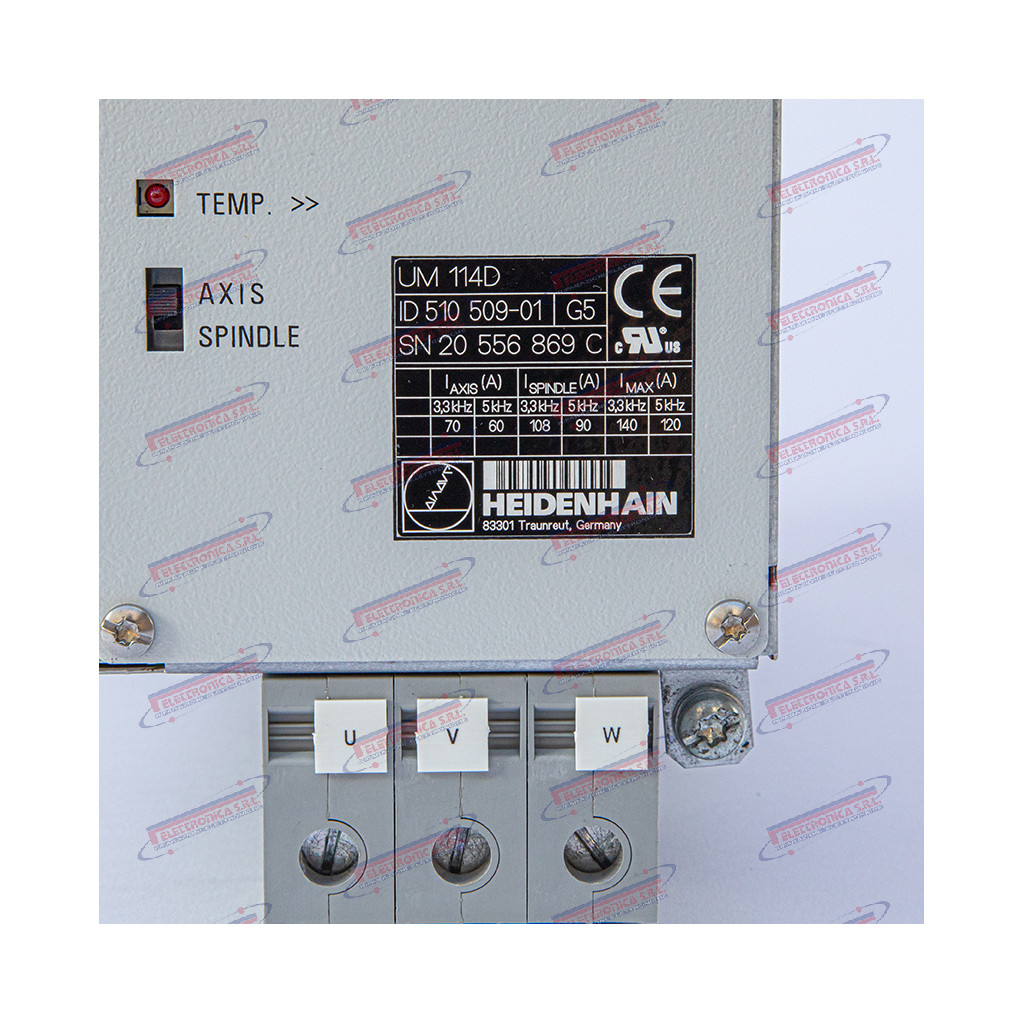
SKU:
UM 114
Cat:
Servo Drive
Brand:
HEIDENHAIN
Service
Exchange service
Repair
Axis Drive Module – HEIDENHAIN UM 114
The UM 114 is an axis servo drive module (“Axis Drive Module”) manufactured by HEIDENHAIN, belonging to the modular drive family integrated into TNC-series CNC systems. The module manages the current and velocity regulation loops for brushless or DC servo motors connected to machine axes, interfacing with the control unit via the proprietary HEIDENHAIN bus. It is compatible with HEIDENHAIN encoders (resolver or incremental/absolute encoder). The commercial part number is UM 114.
The axis drive module is the electronic controller that closes the velocity and current loop on the axis servo motor: it receives the position/speed reference from the CNC unit and generates the current required to move the axis with precision and repeatability. Without it the axis cannot be controlled; any failure immediately halts the machine and makes machining impossible.
HEIDENHAIN is a German company founded in 1889, a world leader in the manufacture of linear and rotary encoders, CNC control systems (TNC series) and drives for high-precision machine tools. Products in the UM family belong to a historical generation of drives: legacy / discontinued, available exclusively as used, surplus or through specialist repair.
Main Technical Specifications
| Type | Axis servo drive module (Axis Drive Module) |
| Part number | UM 114 (UM114) |
| Brand | HEIDENHAIN (Dr. Johannes Heidenhain GmbH) |
| Known application | HEIDENHAIN TNC-series CNC systems (milling machines, machining centres, CNC grinders) |
| Function | Axis servo motor current and velocity regulation; control loop closure |
| Supply voltage | ~200–240 V AC, three-phase |
| Feedback | HEIDENHAIN incremental/absolute encoder or resolver |
| Control interface | Proprietary HEIDENHAIN bus; multi-pin / edge connectors |
| Output current | ~5–15 A |
| Weight | ~0.5–1.5 kg |
| Dimensions | ~150–250 mm |
| Production status | Legacy / discontinued — used/surplus/repair only |


SKU:
UE 211B
Cat:
Servo Drive
Brand:
HEIDENHAIN
Service
Exchange service
Repair
Servo Axis Drive Module – HEIDENHAIN UE 211B
The UE 211B is a servo axis drive module (“Servo Axis Drive Module”) manufactured by HEIDENHAIN, belonging to the family of compact drive units designed for use with HEIDENHAIN TNC CNC controls (documented on TNC 155, TNC 355 systems and compatible variants). The module manages the current and speed regulation of a machine axis servo motor, interfacing with the CNC unit via HEIDENHAIN’s proprietary bus. The designation UE 211B identifies revision B of the 211 series; the unit is typically mounted inside the control cabinet or the machine’s drive assembly.
The servo axis drive module is the component that converts position and speed references from the CNC into drive current for the servo motor: it closes the current loop and contributes to the speed loop, ensuring the dynamic response required for precision machining. If it fails, the controlled axis becomes inoperative and the machine cannot perform any operations; replacement with an identical unit is often the only rapid solution, as these modules are not interchangeable with units of different series.
HEIDENHAIN is a German family-owned company founded in 1889, headquartered in Traunreut (Bavaria), and a world leader in the manufacture of linear and angular measurement systems, rotary encoders, and high-precision CNC controls for machine tools. The UE series modules belong to a legacy generation of drives: legacy / discontinued, available exclusively through the used market, industrial surplus, or specialist repair services.
Main Technical Specifications
| Type | Servo axis drive module |
| Part number | UE 211B (UE211B) |
| Brand | HEIDENHAIN |
| Known application | CNC machine tools with HEIDENHAIN TNC control (TNC 155, TNC 355 and compatible variants) |
| Function | Servo motor current and speed regulation for axis drive |
| Supply | ~24 V DC logic; DC bus from centralised power supply module |
| Rated power | ~1–3 kW |
| Interfaces | Proprietary HEIDENHAIN bus; multi-pin connectors for motor and encoder feedback signals |
| Weight | ~0.8–2.0 kg |
| Dimensions | ~200–300 × 100–150 mm |
| Production status | Legacy / discontinued — used/surplus/repair only |


SKU:
289 133-13
Cat:
Power Supply
Brand:
HEIDENHAIN
Service
Repair
CNC Switching Power Supply Unit – HEIDENHAIN 289 133-13
The 289 133-13 is a switching power supply unit for CNC systems (“Power Supply Unit”) manufactured by HEIDENHAIN, designed to power the logic boards, interface modules, and internal peripherals of TNC-series numeric controls (documented on systems such as TNC 155, TNC 360, and related models). The unit generates the regulated DC voltages required for the control electronics: typically +5 V, ±12 V, and +24 V DC. The alternative part number is listed exclusively in the technical specifications table.
The power supply unit is the energy core of the numeric control: it converts mains voltage into stabilised and filtered voltages indispensable for the CPU, axis boards, I/O modules, and encoders. A power supply failure causes an immediate and total machine shutdown — the CNC will not start, communication with the drives ceases, and any active machining operation is abruptly interrupted, risking part rejection and, in some cases, damage to tooling or the worktable.
HEIDENHAIN is a German manufacturer founded in 1948, a world leader in the production of linear and rotary encoders, scale-based measurement systems, and high-precision numeric controls for machine tools. TNC-series controls are widely deployed on milling machines, machining centres, and precision grinding machines. Internal components for older TNC series are legacy / discontinued: available only as used spares, NOS surplus, or through specialist repair services.
Main Technical Specifications
| Type | Switching power supply unit for CNC numeric control (Power Supply Unit) |
| Part number | 289 133-13 (28913313) |
| Brand | HEIDENHAIN (Dr. Johannes Heidenhain GmbH) |
| Known application | HEIDENHAIN TNC-series numeric controls (TNC 155, TNC 360, and related); CNC milling machines and machining centres |
| Function | Conversion and regulation of supply voltages for CPU, axis boards, I/O modules, and encoder interfaces |
| Input voltage | 115 / 230 V AC, 50–60 Hz |
| Output voltages | +5 V DC, ±12 V DC, +24 V DC |
| Output power | ~50–150 W |
| Interfaces / connectors | Edge connectors / internal terminal strip on TNC rack backplane |
| Protections | Overload, short-circuit, over-temperature (typical for industrial switching PSU) |
| Weight | ~0.8–2.0 kg |
| Dimensions | ~150–280 mm |
| Production status | Legacy / discontinued — used / surplus / repair only |


SKU:
CD1472D1M
Cat:
Monitor
Brand:
HITACHI
Service
Repair
Exchange service
Refurbished sell
14” Colour Industrial CNC Monitor – Hitachi CD1472D1M
The CD1472D1M is a 14” industrial colour CRT monitor (“14-inch Colour CRT Monitor”) manufactured by Hitachi, used as the operator display unit in CNC machine tools from the 1980s through to the early 2000s. It employs colour CRT (cathode ray tube) technology with analogue RGB or TTL RGB video input depending on the variant. The suffix “D1M” identifies the variant with connector type and sync parameters optimised for integration with the numerical control systems of the period. It was adopted as a qualified standard by numerous CNC machine tool OEMs — including machining centres and CNC lathes equipped with Fanuc, Mitsubishi and Mazak controls — that sourced Hitachi monitors as a preferred supplier.
The monitor is the primary visual interface between the operator and the numerical control unit: it displays NC programs, axis positions, alarm messages and configuration menus in real time. A monitor failure — blank screen, distorted geometry, colour loss, horizontal lines or an unstable image — makes it impossible to read any machine parameter and effectively halts production: without visibility of the CNC panel the operator cannot start machining cycles, apply tool offsets or acknowledge alarms.
Hitachi is a Japanese industrial conglomerate founded in 1910, historically active in industrial electronics, professional displays and factory automation. Hitachi CRT monitors for CNC were widely adopted by Japanese and European OEMs throughout the 1980s and 1990s, valued for their proven reliability and long service life. All CRT products in this family are legacy / discontinued: no longer available new and obtainable only as used, surplus or through specialist repair services.
Main Technical Specifications
| Type | 14” industrial colour CRT monitor |
| Part number | CD1472D1M |
| Brand | Hitachi |
| Known application | CNC machine tools — operator station; compatible with Fanuc, Mitsubishi, Mazak and other OEMs using Hitachi monitors as standard |
| Function | CNC operator interface display: NC programs, axis readouts, alarms, parameter menus |
| Display technology | Colour CRT (cathode ray tube) |
| Screen diagonal | 14” (355 mm nominal) |
| Resolution | ~640×480 pixels (VGA) or OEM CNC proprietary resolution |
| Video input | Analogue RGB and/or TTL RGB; BNC multi-connector or 15-pin Sub-D |
| Horizontal frequency | ~15.6–31.5 kHz |
| Power supply | 100–240 V AC, 50/60 Hz |
| Weight | ~12–18 kg |
| Dimensions | ~370×390×420 mm W×H×D |
| Production status | Legacy / discontinued — used/surplus/repair only |
SKU:
EVS9324-ESV004
Cat:
No Category
Brand:
LENZE
Service
Repair
Exchange service
AC Servo Inverter – LENZE EVS9324-ESV004
The EVS9324-ESV004 is an AC servo inverter (“AC Servo Drive”) from the 9300 series by LENZE, designed for field-oriented vector control of AC synchronous/brushless servo motors in CNC and industrial automation applications. The part number identifies a unit from the EVS9300 family with integrated EMC filter (suffix E), in hardware/software variant SV004. The series is documented on CNC machining centres, CNC lathes, packaging machinery and multi-axis motion control systems. The drive provides precise speed and torque control of the servo motor via incremental encoder or resolver feedback. Multiple variants exist within the EVS9300 series, differentiated by power rating and fieldbus communication options.
The servo inverter is the core of the drive chain on a CNC axis: it converts mains voltage into variable voltage and current for the motor, executing real-time field-oriented control (FOC – Field Oriented Control) based on the CNC command and the encoder feedback signal. A servo inverter failure completely disables the controlled axis — the machine can neither position nor interpolate that axis, making any machining operation impossible until the unit is replaced or repaired.
LENZE is a German manufacturer founded in 1947, specialising in electric drives, inverters, gear motors, and automation systems for industrial machinery; the group has remained independent and is still active, headquartered in Aerzen, Germany. The EVS9300 series, introduced in the 1990s, was one of the most widely deployed servo drive families in European CNC and packaging applications; the entire product line is now legacy / discontinued, having been replaced by the i550 and i650 platforms.
Main Technical Specifications
| Type | AC Servo Inverter — AC Servo Drive (EVS9300 series) |
| Part number | EVS9324-ESV004 (EVS9324ESV004) |
| Brand | LENZE (Lenze SE, Germany) |
| Known application | CNC machining centres, CNC lathes, packaging machines, multi-axis motion control systems |
| Function | Field-oriented vector control of AC servo motor speed and torque (FOC) |
| Nominal power | ~3.0 kW |
| Input voltage | 3 × 400 V AC, 50/60 Hz (typical) |
| Nominal output current | ~8 A |
| Control method | Field-oriented vector control (FOC) – PWM modulation |
| Encoder interface | Incremental encoder / resolver (TTL); Sub-D connector |
| Communication interfaces | RS-232 / RS-485; optional PROFIBUS-DP, CANopen, DeviceNet (add-on modules) |
| Weight | ~2–4 kg |
| Dimensions | ~270–350 × 70–110 × 200–260 mm H×W×D |
| Production status | Legacy / discontinued — used/surplus/repair only |
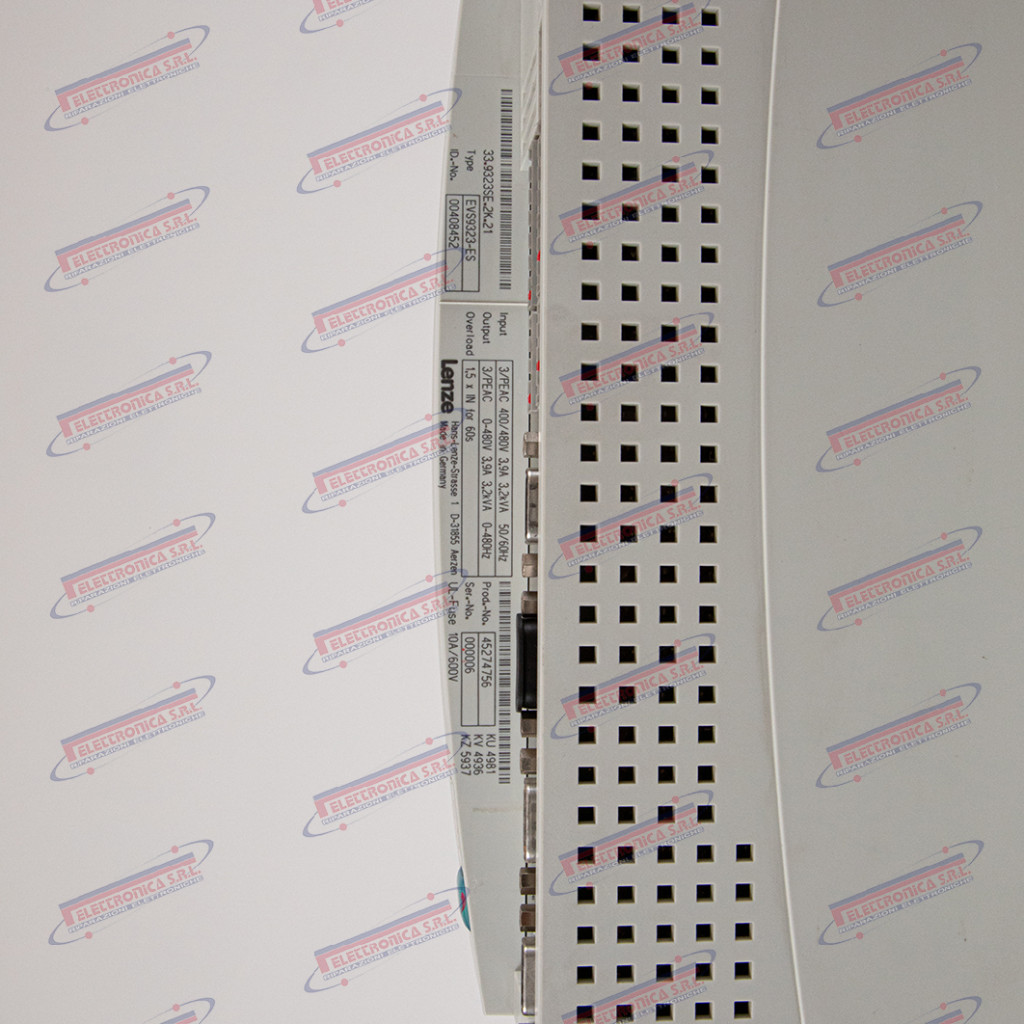
SKU:
EVS9323-ES
Cat:
No Category
Brand:
LENZE
Service
Repair
Exchange service
AC Servo Inverter – LENZE EVS9323-ES
The EVS9323-ES is an AC servo inverter (“AC Servo Inverter”) from the 9300 series manufactured by Lenze, designed for field-oriented vector control of synchronous and asynchronous AC servo motors in industrial automation and CNC machine tool applications. The unit implements PWM modulation with high-dynamic speed and torque regulation; the ES variant identifies a specific functional and communication configuration within the EVS9300 family. The device supports feedback via incremental encoder or resolver and fieldbus protocols for seamless integration into the machine control system.
The EVS9323-ES is the axis controller that receives the position or speed reference from the CNC and generates the output voltage and frequency required to drive the motor with micrometric precision in both speed and torque. A failure of this component renders the controlled axis completely inoperative: the machine stops on alarm, the current machining operation must be aborted with the consequent risk of scrapping the workpiece in progress, and recovery requires replacement or repair of the module before the production cycle can be restarted.
Lenze SE is a German company headquartered in Aerzen (Lower Saxony), founded in 1947 and specialised in drive and industrial automation technology: frequency inverters, servo drives, gearboxes and control systems for the manufacturing industry. The EVS9300 series has been progressively superseded by next-generation platforms (including the i700 series); products in the EVS9300 family are now considered legacy / discontinued and available exclusively as used spare parts, NOS surplus or through specialist repair services.
Main Technical Specifications
| Type | Three-phase AC servo inverter – AC Servo Inverter (9300 series) |
| Part number | EVS9323-ES (EVS9323ES) |
| Brand | Lenze (Lenze SE, Germany) |
| Series | EVS9300 – Single-axis servo inverter |
| Known application | CNC machine tools, industrial automation systems with synchronous and asynchronous AC servo motors |
| Function | Field-oriented vector control (FOC) of speed and torque on synchronous / asynchronous AC servo motor |
| Input voltage | 3×400 V AC ±10 %, 50/60 Hz |
| Rated power | ~4–7.5 kW |
| Control type | Field-oriented vector control (FOC) with PWM modulation; position, speed and current loops |
| Feedback | Incremental encoder (TTL/HTL) or resolver; sin/cos support (typical 9300 series) |
| Communication interfaces | CANopen / LECOM / optional fieldbus (depending on ES variant) |
| Digital / analogue I/O | Digital and analogue inputs/outputs for enable, alarm and speed reference (typical 9300 series) |
| Weight | ~3–7 kg |
| Dimensions | ~200–400 mm × 100–250 mm |
| Production status | Legacy / discontinued — used/surplus/repair only |
SKU:
LDS-3WAS
Cat:
No Category
Brand:
MAZAK
Service
Repair
Exchange service
Industrial CNC Floppy Disk Drive – LAND LDS-3WAS
The LDS-3WAS is an industrial 3.5” floppy disk drive (“Industrial Floppy Disk Drive”) manufactured by LAND, designed specifically for use on computer numerical control machines. The unit supports standard DD (720 KB) and HD (1.44 MB) formats and is equipped with a 34-pin interface compatible with the conventional floppy bus adopted by major CNC manufacturers. The device is conceived as a direct drop-in replacement for the original floppy units installed in CNC control panels of the 1980s–1990s–2000s generations.
The floppy disk drive is the mass storage device that enables part program transfer (ISO/DIN files) to and from the numerical controller, as well as the saving and restoration of machine parameters, tool offsets, and configuration data. A drive failure prevents loading new programs and backing up critical data, halting production or exposing the machine to the risk of irreversible configuration loss in the event of work on the controller.
LAND is a manufacturer specialising in floppy disk units and storage peripherals for industrial applications, with a catalogue focused on the CNC, metrology and factory automation sectors. The LDS product range is designed as direct drop-in replacements for original units fitted by manufacturers such as Fanuc, Siemens, Mitsubishi and Yasnac. This product type is legacy / discontinued in its original magnetic floppy versions; units are now found mainly as used/surplus stock or replaced by drop-in USB emulators.
Main Technical Specifications
| Type | Industrial 3.5” floppy disk drive for CNC |
| Part number | LDS-3WAS (LDS3WAS) |
| Brand | LAND |
| Known application | Various CNC machines (machining centres, lathes, milling machines) – compatible with Fanuc, Siemens, Mitsubishi, Yasnac and other systems with standard floppy bus |
| Function | Reading and writing CN part programs (ISO/DIN), machine parameter and tool offset backup and restore |
| Disk format | 3.5” – DD 720 KB and HD 1.44 MB |
| Interface | Standard 34-pin floppy connector |
| Power supply | +5 V DC |
| Disk rotation speed | 300 RPM (standard 3.5” floppy) |
| Weight | ~0.3–0.5 kg |
| Dimensions | ~101 × 42 × 146 mm (standard 3.5” half-height) |
| Production status | Legacy / discontinued — available as used/surplus; USB emulator replacement recommended |
SKU:
D72JV007910
Cat:
No Category
Brand:
MAZAK
Service
Repair
Servo Axis Drive Module – MAZAK D72JV007910
The D72JV007910 is an electronic servo axis drive module (“Servo Axis Drive Unit”) manufactured by MAZAK (Yamazaki Mazak Corporation), used in CNC machining centres and lathes equipped with the proprietary MAZATROL control system. The module manages the position, speed and current regulation loops of the servo axis motor, interfacing with the machine’s CN board and with the motor via encoder or resolver. The factory part number D72JV007910 uniquely identifies this unit within the MAZAK spare-parts architecture; no distinct alternative part number is documented.
The servo axis drive module is the electronic core that converts position commands issued by the CNC into precise phase currents for the servo motor: it manages the current loop, speed loop and position loop in real time, ensuring dimensional accuracy and repeatability of axis movements. A failure in this component completely locks the controlled axis, making the machine inoperable; partial degradation causes oscillations, dimensional errors and drive alarms on the MAZATROL panel.
Yamazaki Mazak Corporation, founded in Japan in 1919 and headquartered in Oguchi (Aichi Prefecture), is one of the world’s largest manufacturers of CNC machine tools: vertical and horizontal machining centres, multitasking turning centres and FMS systems. The MAZATROL control system is developed in-house and defines the entire product range. Electronic components of the D72JV series belong to control generations no longer in production: legacy / discontinued, available exclusively as used, surplus or through specialist repair centres.
Main Technical Specifications
| Type | Servo axis drive module (Servo Axis Drive Unit) |
| Part number | D72JV007910 |
| Brand | MAZAK – Yamazaki Mazak Corporation |
| Known application | MAZAK CNC machining centres and lathes with MAZATROL control (D72JV-compatible series) |
| Function | Servo axis motor position, speed and current regulation |
| Speed reference | MAZATROL digital serial bus / analogue signal ±10 V (typical) |
| Feedback | Incremental encoder or resolver from servo axis motor |
| Supply voltages | 200–240 V AC three-phase / internal DC bus (typical MAZAK installation) |
| Logic supply voltages | ±15 V and +5 V DC (typical) |
| Interfaces / connectors | Edge and comb connectors for CN bus, encoder feedback, power supply and motor output |
| Weight | ~1.0–3.0 kg |
| Dimensions | ~150–350 mm |
| Production status | Legacy / discontinued — used / surplus / repair only |
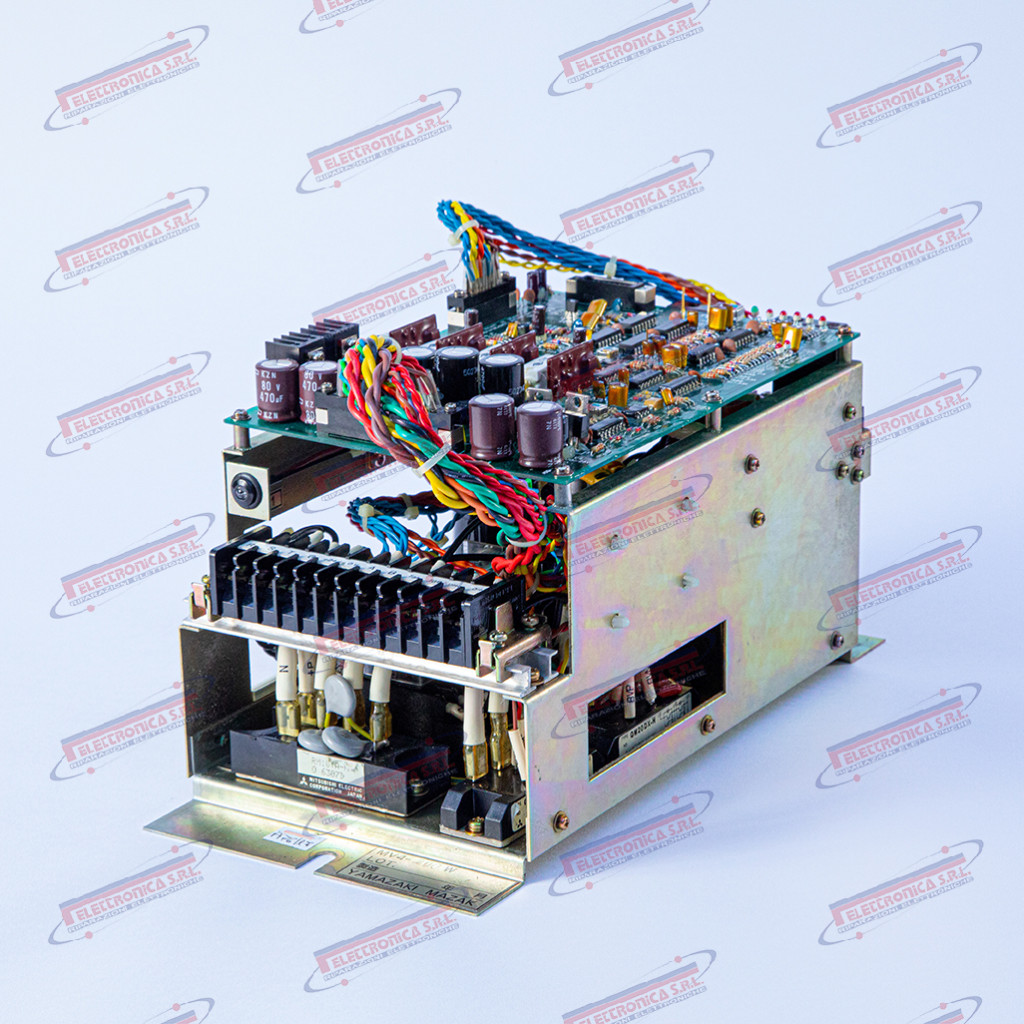
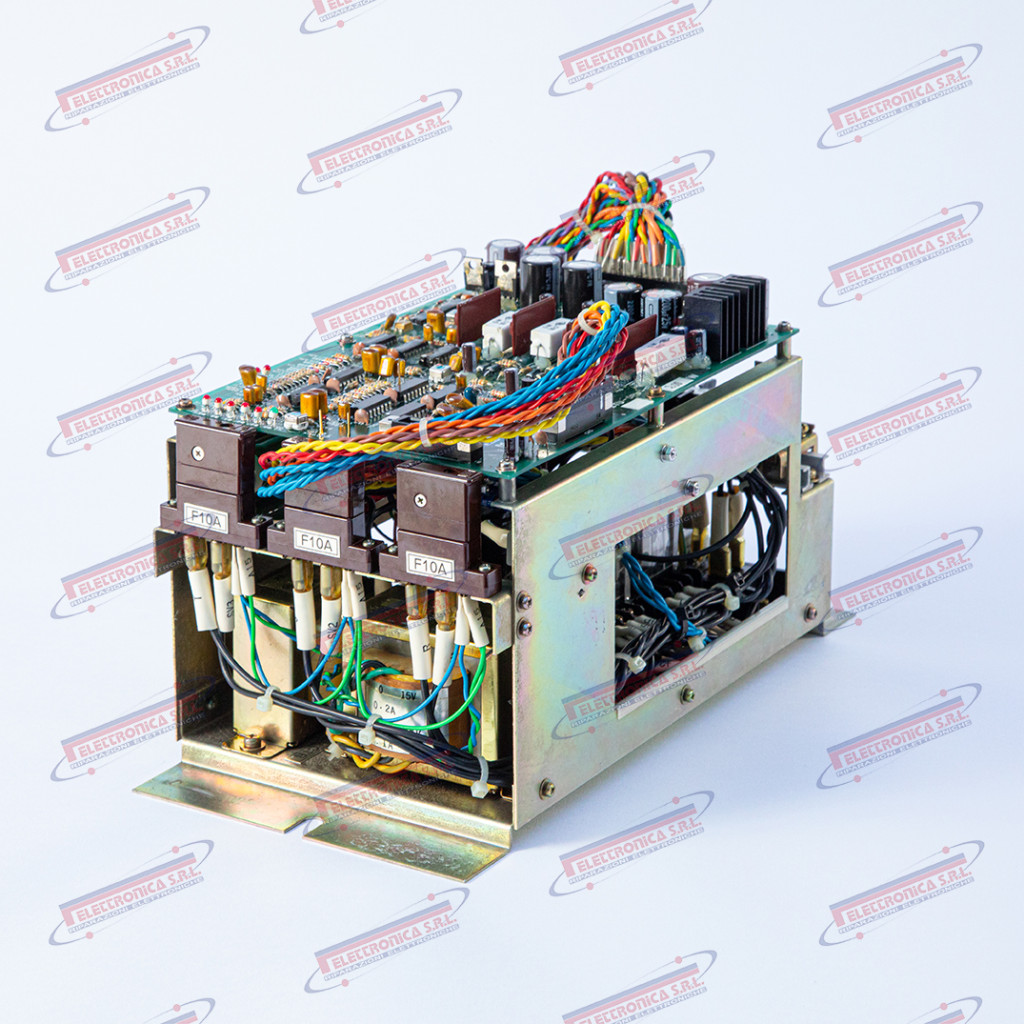
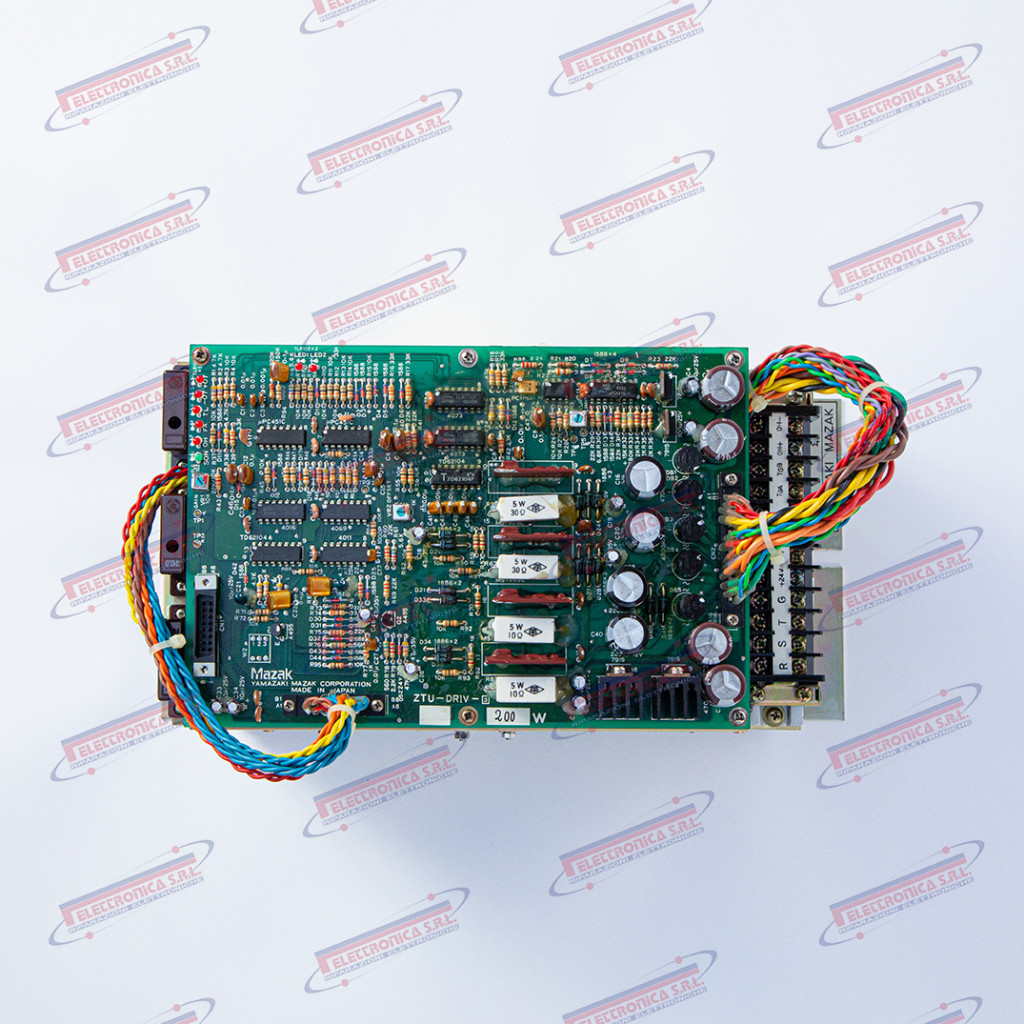
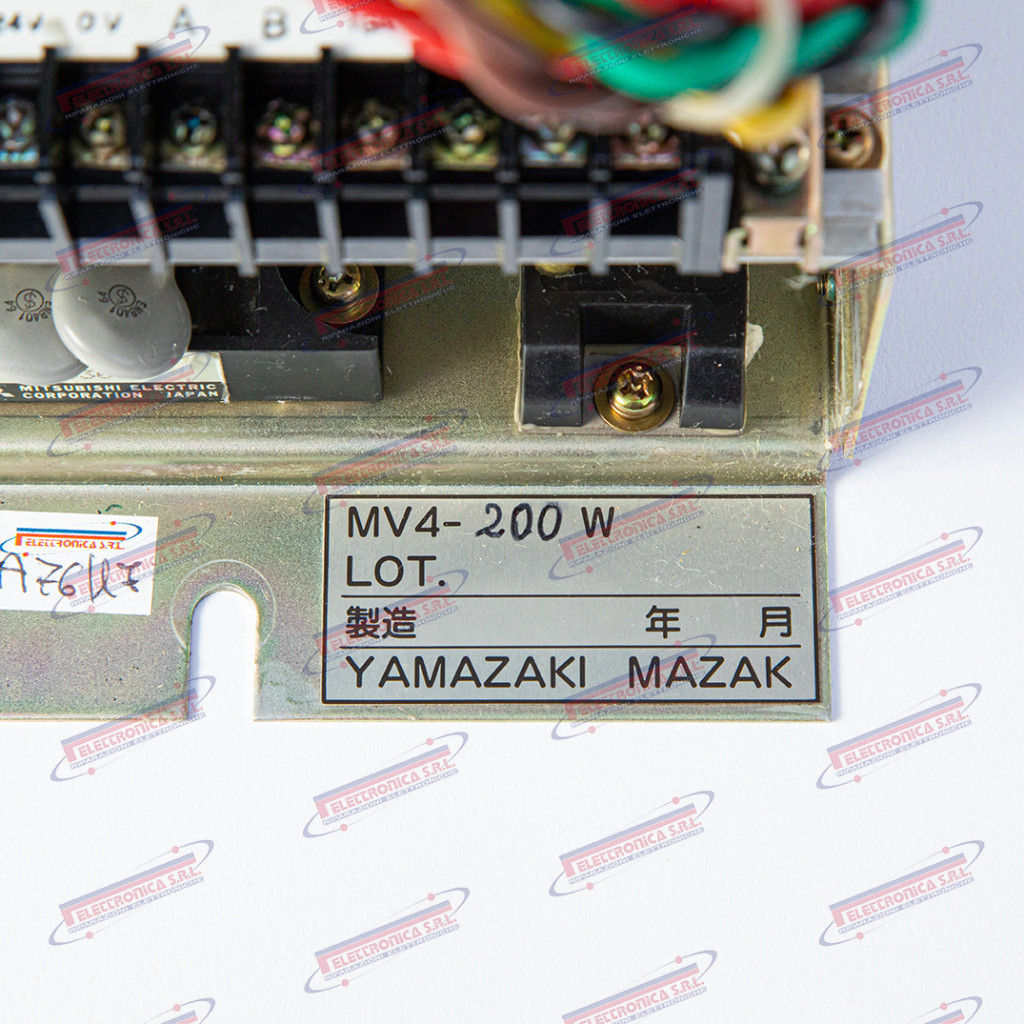
SKU:
MV4-200 W
Cat:
Servo Drive
Brand:
MAZAK
Service
Exchange service
Repair
CNC Servo Drive – MAZAK MV4-200 W
The MV4-200 W is an electronic servo drive module for CNC control (“Servo Drive / Servo Amplifier”) manufactured by Mazak (Yamazaki Mazak Co., Ltd.), documented as the axis motion power amplifier in CNC vertical machining centres of the MV series (specifically the MV-4) equipped with the Mazatrol CNC control. The module integrates power amplification and speed/current regulation functions for the axis servo motor, interfacing with the Mazatrol CNC unit via a dedicated bus. The designation “200 W” denotes the nominal output power rating to the servo motor.
The servo drive is the electronic component that receives position and speed commands from the Mazatrol CNC unit and converts them into power current for the axis servo motor: it closes the position, speed, and current control loops, ensuring precision and repeatability in the machine’s movements. A drive failure causes immediate axis lock, a CNC alarm, and prevents any machining operation until the module is replaced or repaired.
Yamazaki Mazak Co., Ltd. is one of the world’s leading CNC machine tool manufacturers, founded in 1919 in Oguchi, Japan; it produces machining centres, CNC lathes, laser systems, and the proprietary Mazatrol numerical control. Components from the MV series of the 1980s–1990s are legacy / discontinued: availability is limited to the used market, NOS surplus stock, or through specialist repair services.
Main Technical Specifications
| Type | CNC servo drive – Axis power amplifier module (Servo Drive / Servo Amplifier) |
| Part number | MV4-200 W (MV4200W) |
| Brand | Mazak – Yamazaki Mazak Co., Ltd. |
| Known application | CNC vertical machining centre Mazak MV series (MV-4 and compatibles), Mazatrol control |
| Function | Power amplification and speed/current regulation for CNC axis servo motor |
| Rated power | ~200 W (from part number; verify on nameplate) |
| Supply voltage | ~200–230 V AC three-phase |
| Interfaces / Connectors | Dedicated connectors to Mazatrol CNC unit and axis servo motor; power terminal strip |
| CNC system | Mazatrol (T-2, M-2 or compatible variants for the MV series) |
| Weight | ~1–3 kg |
| Dimensions | ~150–300 mm |
| Production status | Legacy / discontinued — available as used, NOS surplus or through specialist repair only |
SKU:
S-25-12
Cat:
No Category
Brand:
MEAN WELL
Service
Repair
Switching Power Supply 25 W 12 V DC – MEAN WELL S-25-12
The S-25-12 is a single output switching power supply 25 W / 12 V DC (“Single Output Switching Power Supply”) manufactured by MEAN WELL. It belongs to the S-25 series, featuring a universal AC input of 85–264 V AC (or 120–370 V DC) and a regulated output of 12 V DC / 2.1 A. It is documented as a component in CNC control cabinets, industrial automation systems, and electronic equipment in general. The unit is fanless (natural convection cooling) and compliant with CE/UL standards. The output voltage is adjustable via an onboard trimmer in the 10–13 V range; no significant revision variants exist in the standard version.
The S-25-12 provides the regulated 12 V DC auxiliary supply required to power logic boards, relays, transducers, displays, and other subsystems inside the CNC control cabinet. A failure results in loss of voltage across all 12 V circuits: the machine stops, drives lose their auxiliary supply, and the CNC cannot complete the enable sequence. In many control cabinets it is a critical, non-redundant component.
MEAN WELL is a Taiwanese switching power supply manufacturer founded in 1982, now one of the world’s leading suppliers with over 10,000 catalog models and worldwide distribution. The S-25 series is actively produced and widely available from major global electronics distributors.
Main Technical Specifications
| Type | Single output switching power supply (Single Output SMPS) |
| Part number | S-25-12 (S2512) |
| Brand | MEAN WELL |
| Known application | CNC control cabinets, industrial automation, electronic equipment |
| Function | Regulated 12 V DC auxiliary supply for logic and control circuits |
| Input voltage | 85–264 V AC / 120–370 V DC (universal) |
| Output voltage | 12 V DC (adjustable 10–13 V via trimmer) |
| Output current | 2.1 A nominal |
| Output power | 25.2 W |
| Efficiency | ~78% (typical at full load) |
| Protections | Over-current, over-voltage, short-circuit |
| Cooling | Natural convection (fanless) |
| Interfaces / connectors | Screw terminal blocks on AC input and DC output side |
| Weight | ~0.2 kg |
| Dimensions | 99 × 82 × 30 mm |
| Production status | Active production — available from stock |
SKU:
PS-25-12
Cat:
No Category
Brand:
MEAN WELL
Service
Repair
Switching Power Supply 25 W / 12 V DC – MEAN WELL PS-25-12
The PS-25-12 is a single-output enclosed switching power supply (“Single Output Switching Power Supply”) rated at 25 W, manufactured by MEAN WELL, with a regulated output of 12 V DC / 2.1 A and universal input 85–264 V AC. It belongs to MEAN WELL’s PS series, designed for industrial applications, CNC control panels, machine tools and automation systems. The internal part number is PS2512. There are no output-voltage variants under this part number: the trailing “12” uniquely identifies the 12 V output version.
The power supply delivers the regulated 12 V DC voltage to logic circuits, relays, sensors and control boards inside the CNC machine’s electrical cabinet. A power supply failure immediately disables all 12 V-powered subsystems: the machine loses control over I/O, safety interlocks and internal communications, making any machining operation impossible until the unit is replaced.
MEAN WELL is a Taiwanese manufacturer founded in 1982 and a world leader in standard switching power supplies. With over 10,000 models in its catalogue, its products are used in industrial automation, machine tools, LED lighting and distributed control systems. The PS series is legacy / discontinued: it has been superseded by newer series (RS, MDR, HDR), but remains widely available as used or surplus stock.
Main Technical Specifications
| Type | Single-output enclosed switching power supply |
| Part number | PS-25-12 (PS2512) |
| Brand | MEAN WELL |
| Known application | CNC panels, machine tools, industrial automation, electrical control cabinets |
| Function | Regulated 12 V DC supply for logic circuits, relays, sensors and control boards |
| Input voltage | 85–264 V AC / 120–373 V DC (universal input) |
| Output voltage | 12 V DC (±2%) |
| Output current | 2.1 A max |
| Output power | 25 W |
| Efficiency | ~77% |
| Protections | Short circuit, overload, overvoltage |
| Interfaces / connectors | Screw terminals (AC input, DC output); free-standing or panel mount |
| Weight | ~0.27 kg |
| Dimensions | 99 × 82 × 36 mm (L × W × H) |
| Production status | Legacy / discontinued — available as used, surplus or replacement with RS / MDR / HDR series |
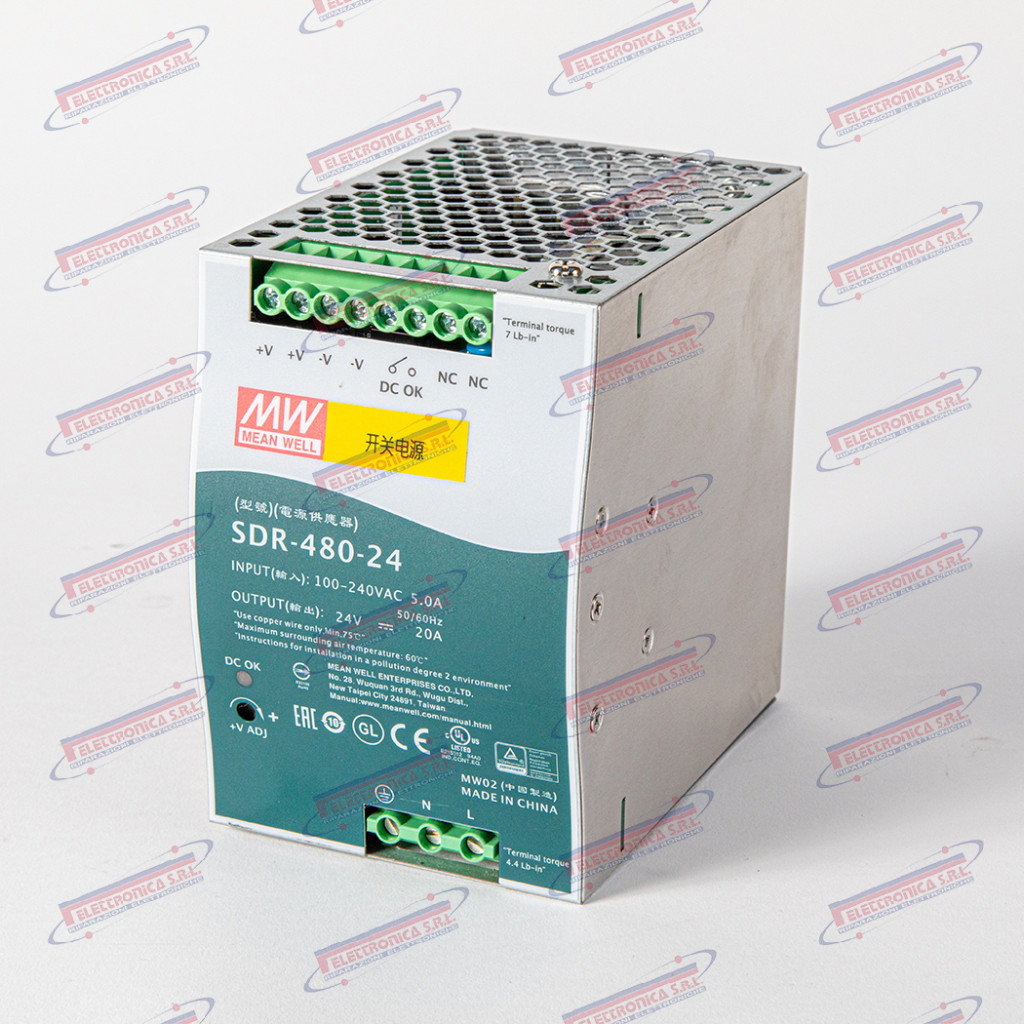

SKU:
SDR-480-24
Cat:
Power Supply
Brand:
MEAN WELL
Service
Exchange service
Repair
DIN Rail Switching Power Supply – MEAN WELL SDR-480-24
The SDR-480-24 is a single-output DIN rail switching power supply (“Single Output DIN Rail Switching Power Supply”) manufactured by MEAN WELL, part of the SDR series. It delivers 480 W nominal output power at 24 V DC with a maximum current of 20 A. The input is universal (90–264 V AC, 47–63 Hz), featuring active power factor correction (active PFC) and an integrated fan for forced-air cooling. Output voltage is adjustable in the range 22–27 V DC via trimmer. Widely used as the primary power supply in CNC control cabinets, machine tools, industrial automation systems, and 24 V DC distribution applications.
The power supply is the component that converts AC mains voltage into stable DC voltage to power the CNC control logic, I/O modules, operator panels, and auxiliary components in the electrical cabinet. A power supply failure instantly halts the entire machine control chain: the CNC loses its reference, axes stop safely, and the machine cannot resume its cycle until the component is replaced or repaired. The stability of the DC supply voltage directly affects the reliability of inter-module communication and axis positioning accuracy.
MEAN WELL is a Taiwanese switching power supply manufacturer founded in 1982, one of the largest and most widely used producers of standard power supplies in industrial and automation applications worldwide. Its products carry UL, CE, and TÜV certifications and are extensively used in electrical cabinets, CNC machines, and embedded systems. The SDR series is currently in active production.
Main Technical Specifications
| Type | Single-output DIN rail switching power supply |
| Part number | SDR-480-24 (SDR48024) |
| Brand | MEAN WELL |
| Known application | CNC control cabinets, machine tools, industrial automation, 24 V DC distribution |
| Function | AC/DC conversion: power supply for CNC control logic and cabinet auxiliary components |
| Input voltage | 90–264 V AC, 47–63 Hz (universal input) |
| Output voltage | 24 V DC (adjustable 22–27 V via trimmer) |
| Output current | 20 A |
| Rated power | 480 W |
| PFC | Active (>0.95 at full load) |
| Typical efficiency | ~91 % |
| Cooling | Integrated fan, forced-air flow |
| Protections | OVP (over-voltage), OCP (over-current), SCP (short circuit), OTP (over-temperature) |
| Mounting | DIN rail TS-35 |
| Operating temperature | –20 °C to +70 °C |
| Certifications | UL, CE, TÜV |
| Weight | ~1.2–1.8 kg |
| Dimensions | ~85 × 125 × 130 mm W × H × D |
| Production status | Currently in active production |
SKU:
TT-A-11
Cat:
Encoder
Brand:
MITSUBISHI
Service
Refurbished sell
Rotary Encoder – MITSUBISHI TT-A-11
The TT-A-11 is a rotary encoder (“Rotary Encoder”) manufactured by Mitsubishi Electric, used as a feedback component in Mitsubishi MELDAS CNC systems and MELSERVO series servo drives. It provides the angular position and speed signal to the controller, enabling closure of the position and velocity control loops. The unit is compatible with Mitsubishi servo drive units and is documented as a feedback component on various CNC machine tools.
The encoder is the feedback sensor that communicates the precise angular position and speed of the axis or motor to the CNC: without it the control loop cannot be closed and the axis becomes uncontrollable. A faulty encoder or one generating incorrect signals causes immediate alarms on the CNC, positioning errors, or irregular axis behaviour that can damage the workpiece or the machine itself.
Mitsubishi Electric is one of Japan’s leading industrial automation conglomerates, offering a complete range of CNC controllers (MELDAS/M700 series), servo drives (MELSERVO MR-J series) and motors for machine tools. Products in the TT series are legacy / discontinued: replacement is typically carried out using OSA/OSE series encoders or compatible equivalents available from specialist suppliers.
Main Technical Specifications
| Type | Incremental rotary encoder (Rotary Encoder) |
| Part number | TT-A-11 (TTA11) |
| Brand | Mitsubishi Electric |
| Known application | Mitsubishi MELDAS CNC systems; MELSERVO servo drives |
| Function | Angular position and velocity feedback for control loop closure |
| Supply voltage | 5 V DC (typical) |
| Resolution | ~2,000–10,000 pulses/rev |
| Output signal | Quadrature pulses (A, B, Z) differential RS-422 (typical) |
| Interfaces / connectors | Multi-pin connector compatible with MELSERVO drives |
| Weight | ~0.2–0.5 kg |
| Dimensions | diameter ~50–80 mm |
| Production status | Legacy / discontinued — used/surplus/repair only |
SKU:
RF203
Cat:
No Category
Brand:
MITSUBISHI
Service
Repair
Exchange service
CNC CPU Board – MITSUBISHI RF203
The RF203 is a CNC CPU control board (“CNC CPU Board”) manufactured by Mitsubishi Electric, a component of the MELDAS numerical control line for machining centres and CNC machine tools. The board handles main part-program processing, axis management and communication with peripheral modules of the CNC system. Multiple hardware revisions are documented; the board integrates into the control rack via a dedicated internal bus.
The CPU board is the computational heart of the numerical control: it interprets the ISO/G-code part program, calculates axis trajectories in real time and coordinates all CNC subsystems (servo drives, I/O modules, operator interface). A CPU failure causes an immediate machine stop and makes any machining impossible; diagnosis is critical because faults often manifest as system errors that are not immediately traceable to the board itself.
Mitsubishi Electric is one of the world’s leading manufacturers of CNC numerical controls, with the MELDAS line serving machine shops worldwide for over forty years. Products of this generation are legacy / discontinued: official support has ended and spare parts are available exclusively through used, surplus or specialist repair channels.
Main Technical Specifications
| Type | CNC CPU control board (CNC CPU Board) |
| Part number | RF203 |
| Brand | Mitsubishi Electric |
| Known application | Mitsubishi MELDAS series CNC controllers (verify compatibility against machine documentation) |
| Function | Part-program processing, axis management, CNC subsystem coordination |
| Processor | Dedicated CPU for real-time processing (specifications to be verified against original documentation) |
| Supply voltage | +5 V DC / ±12 V DC via rack bus (typical) |
| Interfaces | CNC rack internal bus; serial and parallel connectors to I/O modules and servo drives |
| Memory | RAM and ROM/EPROM for firmware and part programs (capacity to be verified against documentation) |
| Axis compatibility | Multi-axis (exact number to be verified against original documentation) |
| Weight | ~0.3–0.8 kg |
| Dimensions | ~200–350 mm |
| Production status | Legacy / discontinued — used/surplus/repair only |

SKU:
SE-I01
Cat:
Card
Brand:
MITSUBISHI
Service
Refurbished sell
Drive CPU Board – MITSUBISHI SE-I01
The SE-I01 is an electronic drive CPU control board (“Drive CPU Board”) manufactured by Mitsubishi Electric, belonging to the drive family for MELDAS / MELSERVO CNC systems. The board integrates the main microprocessor responsible for executing drive control algorithms (current and speed loops), managing serial communications with the CNC unit, and supervising the converter’s hardware protections. It can be installed in servo and/or spindle drives of the compatible series.
The drive CPU board is the computational core of the drive unit: it receives position or speed references from the CNC controller, executes real-time regulation algorithms and generates commands for the power stage. A failure of this component renders the drive completely inoperative, preventing any controlled axis or spindle movement and causing an immediate machine stop.
Mitsubishi Electric is one of the world’s leading manufacturers of CNC systems, servo drives and industrial automation; its FA (Factory Automation) division has developed MELDAS numerical controllers and MELSERVO drives since 1970, widely used in milling machines, lathes and machining centres. Boards of this generation are legacy / discontinued: available only as used parts, surplus stock or through specialist repair centres.
Main Technical Specifications
| Type | Drive CPU control board (Drive CPU Board) |
| Part number | SE-I01 (SEI01) |
| Brand | Mitsubishi Electric |
| Known application | MELDAS / MELSERVO CNC drive series (Mitsubishi Electric) |
| Function | Regulation algorithm processing (current, speed), CNC–drive communication management, hardware protection supervision |
| Processor | Dedicated MCU / DSP for axis control (Mitsubishi proprietary architecture) |
| Communication | Serial interface to CNC unit (Mitsubishi proprietary protocol) |
| Logic supply | +5 V / ±15 V DC (typical) |
| Interfaces | Edge connectors / flat cable to power board and drive I/O |
| Weight | ~0.2–0.5 kg |
| Dimensions | ~150–260 mm × 100–180 mm |
| Production status | Legacy / discontinued — used / surplus / repair only |

SKU:
SE-CPU2
Cat:
No Category
Brand:
MITSUBISHI
Service
Repair
Exchange service
CNC CPU Board – Mitsubishi SE-CPU2
The SE-CPU2 is a CNC central processing unit board (“CNC CPU Board”) manufactured by Mitsubishi Electric, and serves as the main computing component of the MELDAS series CNC control systems. The board integrates the main processor, program memory (Flash/EEPROM) and working memory (RAM), managing part program execution, axis interpolation and communication with peripheral modules via the system’s proprietary bus. Available in the SE-CPU2 variant, it may exist in different hardware revisions; compatibility with the installed CNC system software version must be verified before replacement.
The CPU board is the computational core of the CNC controller: it performs real-time axis interpolation, interprets ISO/G-code part programs and coordinates the operation of all system modules (axes, spindle, I/O, serial communications). A CPU board failure results in a complete machine stoppage — no movement is possible without this component, making its replacement or repair an absolute priority for production recovery.
Mitsubishi Electric is one of the world’s leading manufacturers of CNC systems and industrial automation, with the MELDAS line — now evolved into the MELDASMAGIC and M800/M80 series — installed in thousands of machine tools worldwide. Products in the SE series are legacy / discontinued: available exclusively as used, surplus, or through specialist repair service.
Main Technical Specifications
| Type | CNC central processing unit board (CNC CPU Board) |
| Part number | SE-CPU2 (SECPU2) |
| Brand | Mitsubishi Electric |
| Known application | Mitsubishi MELDAS series CNC systems (CNC machine tools) |
| Function | CNC central processing: real-time axis interpolation, ISO/G-code part program execution, system bus and peripheral module management |
| Supply voltage | +5 V DC (logic), ±12 V DC (typical for this series) |
| Memory | Flash/EEPROM for OS and firmware + RAM for working data |
| Interfaces | Mitsubishi MELDAS proprietary bus; backplane rack connectors |
| Serial communications | RS-232C / RS-422 (typical for MELDAS series) |
| Software compatibility | Verify hardware revision and MELDAS OS version before replacement |
| Weight | ~0.3–0.8 kg |
| Dimensions | ~200–350 mm |
| Production status | Legacy / discontinued — used/surplus/repair only |
SKU:
RF01
Cat:
Card
Brand:
MITSUBISHI
Service
Repair
Exchange service
CNC Control Circuit Board – MITSUBISHI RF01
The part number RF01 identifies an electronic control board (“Control Circuit Board”) manufactured by Mitsubishi Electric, belonging to the Japanese manufacturer’s CNC and industrial automation product range. Specific technical documentation for code RF01 is limited: the board is compatible with Mitsubishi CNC systems of the MELDAS and/or MELSERVO series and may perform axis control, I/O management, encoder feedback, or servo drive regulation functions depending on the installation context. Revision variants cannot be excluded; compatibility must be verified against the relevant machine documentation before installation.
Electronic control boards in Mitsubishi CNC systems manage regulation, supervision, and communication functions between the main controller and the power or field components. A failure on this type of board typically causes immediate machine shutdown, non-resettable alarm errors, and inability to execute any machining cycle until the module is replaced or repaired.
Mitsubishi Electric is a Japanese multinational founded in 1921 and a world leader in industrial automation, motor drives, and CNC systems. The brand is active and current products are fully supported; however, modules from the legacy MELDAS and MELSERVO series of the 1980s–1990s are legacy / discontinued and available only through the used market or specialist repair services.
Main Technical Specifications
| Type | CNC electronic control board (Control Circuit Board) |
| Part number | RF01 |
| Brand | Mitsubishi Electric |
| Known application | Mitsubishi CNC systems MELDAS / MELSERVO series (verify against machine manual) |
| Function | CNC control and regulation (specific function to be verified on machine schematic) |
| Logic supply voltage | ±15 V / +5 V DC |
| Interfaces / connectors | Edge connectors / internal terminal strip (to be verified) |
| Feedback | Encoder / resolver / tachogenerator (to be verified on schematic) |
| Weight | ~0.2–0.8 kg |
| Dimensions | ~150–300 mm |
| Production status | Legacy / discontinued — used/surplus/repair only |

SKU:
QX084
Cat:
Power Supply
Brand:
MITSUBISHI
Service
Repair
Exchange service
Switching Power Supply CNC – Mitsubishi QX084
The QX084 is a panel-mount switching power supply unit (“Switching Power Supply Unit”) manufactured by Mitsubishi Electric, designed for CNC and industrial automation control systems of the MELDAS and related series. The module converts the mains AC input voltage into regulated DC voltages required by the machine tool control circuits (CPU boards, I/O boards, axis modules). It provides the stabilised supply rails demanded by the control rack; revisions or code variants may differ in connector layout or input voltage range.
The power supply is the foundational component of the entire CNC system: without it no processing board, no drive and no I/O module receives its operating voltage. A power supply failure causes an immediate and total machine stop; the quality of the generated voltages directly affects the reliability and lifespan of all other electronic circuits in the control unit.
Mitsubishi Electric is one of the world’s leading manufacturers of CNC systems (MELDAS, M70, M80 series), programmable logic controllers (MELSEC), and servo drives (MELSERVO). Founded in 1921 as a division of the Mitsubishi group, it has developed a comprehensive range of industrial automation products. Legacy models such as the QX084 are discontinued: available only as used parts, NOS (New Old Stock), or through specialist reconditioning.
Main Technical Specifications
| Type | Panel-mount switching power supply (Switching Power Supply Unit) |
| Part number | QX084 |
| Brand | Mitsubishi Electric |
| Known application | Mitsubishi CNC systems MELDAS / M series; FA control racks |
| Function | Conversion and regulation of supply voltages for CNC control circuits |
| Input voltage | 100–240 V AC, 50/60 Hz |
| Output voltages | +5 V DC, ±12 V DC or ±15 V DC, +24 V DC (typical for MELDAS systems; verify against specific documentation) |
| Total power | ~50–200 W |
| Interfaces / connectors | Multiple edge connectors and/or terminal strips for voltage distribution to control rack |
| Protections | Overvoltage, overcurrent, short-circuit (typical for industrial switching PSUs) |
| Weight | ~0.8–2.5 kg |
| Dimensions | ~150–300 mm |
| Production status | Legacy / discontinued — used/surplus/repair only |
SKU:
OSE105S2
Cat:
Encoder
Brand:
MITSUBISHI
Service
Repair
Exchange service
Optical Serial Encoder – MITSUBISHI OSE105S2
The OSE105S2 is an optical serial rotary encoder (“Optical Serial Encoder”) manufactured by Mitsubishi Electric, designed as a feedback device for HC-series servo motors (HC-KFS, HC-MFS, HC-SFS) paired with MELSERVO MR-J2S servo amplifiers and MELDASMAGIC / MELDAS CNC systems. The device transmits rotor angular position and speed signals to the servo amplifier via Mitsubishi’s proprietary serial protocol. Available as a standalone unit for direct shaft mounting; encoder cable not included.
The position encoder is the sensor that closes the servo amplifier’s feedback loop: it transmits the motor’s angular position and speed in real time, allowing the controller to instantly correct any position or speed error. Without it, the servo amplifier triggers an encoder alarm and disables the motor; incorrect or missing feedback causes loss of positional accuracy, axis vibrations, and potential machine collisions.
Mitsubishi Electric is one of the world’s leading manufacturers of industrial automation and CNC systems, covering the MELSERVO (servo drives), MELDAS / MELDASMAGIC (CNC controllers) and MELSEC (PLC) product lines. HC-series motors paired with MR-J2S amplifiers are legacy / discontinued: superseded by the MR-J3, MR-J4 and MR-J5 platform; OSE encoders for these motors are available exclusively as used, surplus or original warehouse stock.
Main Technical Specifications
| Type | Optical serial rotary encoder (Optical Serial Encoder) |
| Part number | OSE105S2 |
| Brand | Mitsubishi Electric |
| Known application | HC-KFS, HC-MFS, HC-SFS servo motors – MELSERVO MR-J2S amplifiers; MELDAS / MELDASMAGIC CNC systems |
| Function | Rotor angular position and speed feedback for servo amplifier |
| Resolution | 131,072 pulses/revolution (17-bit) – typical Mitsubishi OSE series |
| Supply voltage | 5 V DC (±5 %) |
| Output signal | Serial – Mitsubishi proprietary protocol (SSE) |
| Connector | Dedicated Mitsubishi encoder connector (6-pin, typical) |
| Operating temperature | 0 – 55 °C (typical) |
| Weight | ~0.2–0.4 kg |
| Dimensions | Ø ~60–80 mm × length ~40–60 mm |
| Production status | Legacy / discontinued — used / surplus / repair only |
SKU:
OSA104S2
Cat:
No Category
Brand:
MITSUBISHI
Service
Repair
Exchange service
Absolute Optical Encoder – MITSUBISHI OSA104S2
The OSA104S2 is an absolute optical multi-turn encoder (“Optical Serial Absolute Encoder”) manufactured by Mitsubishi Electric, designed to be mounted directly on the shaft of AC servo motors of the HC and HA series, compatible with MR-J2S and MR-J3 servo drives. The device transmits the absolute multi-turn angular position to the CNC or drive via Mitsubishi’s proprietary serial protocol. The S2 suffix identifies the motor-side connector variant.
The absolute encoder is the position transducer that allows the servo drive to know the exact angular position of the motor at any instant, without the need for a homing procedure at power-up. In the event of failure, the axis becomes uncontrollable: the CNC raises a position alarm and stops the machine, making any machining operation impossible until the component is replaced.
Mitsubishi Electric is one of the world’s leading industrial automation manufacturers, with an established range of servo systems (MR-J series) and CNC controllers (MELDAS / M800 series). Products in the OSA104 family were widely used in servo systems throughout the 1990s–2010s; some variants are legacy / discontinued and available only as used, surplus or compatible replacement.
Main Technical Specifications
| Type | Absolute optical multi-turn encoder (Optical Serial Absolute Encoder) |
| Part number | OSA104S2 |
| Brand | Mitsubishi Electric |
| Known application | AC servo motors HC / HA series with MR-J2S, MR-J3 drives – MELDAS CNC systems |
| Function | Absolute multi-turn angular position transduction for position and speed loop closure |
| Resolution | 131 072 p/r – 17 bit |
| Output signal type | Mitsubishi proprietary asynchronous serial (SSA protocol) |
| Supply voltage | 5 V DC ±5 % (typical) |
| Current consumption | ~200 mA |
| Connector | S2 type – Mitsubishi-specific motor-side connector |
| Operating temperature | 0 – +55 °C (typical for series) |
| Weight | ~0.2–0.5 kg |
| Dimensions | ~ø60–80 × 40–60 mm |
| Production status | Legacy / discontinued — available as used / surplus / repair only |
SKU:
MR-S1-200-E01
Cat:
Servo Drive
Brand:
MITSUBISHI
Service
Repair
Exchange service
AC Servo Amplifier – MITSUBISHI MR-S1-200-E01
The MR-S1-200-E01 is an AC servo amplifier (“AC Servo Amplifier”) from the MELSERVO MR-S1 series by Mitsubishi Electric, with a rated output of 200 W. It is documented as a component of CNC systems equipped with Mitsubishi MELDAS controllers, where it regulates a servo axis in machine tools. The suffix E01 identifies a specific hardware variant of the series; the primary stock code is MRS1200E01.
The servo amplifier is the power and regulation module that closes the position, speed, and current loops on a machine tool axis: it receives the position or speed reference from the CNC and drives the servo motor to ensure positioning accuracy and cycle repeatability. If it fails, the controlled axis goes offline and the machine cannot perform any machining operations; in multi-axis systems, a single faulty drive stops the entire production process.
Mitsubishi Electric is one of the world’s leading manufacturers of industrial automation and power electronics, with the MELSERVO line among the most widely deployed servo drive systems for CNC machine tools. The MR-S1 series has been superseded by later generations (MR-J2S, MR-J3, MR-J4, MR-J5); all products in this family are legacy / discontinued and available exclusively as used, surplus or through specialist repair services.
Main Technical Specifications
| Type | AC Servo Amplifier |
| Part number | MR-S1-200-E01 (MRS1200E01) |
| Brand | Mitsubishi Electric – MELSERVO line |
| Known application | CNC machine tools with Mitsubishi MELDAS control systems |
| Function | Position, speed and current regulation of CNC axis servo motor |
| Rated output power | 200 W |
| Power supply | 200–230 V AC, single phase (typical MR-S1 series) |
| Reference input | Pulse train / analogue ±10 V |
| Feedback | Incremental encoder from Mitsubishi HC/HA series servo motor |
| Connectors | CN1 (CNC command), CN2 (motor encoder), CN3 (digital I/O) |
| Weight | ~1.0–2.0 kg |
| Dimensions | ~150–250 mm |
| Production status | Legacy / discontinued — used/surplus/repair only |

SKU:
MR-S11-200-E01
Cat:
No Category
Brand:
MITSUBISHI
Service
Repair
Exchange service
AC Servo Amplifier – MITSUBISHI MR-S11-200-E01
The MR-S11-200-E01 is an AC servo amplifier (“AC Servo Amplifier”) from the MELSERVO MR-S11 series by Mitsubishi Electric, documented for use with MELDAS CNC systems (Mitsubishi Electric CNC). The suffix 200 denotes the nominal power class of 200 W, while E01 identifies the variant or firmware / motor parameter revision. The unit manages the speed and position loops of the servo axis, receiving analogue or pulse-train references from the CNC controller and driving HC series brushless servo motors by Mitsubishi. Variants may exist with different encoder interfaces or alternative current profiles.
The servo amplifier is the component that converts the position and speed reference issued by the CNC into modulated three-phase current for the motor: it controls speed, acceleration and torque of the work axis in real time. In the event of failure, the controlled axis loses precise motion entirely, making any machining operation impossible; the CNC raises position or following-error alarms and halts the machine in a protective state.
Mitsubishi Electric is one of the world’s leading manufacturers of industrial automation, with its Factory Automation (FA) division specialising in CNC controllers (MELDAS, M70, M80 series), servo drives (MELSERVO), inverters and PLCs (MELSEC). Products of the MR-S11 series are legacy / discontinued, superseded by the later generations MR-J2S, MR-J3, MR-J4 and MR-J5: available as used, surplus or through specialist repair only.
Main Technical Specifications
| Type | AC Servo Amplifier |
| Part number | MR-S11-200-E01 (MRS11200E01) |
| Brand | Mitsubishi Electric – MELSERVO division |
| Known application | Mitsubishi MELDAS CNC systems; machine tools with HC series brushless servo axes |
| Function | Servo axis control: speed, position and torque regulation of brushless motor |
| Rated power | 200 W |
| Power supply | Three-phase 200–230 V AC, 50/60 Hz (typical MR-S11 series) |
| Command interface | Analogue reference (±10 V) or pulse train; digital I/O signals |
| Compatible motor | Mitsubishi HC series brushless servo motors (e.g. HC-MF, HC-SF) – 200 W |
| Feedback | Incremental serial encoder (Mitsubishi proprietary interface) |
| Weight | ~0.8–1.5 kg |
| Dimensions | ~130–180 mm × 60–80 mm × 130–160 mm |
| Production status | Legacy / discontinued — used/surplus/repair only |
SKU:
MR-S12-80A-E01
Cat:
No Category
Brand:
MITSUBISHI
Service
Repair
CNC Axis Servo Amplifier – Mitsubishi MR-S12-80A-E01
The MR-S12-80A-E01 is an AC servo amplifier for CNC axis drives (“AC Servo Amplifier”) from the MELSERVO MR-S series, manufactured by Mitsubishi Electric. Rated at a continuous output current of 80 A, it is designed to drive AC servo motors on the feed axes of CNC machine tools equipped with a MELDAS controller (M60/M64/M500 series and derivatives). The suffix E01 identifies the specific product variant and revision. Communication with the CNC controller is via a dedicated serial bus (SSCNET) or analogue reference ±10 V; position feedback is handled via an incremental or absolute encoder mounted on the servo motor.
The servo amplifier converts the position and velocity commands from the CNC into power current applied to the servo motor windings, simultaneously closing the current, speed and position loops to ensure faithful tracking of the machining profile. In the event of failure the controlled axis is immobilised or loses positioning accuracy, making any machining operation impossible; in multi-axis systems, the failure of a single drive halts the entire machine.
Mitsubishi Electric is one of the world’s leading manufacturers of motion control and CNC systems, with the MELSERVO division producing AC servo amplifiers and motors for industrial automation and machine tools since the 1980s. The MR-S series is a legacy / discontinued family, superseded by the MR-J2, MR-J3 and MR-J4 generations; spare parts are available exclusively as used, NOS (new old stock) or through specialist repair services.
Main Technical Specifications
| Type | AC Servo Amplifier – CNC axis drive (MELSERVO MR-S series) |
| Part number | MR-S12-80A-E01 (MRS1280AE01) |
| Brand | Mitsubishi Electric – MELSERVO (legacy MR-S series) |
| Known application | CNC machine tools with Mitsubishi MELDAS controller (M60, M64, M64S, M500 series) |
| Function | AC servo motor drive for CNC axis – current, speed and position regulation |
| Rated output current | 80 A |
| Power supply | 3× AC 200–230 V, 50/60 Hz (typical) |
| DC bus voltage | ~280–320 V DC (typical) |
| CNC interface | SSCNET (dedicated serial bus) / analogue reference ±10 V |
| Feedback | Incremental or absolute encoder on servo motor |
| Built-in protections | Overcurrent, overtemperature, DC bus overvoltage, encoder fault |
| Weight | ~4–8 kg |
| Dimensions | ~150×300×200 mm |
| Production status | Legacy / discontinued — used/surplus/repair only |
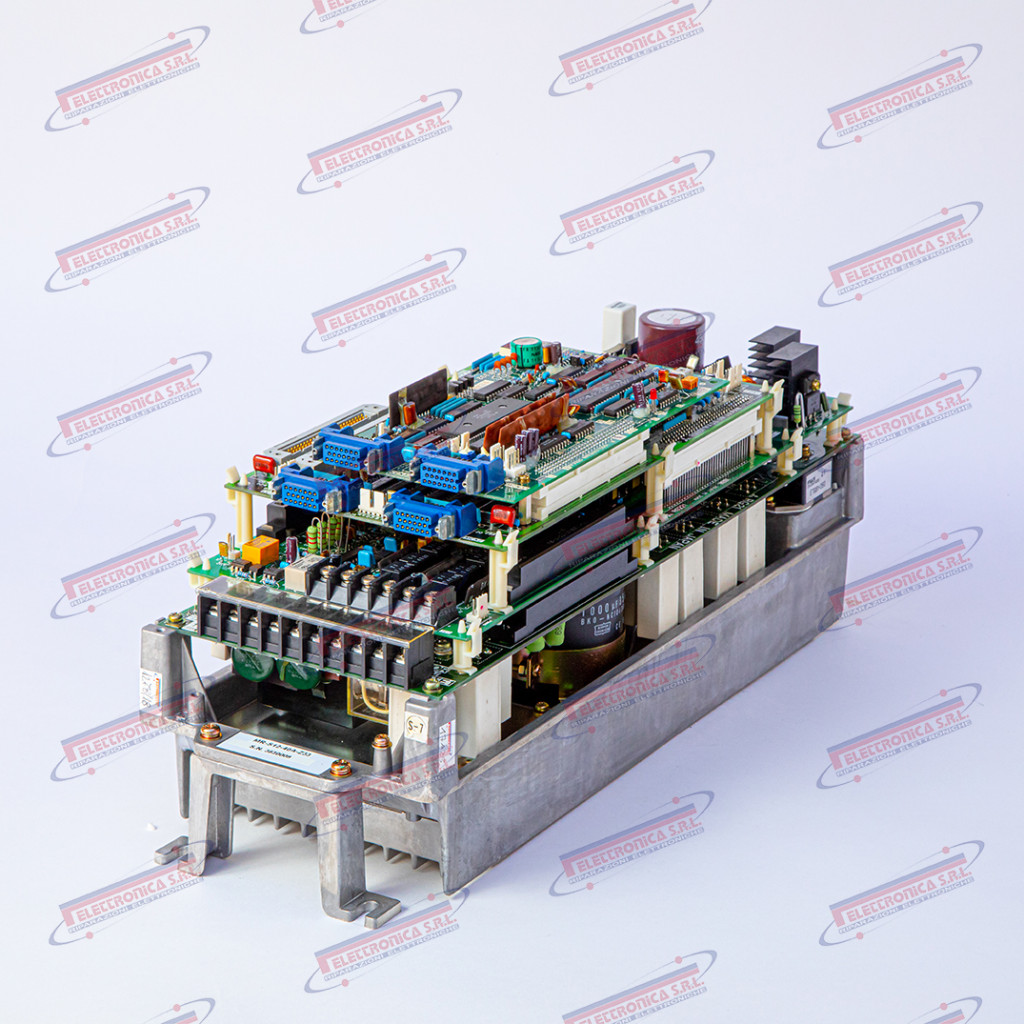


SKU:
MR-S12-40A
Cat:
No Category
Brand:
MITSUBISHI
Service
Repair
Exchange service
Servo Drive – MITSUBISHI MR-S12-40A
The MR-S12-40A is an analogue servo drive (“Servo Amplifier”) from the MELSERVO MR-S series manufactured by Mitsubishi Electric. It belongs to the analogue generation of Mitsubishi servo amplifiers and is designed for closed-loop control of AC brushless servo motors in CNC applications (machining centres, lathes, milling machines). It accepts an analogue speed reference, manages the current and speed control loops, and returns status signals to the controller. The model designation indicates a nominal output current of 40 A, suitable for medium-power servo motors typically paired with the main linear axes. This is a legacy component, direct predecessor of the MR-J, MR-J2S, and MR-J4 series.
The servo drive is the electronic heart of the axis control chain: it receives the position or speed reference from the CNC, closes the feedback loop on the motor encoder, and generates the current required to maintain precise positioning during machining. A drive failure completely disables the corresponding axis, rendering the machine inoperable; degraded operation causes position errors, vibration, and dimensional rejects in the workpiece.
Mitsubishi Electric is one of the world’s leading industrial automation and motion control manufacturers, with the MELSERVO line present in the CNC market since 1981. The MR-S series represents the analogue generation of Mitsubishi drives, now fully superseded by the digital MR-J4 and MR-J5 platforms. All products in the MR-S12 family are legacy / discontinued: available exclusively as used, NOS (New Old Stock), or through specialist repair services.
Main Technical Specifications
| Type | Analogue servo drive / servo amplifier |
| Part number | MR-S12-40A (MRS1240A) |
| Brand | Mitsubishi Electric – MELSERVO MR-S series |
| Known application | CNC machining centres, lathes and milling machines with Mitsubishi MELDAS / M-Series control (1990s–2000s generation) |
| Function | Servo motor speed and current regulation; position loop closure in cascade with the CNC |
| Power supply | 3-phase 200–230 V AC, 50/60 Hz (typical MR-S series) |
| Rated output current | 40 A (continuous) |
| Reference input | Analogue ±10 V (speed / torque) or pulse train (position) |
| Feedback | Incremental encoder from Mitsubishi HC / HA series servo motor |
| Interfaces / connectors | Edge connectors and terminal strips; digital I/O signals for alarm, enable and machine ready |
| Weight | ~3–7 kg |
| Dimensions | ~300×160×190 mm H×W×D |
| Production status | Legacy / discontinued — used / NOS / repair only |

SKU:
MR-J2-100CT
Cat:
No Category
Brand:
MITSUBISHI
Service
Repair
Exchange service
AC Servo Drive 1 kW – MITSUBISHI MR-J2-100CT
The MR-J2-100CT is an AC servo amplifier from the MELSERVO-J2 series manufactured by Mitsubishi Electric, rated at 1 kW. It belongs to the second generation of the MELSERVO family and is designed for vector torque, speed and position control of Mitsubishi AC brushless servo motors in the HC-SF / HC-KF series. The CT suffix identifies a specific variant within the MR-J2 range. The drive is documented as a component of machining centres, CNC lathes, grinding machines and industrial automation systems equipped with Mitsubishi MELDAS CNC.
The servo drive is the heart of the controlled axis: it receives the position or speed reference from the CNC, reads the encoder feedback from the motor and generates the current required to follow the motion profile with maximum accuracy. In the event of a failure, the axis loses movement completely: the machine trips an alarm and cannot resume machining until the drive is replaced or repaired.
Mitsubishi Electric is one of the world’s leading manufacturers of CNC systems, servo drives and industrial inverters, with over a century of history in power electronics and automation. The MELSERVO-J2 series was introduced in the late 1990s and equipped millions of machines worldwide before being superseded by the J3, J4 and J5 generations. MR-J2 products are legacy / discontinued: available exclusively as used, NOS surplus or through specialist repair.
Main Technical Specifications
| Type | AC servo amplifier (AC Servo Amplifier) |
| Part number | MR-J2-100CT (MRJ2100CT) |
| Brand | Mitsubishi Electric – MELSERVO-J2 series |
| Known application | Machining centres, CNC lathes, grinding machines with Mitsubishi MELDAS CNC |
| Function | Speed, torque and position control of AC brushless servo motor |
| Rated output | 1 kW |
| Main circuit supply | 3-phase 200–230 V AC, 50/60 Hz |
| Rated output current | ~5.0 A |
| Feedback | Incremental encoder from servo motor (connector CN2) |
| Interfaces | CN1 (I/O command / analogue), CN2 (encoder), CN3 (RS-422) |
| Weight | ~1.5–2.5 kg |
| Dimensions | ~55 × 170 × 155 mm W×H×D |
| Production status | Legacy / discontinued — used/surplus/repair only |

SKU:
MDS-D2-CV-370
Cat:
Power Supply
Brand:
MITSUBISHI
Service
Repair
Exchange service
Servo Drive Converter Power Supply – MITSUBISHI MDS-D2-CV-370
The MDS-D2-CV-370 is a regenerative servo drive converter unit (“Servo Drive Converter Unit”) manufactured by Mitsubishi Electric, part of the MDS-D2 series of servo drives for CNC machine tools. The module converts three-phase AC mains into a DC bus to power servo drive modules of the same family (MDS-D2-SP, MDS-D2-V1, MDS-D2-V2), and is documented as a component of Mitsubishi CNC systems series M700, M70 and M800. The suffix “370” denotes a rated power of approximately 37 kW; the unit incorporates regenerative braking circuitry that returns deceleration energy to the AC mains supply, communicating with the CNC via SSCNET III/H interface.
The converter/power supply is the core of the CNC axis energy distribution system: it provides a stabilised DC bus to all connected servo drive modules and manages the regenerative energy produced during rapid axis decelerations, preventing DC bus overvoltage and thermal overload conditions. A failure in this module causes an immediate stop of all controlled axes and the spindle, rendering the machine completely inoperable until the unit is replaced or repaired.
Mitsubishi Electric is one of the world’s leading manufacturers of CNC systems and servo drives for machine tools, headquartered in Tokyo (Japan) and operating globally through its Mitsubishi Electric FA division. The MDS-D2 series has been superseded by the MDS-EJ/EX series; products in this family are now legacy / discontinued and available primarily as used, surplus, or through specialist repair services.
Main Technical Specifications
| Type | Regenerative servo drive converter / power supply unit (Servo Drive Converter Unit) |
| Part number | MDS-D2-CV-370 (MDSD2CV370) |
| Brand | Mitsubishi Electric |
| Known application | Mitsubishi CNC systems series M700, M70, M800 with MDS-D2 servo drives |
| Function | AC→DC bus conversion for servo drives; regenerative braking energy management |
| Rated power | ~37 kW |
| Input voltage | 3-phase 200–230 V AC, 50/60 Hz (typical MDS-D2 series) |
| DC bus output voltage | ~300 V DC (intermediate bus for servo drives) |
| Interfaces | DC bus connectors, AC terminal strip, SSCNET III/H interface (CNC communication) |
| Regeneration | Yes — braking energy returned to AC mains |
| Weight | ~10–20 kg |
| Dimensions | ~300–500 mm H × 200–350 mm W |
| Production status | Legacy / discontinued — used/surplus/repair only |

SKU:
MDS-C1-V1-35
Cat:
No Category
Brand:
MITSUBISHI
Service
Repair
Exchange service
Single-Axis AC Servo Amplifier – MITSUBISHI MDS-C1-V1-35
The MDS-C1-V1-35 is a single-axis AC servo amplifier (“Single-Axis AC Servo Amplifier”) from the MDS-C1 series by Mitsubishi Electric, documented as a component of the MELDAS M60, M64 and M700 CNC systems for numerically controlled machine tools. It receives the DC bus voltage from the MDS-C1-CV power supply unit and drives the servo motor via PWM modulation, communicating with the CNC controller through the SSCNET II optical serial bus. Compatible with Mitsubishi Electric HF and HC series servo motors. The suffix “-35” denotes a peak rated current of 35 A; the designation V1 identifies the single-axis module, as opposed to the twin-axis V2 variant.
The servo amplifier is the power module that converts position and speed commands generated by the CNC into phase current for the motor: it closes the current loop and, in cascade, the speed and position loops, ensuring axis interpolation accuracy during machining. Should it fail, the controlled axis loses all servo movement, causing an immediate machine stop; in the most critical cases an abnormal current response can trigger uncontrolled movements and severe mechanical damage.
Mitsubishi Electric is one of the world’s leading manufacturers of CNC systems and drives for machine tools, with over forty years of experience in industrial motion control. The MDS-C1 series has been superseded by the MDS-D and MDS-E/EX families; all products in the C1 family are therefore legacy / discontinued and available exclusively as used, surplus, or through specialist repair services.
Main Technical Specifications
| Type | Single-axis AC servo amplifier |
| Part number | MDS-C1-V1-35 (MDSC1V135) |
| Brand | Mitsubishi Electric |
| Known application | Mitsubishi MELDAS M60, M64, M700 CNC systems; machining centres and CNC lathes |
| Function | Current, speed and position regulation for one servo axis |
| Peak rated current | 35 A |
| Power supply | DC bus from MDS-C1-CV unit (~283–300 V DC) |
| Communication interface | SSCNET II (Mitsubishi optical synchronous serial network) |
| Number of axes | 1 (single-axis; V2 variant handles two axes) |
| Compatible motors | Mitsubishi Electric HF and HC series AC brushless servo motors |
| Weight | ~1.5–3.5 kg |
| Dimensions | ~60–120 × 180–260 × 150–210 mm |
| Production status | Legacy / discontinued — used/surplus/repair only |

SKU:
MDS-C1-SPH-300
Cat:
No Category
Brand:
MITSUBISHI
Service
Repair
Exchange service
Digital AC Spindle Drive – MITSUBISHI MDS-C1-SPH-300
The MDS-C1-SPH-300 is a digital AC spindle drive (“Digital AC Spindle Drive”) manufactured by Mitsubishi Electric, belonging to the MDS-C1 series. The designation SPH identifies the high-performance spindle drive variant (“Spindle High-performance”) within the series; the suffix 300 indicates a rated output power of approximately 30 kW. The unit is documented on CNC machining centres and lathes equipped with Mitsubishi CNC controllers of the M64, M65, and M700 series (MELDASMAGIC). It controls the spindle motor digitally via vector control, communicating with the CNC through the proprietary SSCNET serial bus (Servo System Controller NETwork). It can operate in a shared DC-bus configuration with MDS-C1-V servo drive units and MDS-C1-CV power supply/regenerative units.
The spindle drive receives speed and torque commands from the CNC via the SSCNET bus and precisely regulates the AC spindle motor through closed-loop vector control algorithms. Without this unit the spindle cannot be driven or speed-controlled: any fault triggers an immediate halt of machining operations and raises system alarms that lock the entire CNC installation.
Mitsubishi Electric is a division of the Mitsubishi Group, one of the world’s largest manufacturers of industrial automation, drives, and CNC systems. The MDS-C1 series is a line of digital AC drives introduced in the 1990s, now legacy / discontinued and replaced by the MDS-C2, MDS-D, and MDS-EJ2 series: available exclusively as used, surplus, or through specialist repair.
Main Technical Specifications
| Type | Digital AC spindle drive, high-performance (Digital AC Spindle Drive – High-performance) |
| Part number | MDS-C1-SPH-300 (MDSC1SPH300) |
| Brand | Mitsubishi Electric |
| Known application | CNC machining centres and lathes with Mitsubishi M64, M65, M700 (MELDASMAGIC) controller |
| Function | Digital speed and torque regulation of AC spindle motor via vector control |
| Rated output power | ~30 kW |
| Supply voltage | 3-phase AC 200 V / 400 V (model-dependent; verify nameplate) |
| CNC interface | SSCNET serial bus (Servo System Controller NETwork – Mitsubishi proprietary) |
| Feedback | Incremental encoder OSE from spindle motor |
| Cooling | Internal forced-air fan |
| Weight | ~8–15 kg |
| Dimensions | ~150 × 350 × 350 mm W×D×H |
| Production status | Legacy / discontinued — used/surplus/repair only |

SKU:
MDS-C1-SPH-185
Cat:
No Category
Brand:
MITSUBISHI
Service
Repair
Exchange service
Spindle Drive Amplifier – Mitsubishi MDS-C1-SPH-185
The MDS-C1-SPH-185 is an AC spindle drive amplifier (“Spindle Drive Amplifier”) from the MDS-C1 series manufactured by Mitsubishi Electric, designed for high-performance vector control of AC spindle motors in CNC machine tools. The part number decodes as: MDS (Mitsubishi Drive System), C1 (second generation of the MDS-C family), SP (Spindle), H (high-current/high-power variant) and 185 (rated output ~18.5 kW). The unit is documented on Mitsubishi CNC systems series M64, M65, M66, C6, E60 and E68, installed on vertical and horizontal machining centres, CNC lathes and milling machines from various OEM builders using Mitsubishi controls. It receives speed, torque and position references from the CNC via the SSCNET serial bus (fibre-optic or dedicated serial connector) and drives the spindle motor through an integrated IGBT power stage.
The MDS-C1-SPH-185 spindle drive amplifier is the electronic controller that governs the spindle motor’s speed, torque and angular position in vector mode: it interprets the CNC commands and maintains stable, precise rotation during cutting operations, even under varying loads. If it fails, the spindle becomes uncontrollable and the machine trips on alarm; critical functions such as rigid tapping, spindle orientation, C-axis positioning and automatic tool change become impossible, causing a complete production stoppage.
Mitsubishi Electric is one of the world’s leading manufacturers of CNC systems, servo amplifiers and motors for machine tools, part of the Mitsubishi group headquartered in Tokyo, Japan. The MDS-C1 series is legacy / discontinued: introduced in the 1990s and superseded by the later generations MDS-D, MDS-D2 and MDS-EX, it remains widely installed on machines built between the late 1990s and early 2000s, for which it is available only as used stock, NOS surplus or through specialist repair.
Main Technical Specifications
| Type | AC spindle drive amplifier (Spindle Drive Amplifier) |
| Part number | MDS-C1-SPH-185 (MDSC1SPH185) |
| Brand | Mitsubishi Electric |
| Known application | Mitsubishi CNC series M64, M65, M66, C6, E60, E68; vertical/horizontal machining centres, CNC lathes |
| Function | Vector control of AC spindle motor speed, torque and current; C-axis positioning, spindle orientation, rigid tapping support |
| Rated output power | ~18.5 kW |
| Input voltage | 3-phase 200 V AC ±10%, 50/60 Hz |
| CNC interface | SSCNET serial bus (fibre-optic / dedicated serial connector) |
| Power stage technology | IGBT (Insulated Gate Bipolar Transistor), PWM modulation |
| Operating modes | Speed control, torque control, C-axis positioning, spindle orientation, rigid tapping |
| Cooling | Integrated forced-air cooling |
| Weight | ~8–15 kg |
| Dimensions | ~300–450 × 200–280 × 150–200 mm |
| Production status | Legacy / discontinued — used/surplus/repair only |

SKU:
MDS-C1-SP-185
Cat:
Servo Drive
Brand:
MITSUBISHI
Service
Repair
Exchange service
Spindle Servo Drive – MITSUBISHI MDS-C1-SP-185
The MDS-C1-SP-185 is a spindle servo amplifier (“Spindle Servo Amplifier”) from the MDS-C1 series manufactured by Mitsubishi Electric, documented as a component of Mitsubishi M700, M64 and M65 CNC systems as well as OEM machine tools — including Mazak machining centres and other builders adopting the Mitsubishi platform. The designation SP identifies the spindle function, while 185 denotes the rated power class (~18.5 kW). The unit performs high-performance vector control of the spindle motor, and supports spindle orientation mode, C-axis operation, and torque control mode. Communication with the CNC controller is via Mitsubishi’s proprietary optical fibre bus.
The MDS-C1-SP-185 manages the complete control loop of the spindle motor: it receives speed and torque references from the CNC via optical fibre, drives the three-phase power stage, and closes the feedback loop via encoder or tachogenerator. If it fails, the spindle loses all vector control capability, making any machining operation impossible; the CNC raises a communication or overcurrent alarm and immediately halts the production cycle.
Mitsubishi Electric is one of the world’s leading manufacturers of industrial automation and CNC systems, with over a century of history in electrical engineering and factory automation. The MDS-C1 series is now a legacy / discontinued generation of drives, superseded by the MDS-D, MDS-D2 and MDS-E families: available exclusively as used/surplus stock or through specialist repair services.
Main Technical Specifications
| Type | Spindle servo amplifier (Spindle Servo Amplifier) |
| Part number | MDS-C1-SP-185 (MDSC1SP185) |
| Brand | Mitsubishi Electric |
| Known application | Mitsubishi CNC M700, M64, M65; Mazak machining centres and OEM machines on Mitsubishi platform |
| Function | Vector speed and torque control of spindle motor; orientation mode; C-axis operation |
| Rated power | ~18.5 kW (SP-185 class) |
| Supply voltage | 3-phase 200–230 V AC, 50/60 Hz |
| Logic supply | 24 V DC (external, from MDS power supply unit) |
| CNC communication | Mitsubishi proprietary optical fibre bus (MDS optical bus) |
| Feedback | Mitsubishi OSE/OSA encoder or tachogenerator signal from spindle motor |
| Interfaces / connectors | CN power connectors, CNA/CNB (encoder), optical fibre CNC bus; auxiliary terminal strips |
| Weight | ~8–14 kg |
| Dimensions | ~300–450 mm × 150–200 mm |
| Production status | Legacy / discontinued — used / surplus / repair only |
SKU:
MDS-C1-CV-300
Cat:
No Category
Brand:
MITSUBISHI
Service
Repair
Exchange service
Regenerative Converter Unit – MITSUBISHI MDS-C1-CV-300
The MDS-C1-CV-300 is a regenerative converter unit (“Regenerative Converter Unit”) manufactured by Mitsubishi Electric, belonging to the MDS-C1 servo and spindle drive series. It converts three-phase mains voltage into a regulated DC bus voltage, supplying the servo amplifier and spindle drive modules connected to the same bus. The CV-300 suffix denotes the power class of the unit (approximately 30 kW). It is documented as a component of machining centres, lathes, and multi-axis CNC machines equipped with Mitsubishi MELDAS M64 / M640 CNC controllers. The main stock part number is MDSC1CV300.
The CV converter unit is the power backbone of the entire MDS-C1 drive system: it supplies the DC bus voltage to all connected servo and spindle modules, and manages regenerative energy recovery during motor deceleration phases, feeding the energy back into the bus rather than dissipating it as heat. A failure of this module renders the entire drive chain inoperative, simultaneously blocking all machine axes and the spindle.
Mitsubishi Electric is one of the world’s leading manufacturers of CNC systems, servo motors, inverters, and industrial automation equipment, with over a century of history in the electrotechnical sector. The MDS-C1 series is a legacy / discontinued product line, now superseded by the more recent MDS-D, MDS-E, and MDS-EJ series: availability is limited to the used, surplus, and specialist repair market.
Main Technical Specifications
| Type | Regenerative converter unit (Regenerative Converter Unit) |
| Part number | MDS-C1-CV-300 (MDSC1CV300) |
| Brand | Mitsubishi Electric |
| Known application | Machining centres and CNC lathes with Mitsubishi MELDAS M64 / M640 controller |
| Function | AC→DC bus conversion; power supply for servo and spindle modules; regenerative energy recovery |
| Input voltage | 3× 200–230 V AC, 50/60 Hz (200 V class) |
| DC bus voltage | ~280–330 V DC |
| Rated power | ~30 kW (CV-300 class) |
| Interfaces/connectors | DC bus to servo/spindle modules; CN control connectors; AC mains terminal strip |
| Weight | ~8–15 kg |
| Dimensions | ~250×350×180 mm |
| Production status | Legacy / discontinued — used/surplus/repair only |
SKU:
MDS-C1-CV-110
Cat:
No Category
Brand:
MITSUBISHI
Service
Repair
Exchange service
DC Bus Converter Power Supply Unit – Mitsubishi MDS-C1-CV-110
The MDS-C1-CV-110 is a DC bus converter / power supply unit (“Converter Unit”) from the MDS-C1 series by Mitsubishi Electric, designed for CNC servo and spindle drive systems. The unit converts three-phase AC mains voltage into DC bus voltage that feeds all connected servo and spindle drive modules in parallel (MDS-C1-SP and MDS-C1-V series). The designation CV identifies the converter module within the modular MDS-C1 architecture; the suffix 110 indicates the nominal power rating. Documented on CNC machines equipped with Mitsubishi M64, M70 and M700 series controls; commonly found on machining centres and CNC lathes by OEM brands such as Mazak, Mori Seiki and others. Includes DC bus connection terminals, three-phase AC input terminal strips, and status/alarm signal connectors to the CNC.
The DC bus converter is the heart of the power supply for the entire drive system: without it all connected servo drives and the spindle drive are deprived of bus voltage and the machine stops completely. A fault in the CV module manifests as missing bus voltage alarms, inability to enable axes, and automatic emergency stop; the machine cannot perform any movement or start the spindle until the unit is replaced or repaired.
Mitsubishi Electric is one of the world’s leading manufacturers of CNC systems and drives for machine tools, active in the sector for over 50 years with the MELDAS and MELSERVO product lines. The MDS-C1 series is a previous generation compared to the current MDS-D2 / MDS-E2, therefore these products are to be considered legacy / discontinued: no longer available as new from the official catalogue, obtainable only as used, surplus, or through specialist repair.
Main Technical Specifications
| Type | DC bus converter / power supply unit (Converter Unit) |
| Part number | MDS-C1-CV-110 (MDSC1CV110) |
| Brand | Mitsubishi Electric |
| Known application | Mitsubishi CNC M64, M70, M700 series; OEM machining centres and CNC lathes (Mazak, Mori Seiki) |
| Function | AC/DC conversion – DC bus supply for MDS-C1 servo and spindle modules |
| Input voltage | 3~ 200–230 V AC, 50/60 Hz |
| DC bus voltage | ~280–300 V DC (MDS-C1 series internal bus) |
| Rated power | Size 110 (~11 kW – verify against official datasheet) |
| Regeneration | Unit with regenerative braking capability (typical of CV series) |
| Interfaces | DC bus connectors, three-phase AC input terminal strips, status/alarm signals to CNC |
| Weight | ~4–8 kg |
| Dimensions | ~135–200 × 300–450 × 180–260 mm |
| Production status | Legacy / discontinued — used/surplus/repair only |

SKU:
MDS-B-V14-70
Cat:
Servo Drive
Brand:
MITSUBISHI
Service
Repair
Exchange service
Servo Drive Amplifier – Mitsubishi MDS-B-V14-70
The MDS-B-V14-70 (internal part number MDSBV1470) is a digital AC servo drive amplifier (“Servo Drive Amplifier”) from the MDS-B series by Mitsubishi Electric, designed for speed and position control of servo axes in MELDAS CNC systems (M60, M64, M64S, M65 series and compatible). The designation V14-70 identifies the axis configuration and the current rating of the amplifier; the unit drives the motor through a three-phase PWM output to a Mitsubishi HF/HA AC servo motor, receiving position and speed references from the CNC via the proprietary SSCNET serial bus (Servo System Controller NETwork). The MDS-B series is available in several current ratings; the suffix 70 denotes approximately 7.0 A continuous or 70 A peak (refer to the specific datasheet for confirmation).
The servo drive is the electronic core of machine axis control: it receives position and speed commands from the CNC, converts them into phase currents for the motor, and closes the position, speed, and current feedback loops in real time. A drive failure causes the immediate lockout of the controlled axis and a machine stop; in more serious cases, a partial failure can generate silent position drift that compromises the dimensional tolerances of machined parts without triggering an immediate alarm.
Mitsubishi Electric is one of Japan’s leading companies in industrial automation and CNC, with over a century of history in motion control and industrial electronics. The MDS-B series was manufactured in the 1990s and early 2000s for MELDAS CNC controllers and is now legacy / discontinued: availability is limited to the used, NOS surplus, and specialist repair market.
Main Technical Specifications
| Type | Digital AC servo drive amplifier |
| Part number | MDS-B-V14-70 (MDSBV1470) |
| Brand | Mitsubishi Electric |
| Series / Family | MDS-B (MELDAS Drive System, B series) |
| Known application | Mitsubishi MELDAS CNC M60 / M64 / M64S / M65 and compatible systems |
| Function | Servo axis control: position, speed and current feedback loops; AC servo motor drive |
| Power supply | 200–230 V AC three-phase, 50/60 Hz (typical MDS-B series) |
| Rated current | ~7.0 A continuous – suffix 70 (verify with specific datasheet) |
| CNC interface | SSCNET serial bus (Servo System Controller NETwork) Mitsubishi |
| Feedback | Absolute / incremental encoder from HF / HA series Mitsubishi AC servo motor |
| Motor output | Three-phase PWM modulated; edge / ribbon connectors on internal backplane |
| Weight | ~2–4 kg |
| Dimensions | ~120–200 mm × 60–100 mm × 160–260 mm |
| Production status | Legacy / discontinued — used / surplus / repair only |

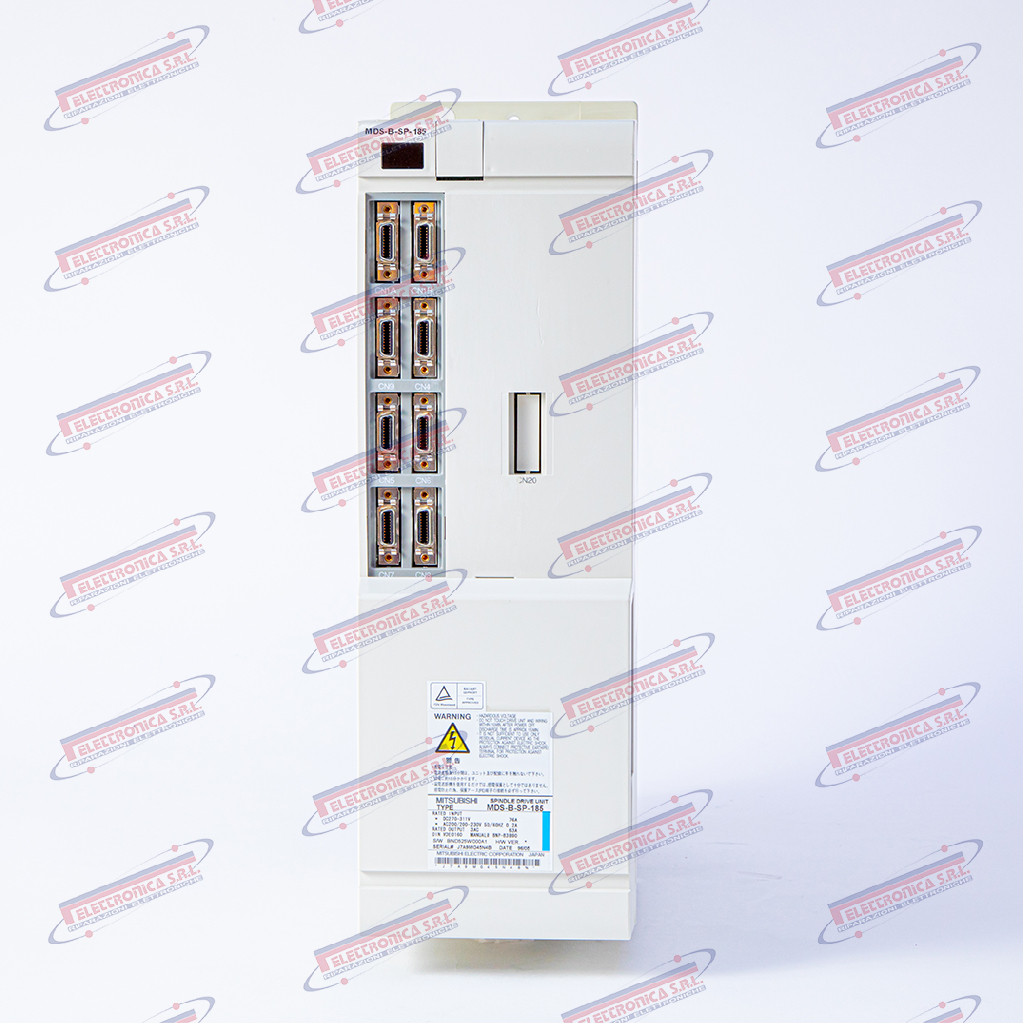
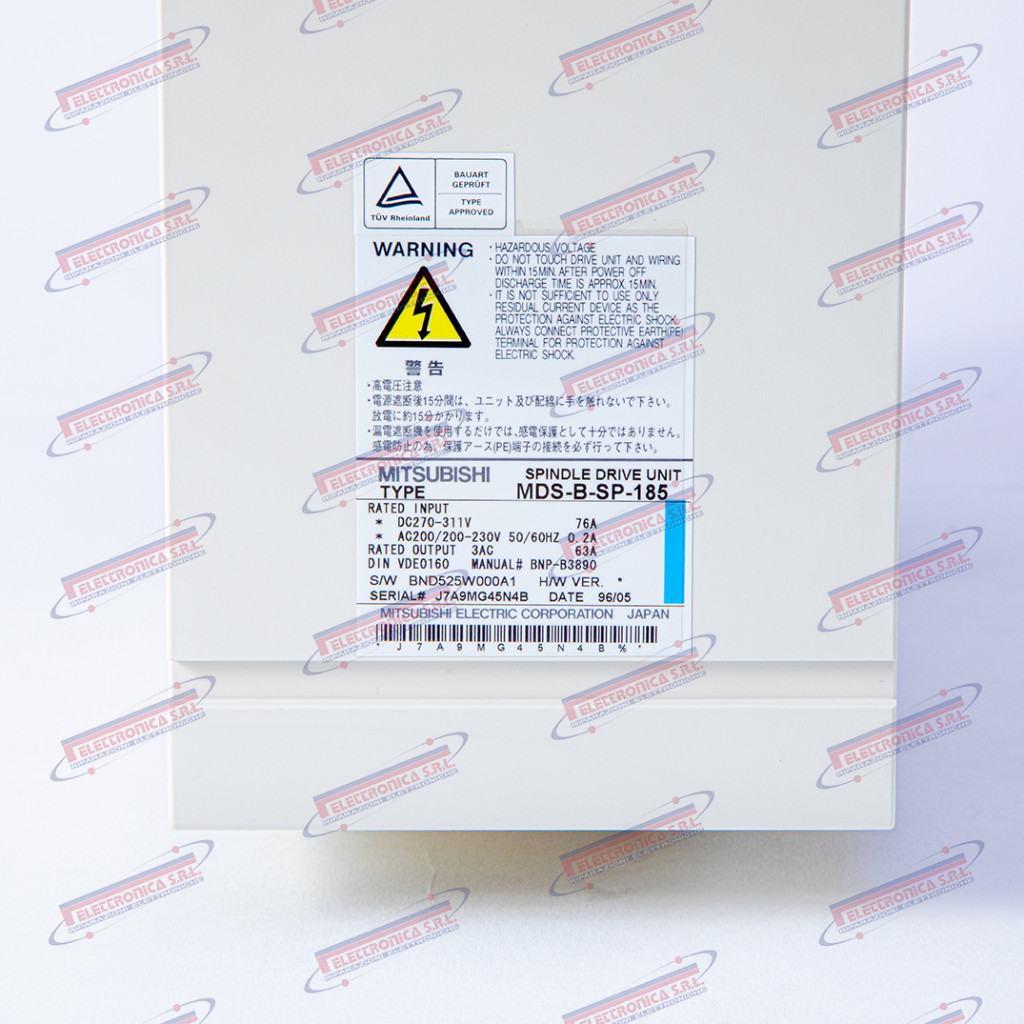
SKU:
MDS-B-SP-185
Cat:
No Category
Brand:
MITSUBISHI
Service
Repair
Exchange service
Spindle Drive Amplifier – MITSUBISHI MDS-B-SP-185
The MDS-B-SP-185 is an AC spindle amplifier (“Spindle Amplifier”) from the MDS-B series manufactured by Mitsubishi Electric, designed for vector control of AC spindle motors in CNC machine tools. It is documented as a component of Mitsubishi’s MELDAS 600, MELDAS 640 and M64 CNC systems, where it performs speed and torque regulation of the main spindle motor. The “SP” suffix identifies the spindle variant within the MDS-B family, while “185” denotes a rated output current of 185 A. It is not interchangeable with the servo-axis variants MDS-B-V1 and MDS-B-V2. Available in different input voltage ratings (200 V and 400 V classes).
The MDS-B-SP-185 spindle amplifier is the heart of the spindle regulation system: it receives speed and torque references from the CNC controller via Mitsubishi’s proprietary high-speed serial servo bus and closes the current and speed loops on the AC spindle motor, ensuring stable rotation and constant cutting power throughout the machining process. A failure of this drive causes immediate spindle shutdown and machine stop: without this module no machining cycle can be started, resulting in complete production downtime and an extraordinary maintenance intervention.
Mitsubishi Electric is one of Japan’s leading industrial electronics multinationals, with its FA (Factory Automation) division specialising in CNC systems, servo drives, inverters and industrial robots for over fifty years. The MDS-B series was manufactured from the 1990s to the early 2000s and is now legacy / discontinued: replacement models belong to the MDS-C1 and MDS-D families, which are not always plug-in compatible with existing wiring.
Main Technical Specifications
| Type | AC spindle amplifier (Spindle Drive) |
| Part number | MDS-B-SP-185 (MDSBSP185) |
| Brand | Mitsubishi Electric – FA (Factory Automation) Division |
| Known application | Mitsubishi CNC systems MELDAS 600 / MELDAS 640 / M64 – machining centres and CNC lathes |
| Function | Vector speed and torque regulation of AC spindle motor |
| Input voltage | 3~ 200–230 V AC or 380–480 V AC, 50/60 Hz (verify nameplate) |
| Rated output current | 185 A |
| Rated output power | ~18.5 kW |
| CNC interface | Mitsubishi proprietary high-speed serial servo bus |
| Feedback | Encoder / speed transducer from spindle motor |
| Cooling | Internal forced-air ventilation |
| Weight | ~10–20 kg |
| Dimensions | ~300–400 mm × 450–550 mm × 150–200 mm (W × H × D) |
| Production status | Legacy / discontinued — used/surplus/repair only |


SKU:
HC-MF 13-UE
Cat:
No Category
Brand:
MITSUBISHI
Service
Refurbished sell
AC Brushless Servo Motor CNC Axis – MITSUBISHI HC-MF 13-UE
The HC-MF 13-UE is an AC brushless servo motor (“AC Servo Motor”) from the HC-MF series manufactured by MITSUBISHI Electric, part of the MELSERVO product family. It is documented as an axis drive motor for CNC machine tools equipped with Mitsubishi servo amplifiers of the MR-SA, MR-J or compatible series. The UE suffix identifies a specific variant in terms of encoder or output shaft configuration. The HC-MF series is characterised by low inertia and high dynamic response, designed for rapid and precise positioning applications on machining centres, milling machines, and small to medium format CNC machines.
The servo motor is the electromechanical actuator that converts the torque and speed reference generated by the servo amplifier into precise mechanical movement of the linear or rotary axis. In a CNC machine tool, its failure results in complete loss of the affected axis: any machining operation involving that axis becomes impossible, causing immediate machine downtime and production loss. Loss of the integrated encoder signal can also trigger severe alarms on the CNC controller and potentially damage guideways if not correctly managed.
MITSUBISHI Electric is a Japanese multinational corporation and world leader in industrial automation, motion control, and power electronics. The MELSERVO family (HC-MF, HC-SF, HC-RF series and derivatives) has been a benchmark in the CNC sector since the 1980s. Products in the HC-MF series are legacy / discontinued: available exclusively as used, NOS surplus, or through specialist repair services.
Main Technical Specifications
| Type | AC brushless servo motor (AC Servo Motor) – HC-MF series |
| Part number | HC-MF 13-UE (HCMF13UE) |
| Brand | MITSUBISHI Electric – MELSERVO |
| Known application | CNC machine tools with Mitsubishi MR-SA / MR-J servo amplifiers (machining centres, milling machines, CNC lathes, industrial robots) |
| Function | CNC axis drive: conversion of electrical reference into precise mechanical motion (position / speed / torque) |
| Rated output | ~100–200 W |
| Rated speed | 3,000 rpm (typical HC-MF series) |
| Rated torque | ~0.32–0.64 Nm |
| Power supply | Via dedicated servo amplifier (three-phase / single-phase); do not connect directly to mains supply |
| Encoder / feedback | Integrated incremental encoder (UE suffix); standard Mitsubishi HC-series connector |
| Interfaces / connectors | Power connector + encoder connector (standard MELSERVO wiring) |
| Weight | ~0.5–1.5 kg |
| Dimensions | ~150–250 mm L |
| Production status | Legacy / discontinued — used / NOS surplus / specialist repair only |

SKU:
FR-SE-2-7.5K
Cat:
No Category
Brand:
MITSUBISHI
Service
Repair
Exchange service
AC Frequency Inverter 7.5 kW – Mitsubishi FR-SE-2-7.5K
The FR-SE-2-7.5K is an AC frequency inverter rated at 7.5 kW (“AC Frequency Inverter”) manufactured by Mitsubishi Electric, belonging to the FR-SE (Freqrol) series, designed for variable-speed control of three-phase asynchronous motors in industrial applications and CNC machine tools. The unit dynamically varies output frequency and voltage through PWM (Pulse Width Modulation) modulation to match motor speed to the machining cycle set by the numerical control. The 7.5 kW model is suitable for controlling medium-power spindles, hydraulic pumps, and auxiliary axes. The product may be available in multiple hardware revisions; some versions include an integrated operator panel and dedicated digital and analogue I/O.
The frequency inverter regulates AC motor speed by dynamically varying the supply frequency and voltage: this function is critical in CNC machine tools where spindle or auxiliary axis speed must accurately follow the parameters set by the numerical control. In the event of failure, the controlled motor loses all speed regulation and can no longer follow the CNC reference, making precision machining impossible and risking damage to the tool, workpiece, or machine itself.
Mitsubishi Electric is one of Japan’s leading multinationals in industrial automation, present in the frequency inverter market with the Freqrol (FR) line since the 1980s. The FR-SE series was a compact family designed for robust and straightforward industrial applications; all models in this series are legacy / discontinued and have been superseded by the more recent FR-E800 and FR-D800 series.
Main Technical Specifications
| Type | AC frequency inverter (AC Frequency Inverter) – FR-SE series |
| Part number | FR-SE-2-7.5K (FRSE275K) |
| Brand | Mitsubishi Electric – Freqrol FR-SE (legacy) |
| Known application | CNC machine tools; medium-power spindle, auxiliary axis and hydraulic/coolant pump speed control |
| Function | Variable-speed control of three-phase AC motor via PWM modulation; output frequency and voltage regulation |
| Rated power | 7.5 kW |
| Input voltage | 3~ 200–230 V AC, 50/60 Hz — 200 V class |
| Rated output current | ~38–42 A |
| Output frequency | 0–400 Hz (typical for FR-SE series) |
| Interfaces / connectors | Power terminal strip (R/S/T – U/V/W); control terminal strip (digital and analogue I/O ±10 V); optional operator panel |
| Weight | ~3–5 kg |
| Dimensions | ~200 × 150 × 200 mm (H × W × D) |
| Production status | Legacy / discontinued — used/surplus/repair only |
SKU:
FR-AF740-00770-EC
Cat:
Inverter
Brand:
MITSUBISHI
Service
Repair
Exchange service
37 kW Frequency Inverter – Mitsubishi FR-AF740-00770-EC
The FR-AF740-00770-EC is a 37 kW frequency inverter (“Variable Frequency Drive” – VFD) manufactured by Mitsubishi Electric, belonging to the FREQROL-F740 series. The EC suffix identifies the European version (CE marking, compliant with applicable EN directives). Designed for heavy industrial loads such as spindle motors, pumps, and industrial fans, it operates on a three-phase 380–480 V AC supply and delivers variable voltage and frequency to the controlled AC motor. The F740 series supports both V/f control and sensorless vector control (Advanced Magnetic Flux Vector), with expansion capabilities via optional boards for the main industrial communication protocols.
The frequency inverter converts fixed-frequency mains voltage (50/60 Hz) into a variable-frequency, variable-voltage three-phase output, enabling precise speed control of an AC induction motor. In CNC machine tools it is typically used to drive the main spindle, lubrication pumps, or unit cooling fans. A drive failure causes the controlled motor to stop immediately and halts the machining process entirely, making it a critical component for production continuity.
Mitsubishi Electric is a division of the Mitsubishi Group (founded 1921) and one of the world’s leading manufacturers of industrial drives, factory automation, and power electronics. The FREQROL-F740 series was developed for high-efficiency applications in HVAC, pumping, and machine-tool markets. This family has since been superseded by the FR-F800 series; F740 products are legacy / discontinued and available primarily as surplus stock, tested used units, or through specialist repair services.
Main Technical Specifications
Type |
Frequency inverter – Variable Frequency Drive (VFD) |
Part number |
FR-AF740-00770-EC (FRAF74000770EC) |
Brand |
Mitsubishi Electric |
Series |
FREQROL-F740 |
Known application |
CNC machine tools, HVAC systems, industrial pumping, fans and blowers |
Function |
Three-phase AC motor speed control via variable frequency and voltage output |
Rated output power |
37 kW |
Input voltage |
3φ 380–480 V AC, 50/60 Hz |
Rated output current |
~77 A |
Output frequency range |
0.2–400 Hz |
Control method |
V/f, sensorless vector control (Advanced Magnetic Flux Vector) |
Interfaces / communication |
RS-485 with built-in Modbus RTU; CC-Link, PROFIBUS-DP, DeviceNet via optional boards; analogue and digital control terminals |
Speed reference input |
Analogue 0–10 V / 4–20 mA; digital multi-step frequency |
Protection rating |
IP20 |
Version |
EC – European version, CE marked |
Weight |
~13–17 kg |
Dimensions |
~260 × 460 × 195 mm |
Production status |
Legacy / discontinued — superseded by FR-F800 series; available as used/surplus/repair only |

SKU:
ETU-3MK0IZ
Cat:
No Category
Brand:
MITSUBISHI
Service
Repair
Exchange service
CNC Power Supply Unit – MITSUBISHI ETU-3MK0IZ
The ETU-3MK0IZ is a CNC power supply unit (“CNC Power Supply Unit”) manufactured by Mitsubishi Electric, designed to provide regulated supply voltages to all modules of the CNC system (CPU board, I/O boards, servo drives, and axis units). The code identifies a power supply unit from the MELDAS family or equivalent Mitsubishi Electric CNC series. The component is a dedicated switching unit, with specific connectors for the CNC rack internal bus. Revision variants may differ in output voltages or connector configuration.
The power supply unit is the heart of the control electronics: it generates and stabilises the DC voltages required by all modules of the CNC system. Without it the entire system remains inactive; even a partial fault — such as an out-of-tolerance output — can cause unexpected anomalies in machining cycles, loss of parameters, or damage to downstream modules.
Mitsubishi Electric is one of the world’s leading industrial automation manufacturers, with a CNC division operating under the MELDAS brand (later MELDASMAGIC and the M70/M700/M800 series). Support for legacy products is limited; components from older series are legacy / discontinued and available only as used units or through specialist repair services.
Main Technical Specifications
| Type | CNC power supply unit |
| Part number | ETU-3MK0IZ (ETU3MK0IZ) |
| Brand | Mitsubishi Electric |
| Known application | Mitsubishi Electric CNC systems MELDAS / M-series |
| Function | Generation and stabilisation of DC supply voltages for CNC modules (CPU, I/O, axes) |
| Input voltage | 100–240 V AC, 50/60 Hz |
| Output voltages | ±15 V DC, +5 V DC, +24 V DC |
| Rated power | ~50–200 W |
| Interfaces / connectors | Dedicated connectors for Mitsubishi CNC bus/rack; AC input terminal strip |
| Built-in protections | Overvoltage, overcurrent, short-circuit (typical for industrial switching PSUs) |
| Weight | ~0.8–2.5 kg |
| Dimensions | ~150–300 mm |
| Production status | Legacy / discontinued — used/surplus/repair only |